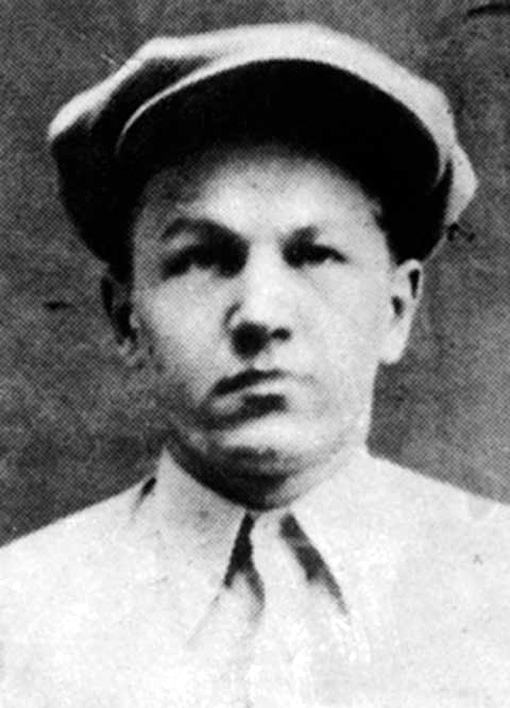
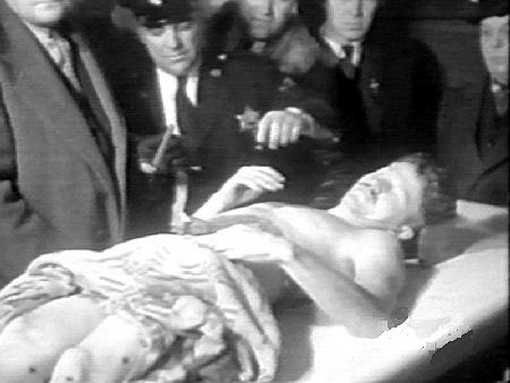
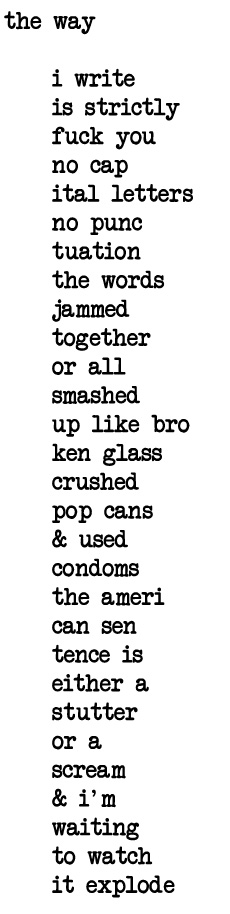
Category Archives: essays by todd moore

everything changes when dillinger arrives

Everything changed when Dillinger arrived. Nobody noticed, at least not at first, the change was so subtle. Everything changed when Dillinger arrived. The black hex sign on the Murphy barn somehow got slicker and brighter with its midnight shine. And, the cracks in the sidewalks got filled in with the night. Nobody noticed that everything changed when Dillinger arrived except the waitress at the Sundown Café who claimed that when she accidentally dropped a paring knife into a pot of coffee, the darkness dissolved it, ate it in the fury of an impossible oblivion.

Everything changed when Dillinger arrived. I was going to write a long poem about Harry Houdini, but Dillinger, who was sitting on the floor in the corner of the room where I was writing said, Forget about Houdini. You’re going to write about me. It was the damndest conversation I ever had. Then, when I asked him who he was he pulled a 45 auto out of his coat and played with it the way a kid would play with a toy and said, The Name’s Dillinger, and that was the moment I knew I had a key line to a poem I had to write and it wasn’t going to be just any poem. It was going to be a very big poem.

Everything changes when Dillinger arrives because he has that power, that fuck you up mojo. I have seen clouds right at the horizon go a deep bruised tornado green black and all Dillinger did was get out of his car. I have seen a bonfire jump a little higher and all Dillinger did was walk toward the heat. I have seen the rain on the sidewalk flame into his shadow, that magic place where the wolf of all wolves continually sleeps. Everything changes when Dillinger arrives. We think everything stays the same, the catfish lunging river, the hundred year old oak tree where the lynch rope still flops, the hundred thousand year old night that never leaves the mountain. These are the primal love affairs of longing and dream. Still, everything changes when Dillinger arrives.

The blood has a way of flowing against itself and according to dream. The breath has a way of folding back into itself, piling so far back into its dark nest of muscle and bone that it feels more like a lightning bolt getting ready to come out instead of a word. And, when that word does appear, it rushes out into mangled and mutilated pieces. It dives out of the fury of its unrepentant darkness into the unabsolved, into the unforgiven air.

When I started to write The Name Is Dillinger I thought I was writing about a man but by the time I finished the poem I realized I was writing about a man who was also a myth with some history and some mystery mixed in on the side. You can’t write about Dillinger without dealing with his myth. Or, to turn that around, you can’t write about Dillinger without his myth somehow dealing with you. It’s like trying to write about Billy the Kid or Pretty Boy Floyd or Jesse James. The myth is as much a part of the man as his blood and if you try to subtract that kind of blood from the story of his breath you are done for.

Everything changes when Dillinger arrives. And, the one thing that changes most is the way that poems get dreamed. You don’t notice it much at first. But, little by little you realize that your dreams have all gone outlaw on you. You didn’t mean to have them go that way. They just do. And, you realize that when I say you in relation to Dillinger I am talking about me. But maybe I am also talking a little bit about you. Maybe I am talking about the way that poetry has grown stale. And, this is not in the last few years. This is in the last generation. I could mention all the great poets of the 20th century and the poems they’ve written but I’ve done that so many times before. All I really have to say is why are poems so boring now. So, goddam lifeless, so corpselike. I open half a dozen poetry magazines and scour the pages looking for something, anything. Maybe a translation of Neruda will do it or something of Lorca’s has got all the best stuff.
What I’m looking for is a poem to grab hold of my shirt front, slap my face half a dozen times, and shake me so hard I know a great poem is on the verge of hijacking me into its dream.

The way a few poets can. John Macker’s ADVENTURES IN THE GUNTRADE along with his new book WOMAN OF THE DISTURBED EARTH, Tony Moffeit’s BLUES FOR BILLY THE KID, Kell Robertson’s just re-issued BEAR CROSSING, Ron Androla’s POET HEAD, S. A. Griffin’s NUMBSKULL SUTRA, Mark Weber’s PLAIN OLD BOOGIE LONG DIVISION, John Dorsey’s THE GRATEFUL DEAD, Scott Wannberg’s STROTHER MARTIN IS MY GOD, Joe Pachinko’s THE URINALS OF HELL. Misti Rainwater-Lites’ DANGEROUS HAIR, Raindog Armstrong’s FIRE AND RAIN, Christopher Robin’s FREAKY MUMBLER’S MANIFESTO, or any poem by John Yamrus. Any one will do. If you are looking for the Outlaw Poem, you’ll find it here. If you are looking for the places where Dillinger has changed things, you will find them here.

Everything changes when Dillinger arrives. Some nights in a dream I go somewhere to see him. It’s like a nightmare park overlooking a big black river. I sit down at a picnic table and wait for him to come. He takes his time getting there though in dreams there really is never any waiting. This isn’t a Kafka story where a man waits for a door to open for him and then at the end of the story is told that the door was always open for him to go in. Nothing like that. And, it isn’t a Beckett play where two characters wait for someone called Godot to arrive and he never shows. Or, Waiting For The Barbarians by Cavafy where the Romans wait for the barbarians to come and sack their city but they somehow never get there.

The one thing I can say about Dillinger is he always arrives and when he does everything changes. When I say change I don’t necessarily mean political change, though we could use a healthy dose of that. And, I don’t mean environmental change though we also could use a positive dose of that. What I am talking about is a change in the way that we see things. A change in the way that we look at and write about poetry. A change in the elitist way that some poets in this country are celebrated while others are almost totally forgotten. And, when I say elitist here I mean that all the way through the blood.

But let’s get back to meeting Dillinger in that nightmare park. He never says anything but he really doesn’t have to. He puts a Thompson submachine gun out on the table. And, even though this is at night and in the dream darkness, I can see every detail of it and I can feel it vibrate and I can hear its nighttalk and I know it is magic. He pats the gun a couple of times, winks at me, then gets up and walks away. I know I can only keep the gun as long as the dream lasts. But, I also know that something from that machine gun, something from that spirit gun lasts from the dream and then I am writing and all of that magic and electricity is pouring into me and it stays with me all the way through the poem and then for a little while afterward. It’s my own personal fire, it’s the way that I burn.

Change is an outlaw; Dillinger is here.

1 Comment

Filed under essays by todd moore

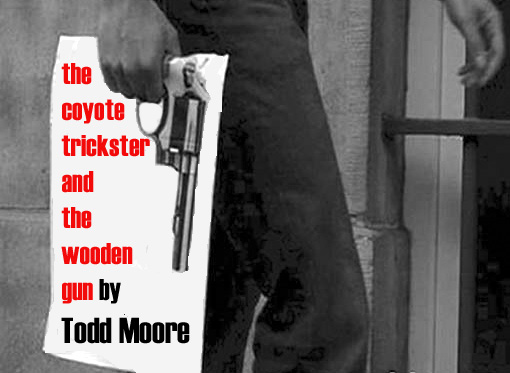
the coyote trickster and the wooden gun

Dillinger is a cluster of mysteries, each one diving headlong into the next. M. C. Escher is the only artist who might have been capable of capturing all of his constantly changing portraits just before they collapsed into themselves. His very essence is a series of essences which were peculiarly american and mysteriously unknown. He looks like someone who could easily have lived next door to you. Part of his visceral genius was his ability to blend in. He also looks like a guy who could have been a celebrity race car driver, a big name baseball player with say the all time record for stealing bases and hitting home runs without the need for steroids. He was a mass of energy masquerading as a man. He could have been a movie star, someone with James Dean’s electric elusiveness and Bogart’s unpredictably violent darkness. I sometimes like to think that Godard used Dillinger as an extra in BREATHLESS, knowing full well who he was and relishing every nano second of it. But this is part of the ongoing charisma of John Dillinger. Surviving his death at the Biograph Theater in 1934. Living on in a culture long after the people who killed him were long dead. It’s like the ultimate hustle in an age when the hustle is the only available gospel we have left.

Once, in the middle of a high stakes poker game, a gambler asked Dillinger, If you weren’t John Dillinger, who would you like to be? Dillinger thought the question over for a few moments while he ran his fingers over the edges of the four aces he held in his hand. Then he looked up, grinned around the cigaret he held between his teeth and said, Dillinger.

Dashiell Hammett, when asked about his novel THE MALTESE FALCON, replied, Sam Spade is who every private eye thinks he is, and what I, on occasion dreamt that I thought I could’ve been. Not that I am or ever could have been a bankrobber. I guess it’s the outlaw in me. The magnetic drag and pull of the outlaw or trickster in an age when cheap irony, predatory coyness, the big lie, the arrogant spin, and outright bullshit are enough to slide along on.

And while Dillinger was both loveable and deadly inside all of his nitro charismas, he was also a riddle. Or, should I say a collection of riddles. So many unanswered questions still surround his life, it’s really difficult to know exactly where to begin. For example, why did he bother to associate with a man as lunatic deadly as Baby Face Nelson? Or, why did Dillinger hang around so long in Chicago in the spring and summer of 1934? Why didn’t he just light out for the territory, Mexico, South America? Why wasn’t he long gone by July 22, the night he was shot down while coming out of the movies? Or, why did Dillinger always feel the need to play the coyote trickster and try to one up the cops? What was that all about? Was he playing death wish tag just to see how long he could fuck with fate?

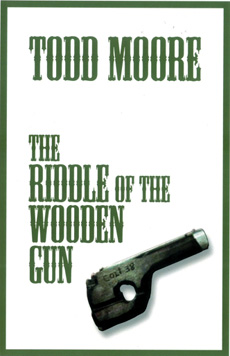
The most fascinating unanswered question of all is what about Dillinger’s wooden gun? No biographer that I know of has ever satisfactorily explained what actually happened at Crown Point Jail in Crown Point, Indiana, March 3, 1934. Did John Dillinger have an automatic or did he use a wooden gun that resembled an automatic in his jailbreak? To this day, nobody knows absolutely and for sure. Some wooden guns attributed to Dillinger have survived but none can be verified as actually having been the one he used that day.

What occurred to me recently while writing a section of Dillinger entitled The Riddle Of The Wooden Gun is that it isn’t the actual wooden gun that has any importance in the Dillinger story. It’s the riddle itself. A riddle can reveal more about the human condition than any thick volume of historical fact. A riddle can point us in the direction of enormously rich archetypal possibilities. About Dillinger, guns, violence, dreams, and most of all about america.

But, let’s start with the riddle. And let’s make it broad enough to include almost everything known and possible regarding this mystery. What is the riddle of Dillinger’s wooden gun? The riddle, of course, includes the mystery of the gun itself, did it actually exist and if so, did Dillinger really use it to break out of jail? Also, was the gun just simply wood and if so what did it look like? And, how did Dillinger come into the possession of a wooden gun? Beyond reality based questions, should we also consider the possibility of the wooden gun’s magical qualities? Was the wooden gun capable of shape shifting? Was the wooden gun a kind of collective hallucination that some of the Crown Point guards were having? And, ultimately, was the wooden gun an outlaw version of the american dream? What kind of gun can bring freedom instead of captivity, offer dreams instead of despair, and hold the possibility of healing instead of wounding followed by nightmares and nightmarish death?

What makes the riddle of the wooden gun so unendingly attractive is that this riddle can’t really ever be solved. And, maybe that is the heart of the fascination with the wooden gun. Think of it this way. Most of us read murder mysteries simply to find out who the killer was. Once you discover the murderer, the book’s interest dwindles and you have no reason to read it again. Unless, of course it is THE BIG SLEEP, THE KILLER INSIDE ME, or THE MALTESE FALCON.

And, I know here I am using the words riddle and mystery interchangeably, but I consider some mysteries to be a mine field of riddles and some riddles to be so deeply layered with mystery as to be completely and utterly unsolvable. Which brings me back to the riddle of the wooden gun. Dillinger’s wooden gun is so undeniably a part of his story, it’s virtually inseparable from the legend of the man. The wooden gun is an intimate part of the fabric of the whole Dillinger myth and could no more be untangled from it than Ahab’s harpoon could be separated from Ahab or the Maltese Falcon be subtracted from the plot of the novel. Without the wooden gun and its subsequent riddle, the whole story of Dillinger becomes nothing more than an action movie without an intelligible center. The riddle of the wooden gun is the key to whatever it means to be an outlaw and an american.

Leave a Comment

Filed under essays by todd moore

inventing the nightmare

History is a nightmare that I’m trying to invent. Propped against the desk next to my right leg is a running iron which stands about knee high. I bought it from an old man at a flea market out in the country. The tag hanging by a string from the iron curled tip read, branding iron, twenty bucks. I picked it up, ran my fingers down the hand forged length of it and said, where’s the sign. What sign you talken about, the old man asked. You, know, the sign. Like the Bar T, the Rocking Y, the Circle Ten. The sign for the outfit, the ranch where this was used. The old man cocked his beaten up black cowboy hat back on his head and said, when you’re an outlaw, you don’t need no sign because you are the sign. Then he smiled and kept on smiling while I dropped the twenty into his hand.

I remember watching my old man pour himself a shot of whiskey. He was always careful with whiskey because it was so hard for him to come by in both money and blood. If he spilled a drop, he licked it up. He used to say, leave a quarter of an inch at the top of the glass. Some barmen are so good they can pour it right to the top and never have spillage. But me, I like to leave a fingernail of space for death to swim in. Then he’d work his nose a little like he was adjusting his face before taking the shot down.

You can’t write it unless you dream it, my old man said, rocking back and forth a little in his chair. He was very drunk or he wouldn’t have talked like that. He probably wouldn’t have said anything at all if he’d been sober. But when he was drunk the door to his darkness opened wide and I never knew just what would come out. You can’t write it unless you dream it, he said again, this time a little louder so he would be sure I knew he was making his point. How much dreaming have you done, I asked, not quite sure I should have said anything. He leaned forward in his chair and I could smell his sour and ongoing rage. When he got like this his eyes would go dangerously blue and dark. You want my story, don’t you? I didn’t say anything. He waited a few seconds, then said, when I talk to you I expect an answer.

You want my story don’t you so you can write the novel and become rich and famous. I know what your goddam game is, don’t think I don’t. And, you know what? You ain’t getting it, because it’s mine. His mouth was open more than usual and his teeth were showing. Somehow I knew the rat in the wall was listening. I was pretty sure it was crouched next to the hole where the plaster had been punched in and the studs exposed. And, that was okay, that was just fine because it was my old man, the rat, and me and it was a nightmare as well as a conversation.

Sometimes when I am writing a section of DILLINGER, I can almost hear the man breathe. It doesn’t always start out that way because I have to trick the poem out. It never comes willingly, it somehow needs to be jumpstarted then it boils out, it blows out like some kind of crazy oil gusher and when that happens Dillinger himself comes close as though he becomes part of the energy, part of the way the air gets just before something ignites it. He was there when I wrote The Name Is Dillinger. He was there alright, I could feel him near. It seemed as though there were times when he would tap me on the shoulder so he could see what was going to happen next and then next and then next like this was a story he had become addicted to and the way I was writing it was just like I was telling it to him and his knowing about it somehow made him so much more of the Dillinger we both dreamed of.

And, Dillinger was there when I wrote The Sign Of The Gun. He really was there then. I could feel the way that he walked around the room, like he was doing a half strut half dance and that was when he was telling me the story only it was more like a series of stories and I could feel the way that he would pause between stories like he wanted to be sure I was getting each and every detail down just right before he got into the next story. Because every story counted with him, every story meant something special and he didn’t want me to overlook anything he said and I let him talk for as long as he wanted, I let him narrate, I let him become all of the voices until he couldn’t be the voices any longer and when that happened I let him stop talking and listened to the sound of his dreaming which was maybe like the way the moon sounds at night when it passes through the tree limbs up in the mountains.

I remember seeing an old photograph of a dead man in a book. The corpse was sprawled out on a barroom floor next to a poker table. It looked as though someone had thrown his hat at him and it landed crown up a few feet from his right hand. He may have died in a gunfight or he may have been a murder victim. It really didn’t matter. The photograph had somehow become the metaphor, the image, the sign of his death. And, the entire scene had taken on a kind of gray, soiled sepia look to it as though death had somehow colored everything. And, for as long as I can remember this has been the only part of history I’ve ever been interested in. The apocalypse of the moment, that one anarchic second when death emerges from the furniture to reveal just how much of a fiction history really is.

History is a nightmare that I’m trying to invent. Without the nightmare side of it, history is just a shitlist of facts and a wishlist of fantasies until you get shot down, blown up, or catch your everloving death of something or other. History is a nightmare that I’m trying to invent before it invents me. History will whistle love songs up your asshole until the skin rots off, history will whisper a sickening sweet poison in your ear and if you don’t believe me ask Hamlet’s father. History will fuck you blind and then blind you in the fucking place. That’s history’s job, that’s history’s genius, that’s the be all and end all of what history does. Or, should I say that’s what death does because he wears the mask of history, it’s the only way he can move among us freely.

Nobody escapes history. Nobody escapes the mask of history. But, what you can do is one up history which is also death by inventing the nightmare. Not even death is capable of that. History which is also death is only capable of clacking one bone against another. That’s the sound of death’s history book, those are the lyrics of history’s death song, the long serenade of nothing and then nothing. Sometimes when death is singing a crow will fly out of its bones and go up into the air like a small black impenetrable cloud. Death doesn’t know it but the crow is alive with death’s massive ignorance. And, the crow is also alive with the black electricity of the universe and is always dreaming.

The big trick if you can pull it off is to capture the crow in the midst of its dreaming, to lay claim to the crow and all of its dreams. Because it’s in those dreams where the nightmare of the world is sleeping and dreaming and it’s in those dreams where the nightmare of the world is waiting for you, because the only way to write is to steal its eyes. It always grows new ones, so it’s easy to do. Once you’ve done that you can invent your own private version of the nightmare any way that you want.

Homer invented the nightmare when he created Achilles, Sophocles invented the nightmare when he created Oedipus, Virgil invented the nightmare when he created Aeneas, Shakespeare invented the nightmare when he created Hamlet, Goethe invented the nightmare when he created Faust, Melville invented the nightmare when he created Ahab, Dostoevsky invented the nightmare when he created Raskolnikov, Kafka invented the nightmare when he created Joseph K., Cormac McCarthy invented the nightmare when he created Judge Holden, and I am inventing the nightmare by creating and conjuring John Dillinger. Inventing the nightmare means dreaming an archetypal character so powerful he can step outside the fiction of history, someone so alive in the word he can survive as long as death itself, if not longer.

1 Comment

Filed under essays by todd moore

night blood, red hands

bloodynite1.jpg

The only thing I remember about the dream was suddenly waking up and checking my hands to see if I had blood on them. Then checking to see if any blood had leaked out of the dream and soaked my bedsheets. And, finally checking the revolver I keep under the bed to see if any blood had come out and gotten on it. But everything was clean. All of the blood had stayed in the nightmare.

Red hands at Guantanamo.

When I was a kid I cut my hand on a coffee can lid and the blood went out all over my hand and somebody said, hey look, he’s got a red hand and after that the image of a red hand stayed in my imagination. And, sometimes during a western movie when a guy would get a gun shot out of his hand and there wouldn’t be any blood, I would suddenly give the actor a red hand because you have to have a red hand if you are going to be wounded. You have to have a red hand if you are ever going to be mortal, you have to have a red hand if you are ever going to write a powerful line of poetry, you have to have a red hand if you are ever going to write anything worthwhile because both life and death have some red in them.

Red hands at Abu Ghraib.

I sometimes wonder if Jackson Pollack discovered the pour by accidentally cutting his hand and letting the blood drip down all over the floor. I sometimes wonder if Rimbaud got some of his best poems after Verlaine shot him and he let the blood from his hand drip on a blank page laid out on a table top. I sometimes wonder if Billy the Kid put his hand to his chest right after Pat Garrett shot him and that red hand was the last thing he saw. I sometimes wonder if the hands on those rocks out in the petroglyphs were red to begin with.

Red hands at My Lai.

I’m looking at a print by Bill Gersh where the dark woman in it has a red hand. I’m thinking of Goya working on THE DISASTERS OF WAR with red hands. I’m thinking of Peckinpah filming THE WILD BUNCH with red hands and at the end of each day it takes him at least an hour to clean all that red off. I’m thinking that just before the first performance of HAMLET Richard Burbage who portrayed him painted his hands a deep deep red and it became fashionable in Elizabethan England to paint the hands red for dinners and masques and public executions. I’m thinking that while Melville was in the midst of writing the last pages of MOBY DICK he painted his hands red in honor of both Ahab and the White Whale. I’m thinking that when Anton Chigurh walked away from that car wreck at the end of NO COUNTRY FOR OLD MEN, his broken arm was bleeding and the blood was going down and making his hand all red.

Red hands in Chiapas.

After Jerry accidentally cut himself while playing with a switchblade knife he said, fuckit, more like he was embarrassed about being so careless and vulnerable and he started doing a little dance of half pain half piss on it I don’t give a shit. Then he walked over and flicked blood all over my shirt.

Red hands touching Lorca’s clothes.

Sonny said, I wouldn’t have done it if I hadn’t been drunk. He showed me his right index finger which was gone down to an inch from the knuckle. Thirty two I got off my cousin, he said smiling his stupid ass smile. It knocked me right down to my knees and i stayed there awhile. Goddam but it made my hand red. And, you know what, I could even see the bone.

Red hands at Wounded Knee.

One of the classic unpublished snapshots of Bukowski has him walking down the street drinking a beer only in this photo the hand he’s holding the beer bottle with is all covered with blood. One of Weegee’s best photographs is one of a guy who has just been shot in the arm. He’s leaning against a streetlight, smoking a cigaret with a bloody hand. One of my favorite photos was a windshield with the outline of a bloody handprint on it surrounded by half a dozen small bullet holes.

Red hands in Baghdad.

Hemingway’s hands go all red while he’s gutting an elk. Blood from the hatchet turns Raskolnikov’s hands red. Seconds after writing the last page of THE BEAR Faulkner discovers a drop of blood in the palm of his right hand. Dashiell Hammett cuts himself on the face with a straight razor while shaving, then tries to wipe it away with his left hand, shoves the blood all over his face and hand and gets the idea for a short novel called BLOOD MONEY.

Red hands in Guernica.

Dillinger is playing a game of grabass with Billie. He keeps chasing her around a table and chairs and she keeps ducking away. Finally, because she is having her period, she reaches down inside her panties, comes out holding some of her blood and tries to touch him with it. She says, you’re a goddam chicken if you won’t let me smear you with this kind of shit. She puts her hand to her mouth, pretending to eat it.

Red hands at Bad Axe.

Sal Mineo is getting stabbed to death in his driveway. He makes a grab for the knife but only gets the blade and it tears a big slice through the meat of his hand. He tries to say something and gets stabbed again. He tries to say something gets stabbed again. The burning of the knife in him, the red of his hand.

Red hands on the Trail of Tears.

The whole time I was writing THE CORPSE IS DREAMING, I kept checking my hands to see if there was anything on them. The way I was writing was I was composing right at the computer, the words going down almost as fast as I got them. But the funny thing about the whole process was while I was focused on the screen and the words going there, it almost seemed as though I could also see down like the way you can see something moving out of the corner of your eye. Only this wasn’t movement. This was color, this was the dark color of blood but every time I glanced down my hands were their own natural color with no blood on them. Still, somehow I knew or was dreaming wide awake that there was blood all over my hands even while I was writing, even while Dillinger was in the middle of dying in the poem. And, the blood was almost as smelly as fresh shit and I was thinking that this is how it smells to die, this is the smell of death itself. And, sometimes I had to get up out of my chair and walk around to get the smell and the color of that death out of me and when I couldn’t hold the words back any longer I sat down and started in again and realized that there was no way to get this red off my hands and this smell of death out of my nostrils except to write it out to dream it out to dance it out to conjure it out to chant it out. And when I was finished, Dillinger walked over and put his bloody hands all over my clothes. I could feel the blood soak in, the cold bitter wetness of it but just as soon as I checked myself out in front of a mirror all the red was gone. Then I realized that it had disappeared inside me. It was a red that was part of my red and was swimming all through me, even into my dreams.

Leave a Comment

Filed under essays by todd moore

the volcanic death song of baby face nelson

How long do you think you could stare down the business end of a loaded pistol without looking away, blinking, or maybe laughing just to dispel the tension? How long do you think you could stand having a loaded revolver pointed at your head without either breaking into a cold sweat or possibly trying to run away, knowing that no matter how fast you run, a bullet is always profoundly faster? Naturally, this is an existential question. Very few people ever experience something like this unless it’s at the movies or on a tv show or in a dangerous fantasy.

Still, this is how writing Relentless felt to me. From the moment I started with the first few lines, “relentless/as a hum,” I knew I was going to be in for the ride of my life and don’t kid yourself, writing twenty pages of poetry is not like strolling through an English garden just before high tea. Especially, when it’s twenty pages of something that will become part of DILLINGER.

I had written poems about Baby Face Nelson before. Russian Roulette stands out as one of the key sections regarding this character. But, I had never successfully gotten inside Baby Face’s head. Never really crawled back into the essence of that primal darkness before. And, I wanted to. Or to put it another way, I had to. I knew Dillinger inside out. The Name Is Dillinger, The Sign Of The Gun, The Corpse Is Dreaming are all very important ways of knowing and dreaming myself into John Dillinger.

But Baby Face Nelson. I only knew him from the outside in. Never the other way and it became increasingly clear that this is the only way worth knowing anyone. It doesn’t matter if it’s Raskolnikov, Hamlet, Ahab, or one of Jim Thompson’s monster sociopaths. Somehow just saying a character is a homicidal maniac doesn’t cut it. You have to inhabit the skin and the dreams and that’s what I set out to do.

In Relentless what you are looking at is a man who is beginning to unravel. Beginning to come right apart at the seams. Suddenly, he is confronted with several dilemmas. Up until this poem, he has functioned, he has been in control. But, now, in Relentless he is finally confronting the demons which have made him so scarily lethal. He is starting to realize that he is a latent gay. He also realizes that he is, against all the logic or anti logic that holds him together, falling in love with Dillinger who is just about as straight as anyone can be. And, he also knows that he is tremendously jealous of Dillinger’s fame. Baby Face knows that Dillinger has a kind of dangerous charisma, something that Baby Face will never have, but desperately wants.

So, it is all of these things merging with Baby Face’s murderous impulses that meet and collide in Relentless. And, it is in this way that the poem twists and plunges down page after page almost like one extremely chaotic flow of interrupted thought. Or, as an onslaught of a hundred plus thoughts streaming through Baby Face while he struggles with his personal demons, flies that only he can see, flies that threaten to invade his mouth his eyes, his entire head. And, he has all he can do to keep from waving them away.

If Relentless is anything it is Baby Face Nelson’s frenzy poured into the pages of this poem. And, frenzy is anything but rational. This is the fury of a man who has always seen himself as the major american criminal of the Thirties. And, what he can’t bear is to see Dillinger embody the dream that he has been having about himself. Which is somehow becoming the dark heart of the american dream. Important, immortal, The Great American Outlaw. And, the fact that Dillinger has suddenly become as famous as a movie star and also someone that Baby Face is torturously in love with is enough to send him to the edge of whatever control he had over himself up until now, the angst of this moment.

Relentless offers no real denouement, no solution to Baby Face’s dilemma. But what it does is explode into a kind of volcanic death song, a molten lava display of what Baby Face may have been suffering through. Historically, what we know about Nelson is that when he was finally brought down by FBI agents, it took more than a dozen bullets to end his fury and his life. But not before he killed every man who was shooting at him.

The way Nelson felt is probably on the scale of Ahab’s rage at the white whale. Only Ahab wasn’t necessarily sexually attracted to the white whale. Nelson’s pile driving frenzy can also be compared to Raskolnikov’s anguished questionings, to Hamlet’s desire for revenge, to Achilles’ fury outside the walls of Troy. And, nothing can bring an end to this kind of fury short of death. There is no redress for this state of mind unless it is murder.

While I was in the middle of writing Relentless I could feel what Nelson must have felt. I could feel the pulsing, humming, miniature scream building up inside. It became a part of the nervousness of each word, maybe each pause, each breath. This is a homicidal scream there are no words for. This is the silence at the end of any of Hamlet’s key soliloquoys where he could have made some unimaginable sound with his mouth. This is the kind of silence at the end of WAITING FOR GODOT or ENDGAME where the audience as well as the actors know that this is the end of something profound, breath, eye blink, an unaccounted for twitch.

I could feel that and I could feel the way that Baby Face must have moved while these thoughts were pouring through his brain. His pointless pacing, his throat clearing, the dryness in his mouth, the held back growl. The way he must have been shaking all the way through the core of his skin and blood. The chill and futility of everything, of the nothingness of everything.

Many years ago Mikhail Bakhtin invented the idea of polyphany in the novel. He used Dostoevsky’s novels as examples where each character speaks in his own particular voice and style. And, I can see how he reaches that conclusion. But beyond Bakhtin, I can also see where each part of a long poem can also demonstrate polyphany. Even more than that I can see where, if the poem is long enough, as in DILLINGER, each section or text can also carry within it a separate consciousness, a peculiar way of thinking or thinking against thinking all of its own. Textual consciousness is where Hamlet survives. Textual consciousness is where Joseph K survives. Textual consciousness is where Dillinger survives. Baby Face burns there in the hellishness of language forged with darkness and fire. And, it is a fire that never goes out.

Leave a Comment

Filed under essays by todd moore

outlaw poetry

toddmooretwo

Todd Moore is a poet in the shockism style. He says,

“For your information gansta poetry in this country isn’t Bukowski’s invention, it’s mine. I’ve been making this kind of stuff since 1970 give or take. And, it has nothing to do with Bukowski’s style or subject matter. Bukowski was the pornagrapher of pussy and a damned good one at that. I’m the pornographer of violence.”

skidrawhotel.jpgTodd Moore grew up in a brother/transient hotel. His father was a railroad man, a fireman, a bagman, a numbers runner, an acquantance of Capone and an aspiring novelist. About his childhood Moore has written: By the time I was twelve I was a street thief and a damned good one. I’d already seen a guy who’d hanged himself and had nearly been cut in a knife fight. In some ways it was both the best and the worst of times. After an overextended stint as a schoolteacher and librarian in Illinois, he now lives with his wife in New Mexico. He has had nearly ninety books of poetry published since 1976. Todd Moore’s images are concrete both literally and figuratively: they are all-consuming street scenes that grumble resonant with rhythms of the digestive fluids in this country’s underbelly.

Moore illuminates the placental world that is as dark as a plum in a cold universe, because his technical virtuosity and grasp of realistic urban speech affords him the reach to open that envelope white door that few have the stomach for, be it a lack of hunger or a lack of courage. Being that it is best to write from the gut, Moore’s strength as a poet and a human being has been his ability to feed on this badly bruised heart of forbidden fruit and let the blood drip from the corners of his mouth onto the page in stripes that deserve fifty stars and an acknowledgment of an inner-city blues as real as shot up vericose veins. His best lines are molten steel that he lays in the grooves of the reader’s gray matter, and as eyes meet image and tongues rolls off words, there in the click-clack of recognition, and the spark of inspiration that was initiated in Moore becomes a conflagration in the mind of any American who does not whimper…” Nelson Gary, from The Outlaw Bible of Poetry

outpost_street.jpgTodd Moore works in a trading post on Central Avenue here in Albuquerque selling tin sheriff badges to the tourists. He watches the whores stroll through the glass. He watches the methadone clinic amputees from around the corner. His white Saturn is parked inside a chain-link fence in back. The Outpost jazz club is next door. He sells them badges and waits till closing. Mark Weber

Todd Moore has been published in hundreds of magazines. Recent books include Working on my Duende and The Corpse is Dreaming (LRB # 20). This is his third book published by the Lummox Press. He was recently honored as Lummox of the Year 2000. It is his first award in 30 years.

toddmoorecorpsepc_copy.jpg


strichblack.jpg

The following Interview with Todd Moore was made by Anita L. Wynn December 1, 2006

strichblack.jpg

Q: What initially inspired you to become a writer?

Todd Moore | I wanted to be a writer for almost as long as I can remember. My father, who was a railroad man and then a fireman, was both an alcoholic and a failed writer. He was a natural born storyteller and for about fifteen years tried writing novels. It was during this time that he got into the habit of reading parts of his novels to me. Even after he realized the futility of what he was trying to do and gave up writing, I continued to think of him as a writer.

skidrawhotel.jpgI mention the alcoholism because that contributed both to his failure as a writer and to circumstances which landed the family in a skidrow hotel for twelve years. This really has nothing to do with inspiration, but the experiences I had in that hotel shaped me as a poet. I didn’t realize it at the time. In fact, it took a college education and another ten years before I finally began to discover who I really was and that mysterious thing called style. As for literary inspirations, I’ve always been drawn to the visceral in fiction and poetry. Hemingway was a big discovery. Ginsberg’s HOWL, Rimbaud, Plath’s ARIEL. Bukowski came later. I put off reading Bukowski even though I’d heard plenty about him simply because I had a story I wanted to dig out of me all on my own.

Q: Do you consider DILLINGER to be your magnum opus? What was the inspiration for that poem, beyond the obvious?

Todd Moore | DILLINGER is the big one. I have no doubt in my mind. It seems as though you can divide my work into some fairly distinct categories. There is the infamous short poem that I’m pretty well known for. I remember when I first started sending out those twenty line poems where the core of the poem is strictly action. I had had enough poems where the poet meditates on the problem of violence, death, time, love, or just simply taking a crap. What I wanted was a poem that gave you the visceral feel of the thing happening as it happened. I remember a friend once saying, you should’ve been a film director. My answer was, I need to write a poem that plays out like a movie.

I’ve also written the medium length long poem. For me, a poem that approaches a thousand lines in length is medium length. In the last ten years I’ve written several medium length long poems including WORKING ON MY DUENDE, which was published back in 1999 and is now out of print. Also, A SACRED MEMORY OF BILLY: NOTES FOR A DADA WESTERN, which is almost finished. The BILLY of the title is Billy the Kid.

However, DILLINGER is probably what I am mainly known for. I started writing it back in 1973. In 1976 I wrote the first really good section entitled “The Name Is Dillinger.” Since then I think I have written about a hundred or so sections. Each one is about 800 to 1500 lines in length.

When you mention the American epic, most people think of Pound’s THE CANTOS or Williams’ PATERSON. DILLINGER as it stands may be at least twice the size of THE CANTOS and many times longer than PATERSON. And, it is distinctly different because in those two long poems, there really is no central character unless you count the poet’s persona as character. However, Dillinger is portrayed as a real life person as well as an archetypal figure out of American history. And, because Dillinger is based on a real person, I have been able to see him with all his flaws, expectations, and desires. He is both as large as life and larger than life. This is why DILLINGER is not the typical American epic, even if you go as far back as Whitman’s SONG OF MYSELF. It’s a break with that whole tradition and it’s also a break with the classical idea of epic with Homer’s ILIAD and ODYSSEY. Dillinger is an outlaw, not a hero. Still, as an anti hero, Dillinger becomes a kind of American everyman because he comes closer to our collective renegade fantasies than nearly anyone else in American literature with the possible exceptions of Melville’s Ahab, Cormac McCarthy’s Judge Holden, and Fitzgerald’s Gatsby. Also, Dillinger has an inner life, something you usually don’t associate with criminals.

teddmooredillinger

Q: For those readers who are not familiar with the “outlaw” school of poetry, how would you describe it, and the poets who follow it?

Todd Moore | In 1949, when my father landed the family in that skidrow hotel, I became an outlaw. I became an outlaw because I became an outcast. I became an outlaw, because for the first time in my life I realized what it meant to be down and out. I was twelve going on thirty. I became an outlaw because all of a sudden my friends were other kids who were street thieves. I became an outlaw because I was rubbing shoulders with all kinds of derelicts. I got to know all the hookers by there first names. I learned the art of shoplifting from the best. the word outlaw was second nature to me.

How I escaped jail or worse, I’ll never know. But I did realize that if I wanted to escape this cycle of petty crime and poverty, I’d better get an education. However, even after I graduated from college I still had some of that outlaw in me. And, even after I taught in the public schools for several years, that outlaw was still there. Finally, I realized that my skidrow background was what I was meant to write about. So, I present myself as a kind of explanation.

However, Outlaw Poetry has been around for a long time. It just has never been seen that way before. Francois Villon was probably the first Outlaw Poet. Arthur Rimbaud may be the most famous Outlaw Poet. Along with Lautreamont. Then segue to Hart Crane and down to the Beats. Ginsberg, Kerouac, Burroughs. Burroughs shot and killed his wife in a drunken orgy. The question remains: did he mean to or was it an accident? Then Charles Bukowski. Bukowski was a whole poetry movement unto himself. Bukowski was an enormous force in poetry in still is even though the snobs in academia refuse to give him any credit for it.

Bukowski
and I were writing contemporaries though he started publishing about fifteen years before me. In some ways, we are two sides of the same coin. Bukowski grew up in a middle class home and at the age of eighteen opted for the down and out life. From the age of twelve until 1961, I lived the down and out life in a skidrow hotel. Bukowski didn’t really find his voice until his mid thirties. The same thing happened to me. Bukowski and I are both known for creating highly recognizable poetic styles. And, we have both pretty much been loners.

outlawpoetry.jpgWhat is Outlaw Poetry? I’ve been writing it for almost forty years. But I haven’t always thought of it as Outlaw. I’ve known it was outside the acceptable limits of polite poetry. I think the force and thrust of things outlaw really picked up impetus with the publication of THE OUTLAW BIBLE OF AMERICAN POETRY edited by Alan Kaufman and S. A. Griffin, Thunders Mouth Press, 1999. I am told this is the best selling poetry anthology ever. And while it is flawed and fat with celebrities, it is also maybe the most important anthology to come down the pike in many years.
Outlaw Poetry, basically, is a stance against academia and the writing degree establishment. Outlaw Poetry is also a stance against the politically correct in poetry. Outlaw Poetry comes along at a time when the arts in general and poetry in particular are moribund, stale, boring, cowardly, candyassed, and dead. Pick up any major poetry mag. The American Poetry Review, or Poetry Magazine are the best examples. The dead wood practically falls off the page. And, try this test. When was the last time you read a poem that truly made the goose bumps crawl up your back. That popped your eyes into your soup? When was the last time a poem mattered so much you jumped out of your chair but didn’t exactly know where it was you were going except that you had to be going somewhere, it was that important to you. For me, this happens almost on a never basis. I have to go back to Whitman or Pound or Eliot or Crane or Tom McGrath or the best of Ted Hughes.

The big problem in our society is that academia owns poetry lock, stock, grant, kiss my ass rewards, and blowjob poetry chairs. The small press is the ghetto. There are no honors there, there are no awards there. There is no money. And, the irony is that the small press is where some of the most important poetry is being written today. Keep this thought in mind. There are no Outlaw Poets writing in academia. Zero. There are no Outlaw Poets teaching poetry in academic writing programs today or really ever. Outlaw Poets, if anything, come from the dark side. Outlaw Poets live at the edge of the edge. Outlaw Poets do not live off foundation money.

Before I bail out of this question, let me list some of the Outlaw Poets whose work matters and is making a difference. Tony Moffeit, Dennis Gulling, John Dorsey, Kell Robertson, Mark Weber, John Macker, R. D. Raindog Armstrong, Scott Wannberg, and S. A. Griffin, among others. Other Outlaws to keep an eye on are Christopher Robin, Misti Rainwater Lites, Joe Pachinko, Theron Moore. And, I apologize to those whose names I have inadvertently left out. I’m not so sure I answered this question except for bludgeoning it to death.

moore-dillingerpublicenemy

Q: What poets, if any, have inspired you? Classical, or neo-classical influences?

Todd Moore | Influences are like time bombs or floating mines in the psyche. They float around inside the dark and have a way of going off when you least expect it. Shakespeare is always there. Melville for MOBY DICK, Faulkner’s THE BEAR, Fitzgerald’s GATSBY, Hemingway’s Santiago in THE OLD MAN AND THE SEA, Bukowski’s continuing saga of CHINASKI, Steinbeck’s THE GRAPES OF WRATH, and much of Dostoevsky. Lately, Tony Moffeit, Mark Weber, John Macker.

Q: I have asked other famous poets this question, and I’d also like you to weigh in on it…what is your opinion of critics in general? Do you think they should have the power to determine the direction of poetry?

Todd Moore | I have almost always been at war with critics. Harold Bloom is probably the classic example of the snob critic in America. His close second is Helen Vendler. Bloom’s dilemma is that he wasn’t born Shakespeare so he’s decided to install Shakespeare as god of the literary canon. Vendler’s problem is that she wasn’t born as T. S. Eliot. These two critics are hellbent for leather to maintain a strict canon which has completely overlooked the poets and writers of the small press in America. As far as they are concerned Bukowski never existed. Or, anyone else from the lower depths. The kind of criticism they espouse takes no chances, brooks no risks, invites no dares, loves no poem that is not Harvard clean and New York Times Book Review sanctioned. These kinds of closed in and closed up critics are part of the reason for Outlaw Poetry.

Q: I have read in one of your essays about the “unknown territory” a poet should explore…the frightening “no-man’s-land” within each of us. Could you tell us a little about how you made this discovery?

Todd Moore | Everyone has an unconscious. Everyone has a dark river flowing just under the skin and down through the blood. I’ve always more or less known about this kind of darkness through such characters as Hamlet, the Karamazovs, Ahab, Faust, Judge Holden. It really wasn’t until I started getting deeper into Dillinger that I realized this no man’s land was part of all of us. My breakthrough into this country happened when I wrote “The Corpse Is Dreaming” which I later incorporated into “The Dead Zone Trilogy” which forms the last three long sections of DILLINGER. “The Dead Zone Trilogy” is what Jung would call a Nekyia, a journey into the deepest part of the psyche. What I wanted to do with Dead Zone was try to get inside Dillinger’s experience of what it felt like to be shot to death and then go from there. I wasn’t interested in the cliché of your life passing before your eyes at the point of death. I was trying for a combination of THE TIBETAN BOOK OF THE DEAD and THE BOOK OF REVELATIONS, all of it sort of mixed together into a cluster of death metaphors, a potent death stew. I’m still not sure if I got there, but I think I came close.

toddmooreandmarkweberbombed

Q: Do you ever feel any pressure, now that you’re well known, to tame your brutal honesty in your poetry?

Todd Moore | It’s what I do, what I have to do.

Q: What advice would you give to an aspiring poet?

Todd Moore | This might be the toughest question of all. First, you have to understand, there is no money in poetry. Most of the poets I have known have worked at something else to survive. Then, there is the example of Charles Bukowski. Bukowski actually became a well to do writer later in life. But, he is the exception to the rule. Becoming the next Bukowski is kind of like trying to win the Lotto. What are the odds at that, like a billion or so to one? Whatever. There are two ways to go as a poet. You can get into a writing program, work toward the MFA and basically become inauthentic and at best a very mediocre poet. Or, you can dig the poems out of your own guts. This is tougher but in the long run, you’ll be able to look at your face in the mirror. And, yes, there are no guarantees. We live in a big country where more and more almost no one reads poetry, let alone reads at all. Most people, both educated and not, do not give a royal fuck about poetry in the first place. Little do these folks realize that without poetry, this country would become the next thing to lobotomized. Not that we aren’t close right now. The fact is, we probably need poetry now more than we have ever needed it before. We need the power of the word, we need the witness of the power, we need great poems, great works of art and not just for a kind of absolution but also for our national survival.

Thank you very much, Todd. We appreciate your thoughts very much.
strichblack.jpg

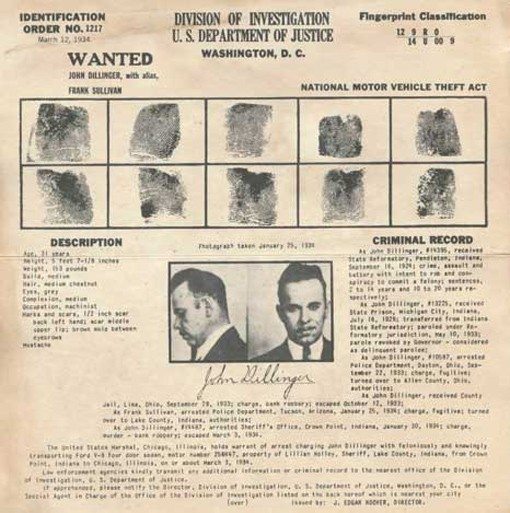
dillingercriminalrecord

some facts about John Dillinger:

John Dillinger (June 22, 1903 – July 22, 1934) was an American bank robber, considered by some to be a dangerous criminal, while others idealized him as a latter-day Robin Hood. He gained this reputation (and the nickname “Jackrabbit”) for his graceful movements during bank heists, such as leaping over the counter (a movement he supposedly copied from the movies) and narrow getaways from police. His exploits, along with those of other criminals of the 1930s Depression era, such as Bonnie and Clyde and Ma Barker, dominated the attentions of the American press and its readers during what is sometimes referred to as the public enemy era, between 1931 and 1935, a period which led to the further development of the modern and more sophisticated FBI.

Dillinger was born on June 22, 1903, in Indiana, Indiana, and grew up in nearby Mooresville. He enlisted in the U.S. Navy, but deserted within a few months and was later dishonorably discharged. Dillinger returned to Indiana where he married a local girl named Beryl Hovious and attempted to settle down. However, he had difficulty holding a job and his marriage disintegrated. One night in 1924, a small-time criminal who was a friend of Dillinger convinced him to collaborate in the mugging of a well-known grocer named Frank Morgan. The two believed that the grocer carried a large amount of cash. They were soon captured. Dillinger’s friend employed a lawyer and received only two years in jail, whereas Dillinger, unable to afford legal representation, was convicted and sentenced to 10-20 years in prison despite having no prior criminal record. Dillinger was paroled after serving 9 years.

Dillinger embraced the criminal lifestyle behind bars, learning the ropes from seasoned bank robbers like Harry Pierpont of Muncie, Indiana and Russell “Boobie” Clark of Terre Haute. The men planned heists that they would commit soon after they were released. Once Dillinger was released from Michigan City Prison, he helped conceive a plan for the escape of Pierpont, Clark and several others, most of whom worked in the prison laundry. The group known as the “first Dillinger gang” included Pierpont, Clark, Charles Makley, Edward W. Shouse, Jr., of Terre Haute, Harry Copeland, “Oklahoma Jack” Clark, Walter Dietrich and John “Red” Hamilton. Homer Van Meter and Lester Gillis (a.k.a. Baby Face Nelson) were among those who joined the “second Dillinger gang” after he escaped from the county jail at Crown Point, Indiana. Altogether, gangs with whom Dillinger was believed to have been associated robbed about a dozen banks and stole over $300,000, an enormous sum in the Depression era, totaling nearly five million in today’s economy.

Dillinger served time at the Indiana state penitentiary at Michigan City, until 1933, when he was paroled. Within four months, he was back in jail in Lima, Ohio, but the gang sprang him, killing the jailer Sheriff Jessie Sarber. Most of the gang was captured again by the end of the year in Tucson, Arizona due to a fire at the Historic Hotel Congress. Dillinger alone was sent to the Lake County jail in Crown Point, Indiana. He was to face trial for the suspected killing of Officer William O’Malley during a bank shootout in East Chicago, Indiana, some time after his escape from jail. During this time on trial, the famous photograph was taken of Dillinger putting his arm on prosecutor Robert Estill’s shoulder when suggested to him by reporters. On March 3, 1934, Dillinger escaped from the “escape-proof” (as it was dubbed by local authorities at the time) Crown Point, Indiana county jail which was guarded by many police and national guardsmen. Newspapers reported that Dillinger had escaped using a wooden gun blackened with shoe polish. Dillinger further embarrassed the town, as well as then-42-year-old Sheriff Lillian Holley, by driving off in her brand new V-8 Ford. The press augmented her chagrin with such headlines as: “Slim woman, mother of twins, controlled Dillinger as sheriff.” Incensed, Holley declared at the time, “If I ever see John Dillinger again, I’ll shoot him dead with my own gun. Don’t blame anyone else for this escape. Blame me. I have no political career ahead of me and I don’t care.”

johndillingerford1932

Driving across the Indiana-Illinois state line in a stolen vehicle, Dillinger violated a federal law and thus caught the attention of the Federal Bureau of Investigation. An investigation concerning the facts of the escape was carried out some time later by the Hargrave Secret Service of Chicago, Illinois on the orders of the Illinois governor. The governor and Illinois state Attorney General Philip Lutz eventually chose not to release information because they did not want Dillinger to know of the informants with whom they spoke. As a result the findings about the gun in the escape were never made public, and this, coupled with Dillinger himself actively perpetuating the wooden gun story as an ego boost, is a reason many believe the “wooden gun” escape was real. The truth behind the infamous gun may never be known. Once out of prison, he continued to rob banks. The United States Department of Justice offered a $20,000 reward on June 23 for Dillinger’s capture, or $5,000 for information leading to his apprehension.

In April, the gang settled at a lodge hideout called Little Bohemia owned by Emil Wanatka, in the northern Wisconsin town of Manitowish Waters. The gang assured the owners that they would give no trouble, but the gang monitored the owners whenever they left or spoke on the phone. Emil’s wife Nan and her brother managed to evade Baby Face Nelson, who was tailing them, and mailed a letter of warning to a U.S. Attorney’s office in Chicago, which later contacted the FBI. Days later, a score of FBI agents led by Hugh Clegg and Melvin Purvis approached the lodge in the early morning hours. Two barking watchdogs announced their arrival, but the gang was so used to Nan Wanatka’s dogs that they did not bother to inspect the disturbance. It was only after the FBI mistakenly gunned down 3 innocent Civilian Conservation Corps workers (as they were about to drive away in a car) that the Dillinger gang awoke. Gunfire between the groups lasted only momentarily, but the whole gang managed to escape in various ways despite the FBI’s efforts to surround and storm the lodge. Agent W. Carter Baum was shot dead by “Baby Face Nelson” during the gun battle.

Dillinger’s last day of freedom was July 22, 1934. Dillinger attended the film Manhattan Melodrama (coincidentally, a gangster film) at the Biograph Theater in the Lincoln Park neighborhood of Chicago with his girlfriend, Polly Hamilton, and Ana Cumpanas (a.k.a. Anna Sage), who was facing deportation charges for running a brothel. Sage worked out a deal with Purvis and the FBI to set up an ambush for Dillinger and drop the deportation charges against her. When they exited the theater that night, Sage tipped off the FBI agents who opened fire into Dillinger’s back, killing him. Dillinger was struck three times, twice in the chest, one actually nicking his heart, and the fatal shot, which entered the back of his neck and exited just under his right eye. According to Purvis, Dillinger died without saying a word.

dillingerposter.jpgSage had identified herself to agent Melvin Purvis by wearing an agreed-upon orange and white dress, which due to the night lights, led to the enduring notion of the “Lady in Red” as a betraying character. Though she had delivered Dillinger as promised, Sage was still deported to her home country of Romania in 1936, where she remained until her death 11 years later. Contrary to newspaper accounts and later depictions in a score of movie re-enactments, those waiting in ambush outside the Biograph Theater that night were operating under the understanding that Dillinger was to be shot on sight. Purvis had assembled a team of both FBI agents and hired guns from police forces outsdie Chicago (Milwaukee, Michigan City, Indiana, etc.) because it was felt that the Chicago police had been compromised and could not be trusted. As a matter of fact, during the stakeout, the Biograph’s manager thought the agents were hoodlums that were setting up a robbery. He called the Chicago police who dutifully responded and had to be waved off by Purvis, who told them that they were on a stake out for a much more mundane quarry. Earlier in the day, Sage had called Purvis and told him that Jimmy Lawrence was going to the movies that night and might even go to two separate shows just to avoid the murderous heat that was smothering Chicago that week. Two theaters were mentioned. One was downtown, and the other was on the North side (the Biograph). Not chancing another embarassing getaway, Purvis split the team of shooters in two and dispatched one team downtown while he accompanied the other group to the Biograph. Three times that night he told the crews to “insure there was no escape”.

He also warned them repeatedly to “not take any chances with Dillinger”. When the movie let out, Purvis stood by the front door and signaled Dillinger’s exit by lighting a cigar. Both Purvis and the agents reported that Dillinger turned his head and looked driectly at Purvis as he walked by, glanced across the street, and then moved ahead of his female companions and bolted into a nearby alley where he quickly came under fire from a number of different guns. No warnings or verbal communications of any kind were exchanged. Two women bystanders were slightly wounded in the legs and buttocks by flying bullet and brick fragments. An ambulance was summoned and although it was clear that Dillinger had quickly died from his gunshot wounds, he was taken to a nearby hospital where his corpse was briefly placed on the grass outside the emergency room where a harried intern came out and officially pronounced Dillinger dead. The body was then taken to the Cook County morgue where the body was repeatedly photographed and death masks were made by local morticians in training, who inadvertently damaged the facial skin. Throughout that night and most of the next day, a huge throng of curiosity seekers paraded through the morgue to catch a glimpse of Dillinger in death. The chief medical examiner finally complained that this mob was interfering with his occupation and Cook County sherrif’s deputies were posted to keep these macabre tourists at bay. There were also reports of people dipping thier handerkerchiefs and skirts into the pools of blood that had formed as Dillinger lay in the alley in order to secure keepsakes of the entire affair.

Dillinger is buried at Crown Hill Cemetery in Indianapolis. His gravestone is often vandalized by people removing pieces as souvenirs.

To this day, loyal fans continue to observe “John Dillinger Day” (July 22) as a way to remember the fabled bank robber. Even at the scene of his death outside the theater, several witnesses soaked their handkerchiefs in his blood as a sort of souvenir of the legend. Members of the “John Dillinger Died for You Society” traditionally gather at the Biograph Theater on the anniversary of Dillinger’s death and retrace his last walk to the alley where he died, following a bagpiper playing “Amazing Grace”. Dillinger and his men had a hideout in Langlade County just south of Forest County, Wisconsin along Highway 55, which is now a small bar named Forest Inn.

dillingerdead.jpgTo this day, there are doubts whether Dillinger actually died on July 22, 1934. Some researchers (chief among them famed Chicago crime writer Jay Robert Nash) believe that the dead man was in truth a petty criminal from Wisconsin named Jimmy Lawrence, who had dated Dillinger’s sometime girlfriend Billie Frechette and bore a close resemblance to the famed bank robber. Some people who knew him said they did not recognize the body; in fact, Dillinger’s father had suddenly exclaimed when first seeing his son’s corpse, “That’s not my boy!” After all, John Dillinger did receive rather crude plastic surgery some time before his death. Moreover, if indeed the agents did mistake Lawrence for Dillinger, the FBI would have had a strong incentive to cover up such a blunder, since J. Edgar Hoover was on the verge of being fired as Bureau director in the wake of the extensive public outrage over the earlier Little Bohemia incident. An autopsy contained information that was controversial, such as:

* The corpse had brown eyes. Dillinger’s were grey, according to police files.
* The body showed signs of some childhood illness which Dillinger never had.
* The body showed a rheumatic heart condition, yet according to the later testimony of Dr. Patrick Weeks — Dillinger’s physician at Indiana State Prison — Dillinger could not have suffered from this disease as he was an avid baseball player while in prison and had served in the Navy.

However:

* The body was positively identified as John Dillinger by his sister Audrey, through a scar on his leg received in childhood.
* The mistake concerning the corpse’s eyes may have been an error on the part of the coroner resulting from eye discoloration caused by a traumatic head wound or decomposition in the intense summer heat.
* The FBI has at least two sets of post-mortem fingerprints of the dead man. Though scarred by acid, the prints were clearly identifiable as those of John Dillinger.

Yet another disturbing fact remains: The small Colt semi-automatic pistol that Dillinger had allegedly drawn on the approaching FBI agents outside the Biograph (and was for years shown in a display case at FBI Headquarters along with Dillinger’s death mask) was not his; it had, in fact, been manufactured five months after Dillinger’s death, which supports the claim that the FBI agents, without warning, shot and killed an unarmed Dillinger.

In 1963 the newspaper The Indianapolis Star received a letter from a person called “John Dillinger” with a return address in Hollywood, California. The letter contained a photo of a man who looked like a more aged Dillinger. When this was ignored, another letter was sent to Emil Wanatka Jr, the proprietor of the Little Bohemia Lodge.

A 2006 Discovery Channel documentary titled The Dillinger Conspiracy examined the legends surrounding his death. Several historians, detectives, and forensic scientists examined the autopsy, the 1963 letter, and Zarkovich’s gun to determine the true story behind his death. Ultimately, the show suggested Zarkovich fired the final bullet which did in fact kill Dillinger, and that FBI was complicit in his death.

dillinger3
source

Leave a Comment

Filed under essays by todd moore

road testing the kid

billy.jpg

DREAMING OF BILLY THE KID is one of those things that just happened. It was an unplanned book, a dream aberration, a wild adoration, a fire in the ice that hypnotized me all the way to the veins. It began as an essay. Then it morphed into a hyper essay. Then it went from there to super discussion with my alternative self. And, finally it just became something I couldn’t resist.

Some house fires get started that way. They begin with a spark, smolder awhile, then bloom into flame, and finally explode. This novel was born of brag, dream, whisper, yell, and howl. If you try to read this book the way you might read THE SUN ALSO RISES or SNOW or HAM ON RYE or THE GREAT GATSBY, you will almost certainly be perplexed. DREAMING OF BILLY THE KID probably is closer to David Jones’ IN PARENTHESIS or Paul Metcalf’s GENOA or Michael Ondaatje’s THE COLLECTED WORKS OF BILLY THE KID. Some of my friends have called it a collage or non linear novel. Those tags come close but they don’t really begin to describe what DREAMING OF BILLY THE KID is about.

I use the word novel knowing full well that THE KID might also qualify as a long poem. Which is fine with me, too. Though, I prefer the word novel because for me it is the novel at its farthest extremity, the novel poised at the mouth of a literary black hole. It’s a novel not so much because I say it’s a novel. It’s a novel because FINNEGAN’S WAKE is a novel and THE BLIND OWL is a novel and PETERSBURG is a novel and TERRA NOSTRA is a novel. It’s a novel because it contains a cast of characters and voices who move back and forth in time searching for certain existential answers. Or, in lieu of that, just looking for oblivion. Keep in mind, this is not so much a definition of the novel as it is a way of explaining how I imagined the novel as I wrote it.

And that is a story all by itself. It began when I tried to write an extended essay on the myth of Billy the Kid and how it influenced such poets as Tony Moffeit and John Macker. But the essay refused to lie down and be a good essay. Instead, it wanted to stand up and howl like a blue norther. So, after awhile I let it. And, then other voices began to intrude. Doc Holliday wanted to say something. And, Billy Clanton wanted to say something. And when Sam Peckinpah decided he wanted to say something, too, I realized this was really more than just an essay. The truth is Peckinpah became the unifying voice of the novel. Not just the unifying voice, but the soul and the conscience of whatever this thing was becoming.

Peckinpah was shooting THE WILD BUNCH, the Earp-Clanton feud was getting ready to explode, guns were going off everywhere. And, this was the cue for Antonin Artaud and Jaime de Angulo to make their stage entrances. Artaud was an exiled surrealist in search of the Tarahumara Indians. De Angulo was searching for the perfect magic animal/shamanic poem. He wanted to roll in the ditches with shamans. I discovered de Angulo almost by accident. La Alameda Press had just brought out a book of his poetry, HOME AMONG THE SWINGING STARS, COLLECTED POEMS OF JAIME DE ANGULO, edited by Stefan Hyner. This book virtually gave me de Angulo’s voice and style. Once I had that I started using a few fragments from de Angulo’s poems. But, I realized I needed to have complete poems in his voice in order to approach any kind of continuity and instead of stealing his work, I just simply started to write the way he did. I wasn’t plagiarizing. I was reinventing de Angulo’s voice and incorporating those poems spoken through me into the text of the novel. This happened somewhere around page seventy or so.

At page seventy two, through some computer glitch, I lost the novel. It just completely went sideways on me. But, I had enough pages printed out and enough notes, and enough scenes in my head to allow me to begin again. Within a month I had recovered everything I needed and then some. Maybe, in a peculiar way this had to happen. In some very strange way I had to take a look at this novel’s oblivion so that I could eventually reenvision the text. Since then, I have lost text to the computer several times, but never as much as seventy two pages. Still, I was able to learn a few strategies to keep from losing everything.

By this time, you have probably guessed that I mostly compose directly onto the computer. Despite the dangers of lost text or the computer crashing, composition this way is almost instantaneous. I love the way that I can fire off page after page of writing right into the ether. It’s fast, it’s of the moment, it’s like watching the fire of the mind being translated into the raw meat of language.

One assumption I’d like to clear up at this point is that DREAMING OF BILLY THE KID looks like a grab bag of notes that I just kept putting in without regard to placement, rhythm, or logic. Wrong. In fact, as I wrote, I continually revised. I, more often than not, found myself taking as much out of the novel as I put in. And, the phrase putting in suggests using found material. Probably ninety nine percent of the book is text that I wrote as I went. There are a few quoted lines here and there. But they are damn few and far between. The novel is meant to appear as though it is composed out of bits and pieces of other books. In a very technical sense it is, but most of those other books are just simply inventions. Borgesian tricks revved to the max. Of the actual books that I did use, I would say I mostly borrowed fewer than seven consecutive words at a time. In very rare cases I might have used a dozen consecutive words at a time. In this respect, DREAMING OF BILLY THE KID has as its precursor THE WASTE LAND. But, it is a WASTE LAND that T. S. Eliot could never have written even on his best day.

Once I finished the novel, I took a week or so and tried not to think about it. But, I quickly discovered that that was impossible. If DREAMING OF BILLY THE KID is anything, it is haunting. It wouldn’t leave me alone. It infected my dreams, it was something I found myself thinking about, day in, day out, it was in the very air I breathed, the food I ate. There were entire nights when I found myself reliving scenes from the novel. They played out in my night movies like flickering trailers that wouldn’t go away. And, the next day I’d have to go back over key scenes just to see if they measured up to what I had dreamt. It’s a habit I developed when I first started writing poetry. Going back over and over the poem. Letting my inner voice read the poem out, letting the rhythm take over. Testing for any nonessential words. Listening for the music lying just underneath the music and then the psychic music underneath that. I know I have read almost every sentence of this novel at least a dozen times or more. Some sentences, scenes, and pages have flowed through me like phantom rivers, again and again and again. The water of the language flooding through me.

Occasionally, I’ll find a glitch, a misspelled word, a phrase that doesn’t work. Or, some random but totally electrical sentence will hit me. Something Doc Holliday had to say or something that Billy Clanton had to know the way a man knows that fate tastes like iron or dreams taste like shorting out smoke slashing the dark. And, that will have to go in.

A day doesn’t go by that I don’t think about this book. It hounds me, it haunts me, it’s the shadow moving next to my feet. There have been many three o’clocks in the morning when I was ready to consign this novel to the Royal Gorge, oblivion, and the bottomless well of amnesia. Adios motherfucker, see you in hell. But, I know and I know this with everything that I know that DREAMING OF BILLY THE KID is just simply there. Like the sphinx, like Ahab, like Hamlet, like Judge Holden, like DILLINGER. Especially like DILLINGER. It’s a force to be reckoned with. It won’t go away.

Todd Moore, 8|22|2007


Leave a Comment

Filed under essays by todd moore

writing dillinger in the eye of the hurricane

hurricane
The writing of The Name Is Dillinger is just about the clearest recollection I’ll ever have of writing a poem. Especially a long poem. It came on as a dammed up fit of rage, desire, power, and expectation. It was April,1976, a Saturday night, and I was becoming more and more restless. I couldn’t sit down and be comfortable and I couldn’t stand up. I was no good for conversation and pieces of me were beginning to burn up inside. I wanted to go somewhere and I really didn’t want to go anywhere at all. The one thing that I began to realize was that I was just starting to hear this voice that started way back in my throat. It was talking counter to all the ways that I was talking. But instead of the talk coming out, that talk was going in.

I was beginning to recall bits and pieces of SONG OF MYSELF. I was beginning to recall some of the speeches of Martin Luther King. I was thinking about some of the old time Baptist preachers I had heard as a kid those few times I was forced to go to church. And, I was picking up from somewhere in the ether refrains from the old blues songs, I was thinking of Chuck Berry and Johnny Cash and some of Elvis and some of Hank Williams and some of the old time hustlers who used to stop by the hotel and regale my old man with the best of their stories. And, I was reminded of some of the hard time railroad drifters who used to hang around the yards and would stand up on old railroad ties to deliver their apocalyptic speeches about the end of the world. And, I was thinking about HOWL the way it must’ve sounded the first time that Ginsberg read it HOWL was not a direct influence on The Name Is Dillinger though I think some of the intensity is in there, and I was thinking about Ann Waldman’s FAST TALKING WOMAN. The first and only time that I read it I knew I could write something better than that. I knew it because there is no real interior life in this poem as there is in Maria Sabina’s Veladas. There was really only the litany of brag and strut with no blood inside it. I knew I could bring blood to my poem and I knew it was going to be Dillinger and I knew that because Dillinger was already talking the way I knew he had always talked and I realized that I had somehow zoned in, bardo thodoled into his lingo, I was THERE where the rivers converged. I WAS THERE.

And, I really didn’t have to worry about the lines because once I tapped into it the words spilled out the way they had to spill out, all in a rush and a gush and a flood. Saturday night I wrote ninety plus lines, more than I had ever written at one sitting before. And, I knew there was more back there, more in the backwash of the psyche where everything spills together, more that was aching to be said. And, while I had written a few long poems before, none of them were any good. None of them had the feel of authenticity, of having breathed in life, of having blood and dreams. And, somewhere I knew that a poem has to have the ability to dream itself or it isn’t any good, it will never be any good without those dreams.

On Sunday, I didn’t write anything. I just wanted it to build and build and build until it wasn’t possible to hold it in anymore. Monday I went to work at the high school where I taught. Outwardly, I must’ve seemed like a zombie because the poem was consuming me. Eating me alive. Somehow I managed to give quiet assignments each day while I wrote. A few kids were onto what I was doing but nobody bothered me. I think they were all glad to have a breather. I managed to keep a tenuous communication with everyone but it seems as though all I did was write.

The Name Is Dillinger is mostly long lines, almost Whitmanic except SONG and NAME are really very different. In style and voice. For all of Whitman’s energy I don’t think he ever had anything in him equivalent of Dillinger’s rage. Anyway, long lines take a long time to write and back then I was lucky to get two hundred lines a day. And, I was almost in over my head because one voice inside me said don’t worry about how long the poem is. Just let it be as long or as short as it needs to be. The other voice said, fuck that. Let this thing bleed out for all that it is worth. Let it burn rubber. Let it go like an oil gusher. Let it blow the fuck out of the printed page. Let the flow of the words blot out the sun if you have to but let it yell itself out of you or somehow you will get sick with the words that are caught inside you. You will get sick and maybe you will never be able to write anything like that again. Who knows. I wasn’t taking any chances.

teddmooredillinger

And, finally, that’s what I did. I just let it go, I let Dillinger take over. All I did was try to figure out what the lines would look like because I knew what they sounded like as I got them down and then down and then down. It felt as though I had tapped into a voice that was both out there and in here and it wouldn’t be quiet. It refused to shut up. But at the same time I realized that it couldn’t shut up until it had said everything that it had to.

I had never experienced anything like this before. It felt like I was going over a waterfall of words and that I was the waterfall, both at the same time. By the end of the day, I was exhausted and when I slept at night the dreams poured out of me just as though I had opened a psychic wound and everything was pouring out. Blood, dreams, entrails, the nightmare refuse of a life and a time and a culture.

The Name Is Dillinger became my own private hurricane, my own intimate tornado, my own personal inferno. Each day that I got up and began thinking about the poem, began wondering what to write, I realized that it really wasn’t up to the me that lived at skin level. It was up to the me that lived just under the depth of my skin, the me that hid in the myster of my blood, the me that cruised all of my nightmares. That was the one who was writing this poem. That was the one who knew all the lines before I did.

And, when I realized that I let that me alone. I backed away and let him have full control of what was getting down on the page. Because he owned the typewriter, he owned the space where it sat, and he owned all the pages where the words went.

It took five full days of writing to finish the poem. I can even recall the moment when I dropped the pen on my desk and took a long full breath. I used a pen because I couldn’t sit at my teacher’s desk with a typewriter going. It’s one of those few times that I actually wrote anything out by hand and by the time I was done writing my hand was practically numb.

And, I also came away with the nastiest of migraines. There was only an hour of school left, and when that bell rang I thought the top of my head was going to explode. Not just from the pain, but from the heightened sense of the duende that had been pounding through me during the past week and also from the feeling that I think most runners get when they have spent everything they have to break a record. It felt as though I had hit a psychic wall, that I was literally splattered, exploded outward and imploded inward.

Thirty one years ago I wasn’t calling myself an Outlaw Poet, but now I know I became one when I wrote The Name Is Dillinger. The one thing I did know then was that I had wagered that poem against Whitman, against Neruda, against Lorca, against Eliot, against Ginsberg, against McGrath, against Pound.

And, I know I kicked their asses.
Todd Moore


Leave a Comment

Filed under essays by todd moore

nightmare splender

https://www.youtube.com/watch?v=b_AJajgl-uY

What are the images of american poetry? We know what the images of american films are. Chuck Workman’s THE FIRST HUNDRED YEAR: A CELEBRATION OF AMERICAN MOVIES makes those images very accessible. Even if you haven’t seen that documentary you know Bogart’s face from THE TREASURE OF THE SIERRA MADRE or CASABLANCA or HIGH SIERRA. There is no mistaking the geography of that face. And, you know John Wayne’s face from STAGECOACH or RIO GRANDE or TRUE GRIT. There just is simply no mistaking the wars that had been waged across that face. We know the cinematic images that have defined our films, shaped our mythologies, and entered our dreams.

We know that butcher knife that Tony Perkins uses to menace Janet Leigh with in PSYCHO. We know the hat that gets blown through the woods in MILLER’S CROSSING. We know the hot rod that James Dean drives to the cliff edge and the oblivion of the Pacific in REBEL WITHOUT A CAUSE. Marlon Brando’s motorcycle cap in THE WILD ONES. That black and white freeze frame in THE WILD BUNCH where William Holden says, “If, they move, killem.” I could go on but you get the picture. These kinds of images have been burned into the american psyche.

The images from american films have shaped us in ways that we can never fully understand. But what about the images from american poems? What do they mean to any of us at all? If you are an american poet, you know practically from the beginning that there is no money in writing poetry. Not like there is for the film director, the Hollywood script writer. A very small percentage of the reading public buys poetry in this country. It doesn’t take a genius to understand that. The strange thing is that the absence of money or an audience for poetry inexplicably somehow it does seem to matter marginally almost in an outlaw way to some readers. And, of course, to everyone writing it.

In a broader sense, poetry is how we define ourselves. Poetry here meaning image making. It doesn’t matter if it’s through the use of a film camera, an old Royal typewriter, a computer, the internet, or a cheap black ink pen and a torn off piece of scrap paper. Poetry does survive, though its survival is both peculiar and perverse. The simple techno fact is that poetry doesn’t seem to have been built to survive, but it does. The premise of it is as fleeting as a dream. And, it really isn’t technologically friendly. While it is taught (I use the word very cautiously here) at many large universities as part of creative writing programs, poetry defies any rational attempt to understand it. You may as well try to understand a wolf fang, you may as well try to understand a harpoon, you may as well try to understand a large rock, a tree limb, a length of rope. When you talk about poetry what you are talking about is something that takes you back thousands of years. If poetry were a celt stone it would have blood smeared on it. If poetry were a spear shaft it would have sweat and the grease from a human hand staining it. If poetry were an old broken stick it would have undecipherable symbols scratched into the bark. And, yet it survives in the age of the internet, tv, film, texting.

And, because it survives it talks to us in ways we can never fully comprehend. It talks to us in dreams. It is part of a kind of national or even international archive of dreams that we can go back to, maybe redream again. Or, involuntarily and without any warning these dreams come to us. Jung loosely defined this reservoir as the collective unconscious but he really didn’t live long enough to see the way that films would evolve and he died long before the internet.

In certain ways poetry is somewhat like water. We take it for granted. If you want a glass of water, you turn on the tap. Or, you go to the store and buy designer water. Water is always there, at least for now, the way that dreams are. Water sustains us in some of the same ways that poetry does. That the movies do. Personally, I go to the movies because my eyes get thirsty. I need to see something on the big screen. I need to be taken out of myself. I need the illusion of going back into the water swimming all over in the theater in that ocean of cinematic light. I need to be bigger than I am. I need to be more mythic than I am. I need to be extraordinary even if it’s for only a little while.

Poems can do that too but they do it perversely. And, they haven’t done that in a very long while. When was the last time that a poem brought you right out of your skin? Or, if not that, then made the hairs on the back of your neck stand up? Or, if not that then compelled you to get up and go out and drive endlessly around in the night trying to figure out what it was in that poem, in those words, and maybe in the insanity of both your life and that poem that got you so itchy crazy you couldn’t sit still. And, poems can do that but they haven’t done it as often in a very long while either.

Poetry can start fires, it is that combustible. And, poetry can turn those fires into ice, it is that shamanic, that magical. Poetry can tell you movies, all you have to do is be the camera. All you have to do is see, see with all the eyes of your body and all the secret eyes of your dreams. Poetry can bring you the movies that movies can’t make. I dream in movies, I write in dreams. And, sometimes there are places in those dreams or in those waking moments when they both come together, when the poem and the film merge into something far more mysterious, something that may not be filmable but can almost certainly be writable. A great poem can take you places that most movies cannot. A great movie has the ability to see you as well as you see it. And, once you know that then you know you have gained that extra eye.

And, when you see that way it is like seeing with outlaw eyes. Because you want to see it all, you have to see it all, you need beyond need to see it all. It is that seeing that leads to a kind of transcendent knowing. Lorca understood that kind of knowing and Rilke understood that kind of seeing.

We know what the images for the great movies are. Some of us have seen certain films ten, twenty, fifty times because each seeing is like being bathed in those images. But, do we know what the images for great poems are? Does Whitman’s lilac still resonate with any of us? Does Hart Crane’s bridge still mean anything to anyone? Can you still see that horse and rider in Plath’s Ariel? Or, how about Tom McGrath’s kachina images in LETTER TO AN IMAGINARY FRIEND? Or, the drowned woman in Richard Hugo’s The Lady In Kicking Horse Reservoir?

What are the images of american poetry? Whatever they are they are almost inextricably entwined with american films, american novels, american hopes, american dreams. You couldn’t separate them even if you wanted to. Who is to say that the White Whale isn’t a poetic image? Who is to say that Gatsby’s green light isn’t a poetic image? Who is to say that Judge Holden isn’t a powerful archetypal and poetic image? Who is to say that Dillinger isn’t also a powerful archetypal and poetic image? Maybe Dillinger is one of the most complicated and powerful poetic images in contemporary poetry.

Images are like strange tokens of magic. Sometimes we pick them out of works of art that move us terribly and fatefully and exuberantly and we carry them with us as emblems as fetishes as good luck charms as ways for conjuring. Each time I see THE TREASURE OF SIERRA MADRE I am reminded of that last scene where Tim Holt and Walter Huston hunker down next to an old adobe wall. The gold dust that they had worked so hard for has just blown away in a desert sandstorm and they are back to being as poor as when they started out. And, suddenly they break out laughing. It’s the kind of laughter that challenges the void. It’s laughter in the face of annihilation, in the face of death and nothingness. This same laughter is what closes THE WILD BUNCH. It’s a laughter that is unsettling and freeing, both at the same time. I suspect it’s the kind of laughter that Sylvia Plath may have had going through her head before she stuck it in the oven, the way Weldon Keys was laughing when he took a header off the Golden Gate Bridge. And, I know I have heard it while writing Relentless or The Corpse Is Dreaming or The Name Is Dillinger. You are free to laugh and you are free to die, both at the same time. You really have to hear it if you want the poem to be any good.

What are the images that define american poetry? They dream us even if we don’t always dream them. They are the images that name us and the images that break us and we love them in all of their terrible nightmare splendor.


2 Comments

Filed under essays by todd moore

blood calls to blood

Blood calls to blood. Blood always calls to blood. That happens whenever I read THE NAME IS DILLINGER. I promise myself to relax, to take it easy, breathe normally, just say the lines in a natural way but the last thing I can be is laid back when I read NAME. It’s like answering to a throwdown, a personal challenge, a psychic slap in the face, a long blood curdling yell from the void. I read the first line out loud and suddenly I am sucked into the current of the poem, in and down and around the roaring flow of the lines. Current and flow are words that apply because THE NAME IS DILLINGER is a big river of a poem, a tsunami of a poem. A torrential flood of a poem and all I can do is swim in the crowd of water, the overpowering rush.

Blood always calls to blood because a poem is made of breath and spit and soul stuff and come and THE NAME IS DILLINGER is the history of all those things plus dreams. Also, the history of the way the blood goes in the veins. The map and the history of the way the voice tries to crack a door in the void. The map and the history and the nightmare strut of my shadow while I try to read it to a wall or to a room full of people. Wall or people it doesn’t matter once I get into the rhythm and the motion of it because once in I am lost to everything but the words and whatever it is that pulses and shakes underneath the words. I get so lost there that I have to read my way out of it, I have to talk my way out of it, I have to chant my way out of it. THE NAME IS DILLINGER is a violent labyrinth of a poem that I have to dive into and then wander around in with exuberant fear, nervous ecstasy, and bushwhacked desire before escaping its hypnotic drag. And, escape is the only way out of NAME. Or, maybe release. The poem releases me, I never release it. I could never release it. It has that much power over me, over who I am, over the way that I am compelled to read it.

Release because the built up energy inside NAME is so intense that it has a way of holding me all the way through it no matter how many mistakes I may make, no matter how many lines I may have skipped or in my excitement have been totally blind to. Release because the pent up energy is so intense that it holds me the way ten thousand volts may hold an electrocuted man to the murder chair until the plug is pulled, the juice is cut. Release because during the reading or performance or whatever defines this intricate dance of words, I am tangled and tied to this blue volt forest fire of words.

And, when I am released, I am almost always exhausted. I can’t think of any other american poem of the nineteenth or twentieth century which is as intense as THE NAME IS DILLINGER. I write this not in arrogance, though it may seem so, but because for the last thirty plus years I’ve compared it to all of the best long poems that I know. I’ve even gone so far as to try reading SONG OF MYSELF aloud, to myself, and found that while it is and will always be the primal american long poem, SONG lacks the blood and breath intensity of THE NAME IS DILLINGER. SONG reminds me of a large gently flowing river, really the first river, while NAME is almost certainly the most violent of large rivers. SONG is a leisurely first stroll into the archetypal american psyche including and incorporating and naming practically everything. NAME is anything but leisurely. It roars through the smashed canyons of angst and rage; it slams the velocity of line against and through the reader’s blood, it is a nightmare longing for a nearly impossible outlaw lingo.

Of all the long poems of the twentieth century only HOWL might match THE NAME IS DILLINGER for intensity. But the intensity in HOWL is that of madness. It’s the madness of Munch’s SCREAM painted into words. It’s the madness of Goya’s black paintings splashed into an archetypal yelling. It’s the anarchic black pourings spilling from Jackson Pollock’s hands. Ultimately, HOWL is the human recoil from war, establishment, authority, nuclear weapons, mindless conformity, and money. HOWL is the sound of the human reeling from the wreckage of the contemporary world.

THE NAME IS DILLINGER is anything but a reeling back or recoiling from any of those things. NAME is the exact opposite of HOWL. Human beings react in one of two ways during extreme situations. It’s either fight or flight. HOWL may be many things, but it is the most extreme form of protest during flight. HOWL makes profound poetry and sublime noise in response to the craziness of the world. What else can you do when you have seen the best minds of your generation destroyed?

If HOWL is flight, THE NAME IS DILLINGER is all about fight. Dillinger refuses to be Allen Ginsberg. Dillinger refuses to be Franz Kafka’s Joseph K. Dillinger refuses to wait for that ominous knock at the door or go howling through the streets, a dark voice in tatters. He’d rather blow the shit out of everything. For every Joseph K. there has to be a John Dillinger. For every HOWL there has to be THE NAME IS DILLINGER. These two poems stand at opposite poles, the extremes of the american psyche. They help us understand what it really means to be an american.. They define the edges of the american dream and the american longing.

Except for SONG OF MYSELF’s primal long chant and HOWL’s white heat of madness, there are no other poems that match THE NAME IS DILLINGER for its careening intensity, its violent and unrelenting bravado, its primal sense of murder danced in and out of words, its complex rage.

I remember the whole time I was writing THE NAME IS DILLINGER it felt as though some unseen presence had grabbed me by the shirt front, by the lapels of my coat, by great handfuls of my hair and skin and was shaking me so hard that all of the breath had just about come out of me. Was shaking me so hard I could barely speak. Was shaking me so hard that I could almost taste the salt and spew of blood at the back of my mouth.

And, while I was writing, I could feel myself shiver but the shiver was going in and not noticeable from any outward appearance. The chill must have resulted from going into the darkness of the blood and the dream. And, I could hardly get the words down because it felt as though my hand was about to jump away from the pen I was holding. And, the times I was working on the old black steel Royal typewriter my hands were almost frightened of the words that were pouring out of them. It felt like a double shot of exultation and enormous fear.

Was it exultation and fear that Rachmaninoff felt when he was composing his third piano concerto? Was he shaking and sweating into the cadences of his nightmare crescendoes?

Aside from HOWL and SONG OF MYSELF, the only thing that can stand up to THE NAME IS DILLINGER for the sheer sake of spiraling intensity is the Rach Three. The violent lyricism of it. No other poem in English from the twentieth century that I know of can equal NAME in this way. Not THE WASTE LAND. Not PATERSON. Not LETTER TO AN IMAGINARY FRIEND. Not MAXIMUS. Not THE DREAM SONGS. Not even any part of THE CANTOS. Maybe Vicente Huidobro’s ALTAZOR. But that’s a poem written in Spanish. Still, I wonder.

I sometimes wonder what it could have been like reading THE NAME IS DILLINGER against Walt Whitman reading SONG OF MYSELF. In his prime, maybe down on the seashore with the waves rushing in. He could read a part of SONG and I could read a part of NAME, against ourselves, against each other, and against the ocean. And, we’d go back and forth mano a mano with the wind trying to one up everything. Or, in his stead, Ginsberg could read HOWL. At Vesuvio’s. Or, at Six Gallery if there is a Six Gallery anymore. Or, how about City Lights Bookstore for one last go round? Let her rip and let it be total war during the reading. Make it a reading with all of the stops pulled out. A reading with no time limit. And none of that cheap slam third rate acting bullshit. This would be several notches above amateur night. All we’d need was just the frenzy and the fury of the human voice where the vocal chords nearly crack in two. And then, make it a draw. Because it has to be a draw. Because between them both poems form the equivalent of the american psyche.

I haven’t read THE NAME IS DILLINGER much lately, though there are times when I ache to hear it echo all the way through me like the deepest dream voice I’ll ever know. It isn’t because I don’t love it. I love it the way Beethoven had to love the Ninth, the way Goethe had to love Faust, the way Shakespeare must have loved Hamlet, the way Mozart had to love Don Giovanni. I don’t read it because it is like wrestling with a monstrous demon. It is like getting into the worst of fistfights with someone who is eternally young and undeniably strong and unbelievably quick. I rarely read THE NAME IS DILLINGER anymore because it is a power source that I normally think twice about before tapping into.

It is said that Lorca, before giving a reading, would invoke the duende much the same way that a shaman would call down the energy for a healing ceremony. When I read THE NAME IS DILLINGER, I never have to do this because NAME is all duende. And, except for THE CORPSE IS DREAMING, it is a poem that is directly hooked into what Ted Hughes has called “the elemental power circuit of the universe.”

The thing is it doesn’t matter whether or not I read THE NAME IS DILLINGER. The fact that I wrote I means that somehow or other I will float in that river of energy forever. And, it is there that blood will always call to blood.


Leave a Comment

Filed under essays by todd moore