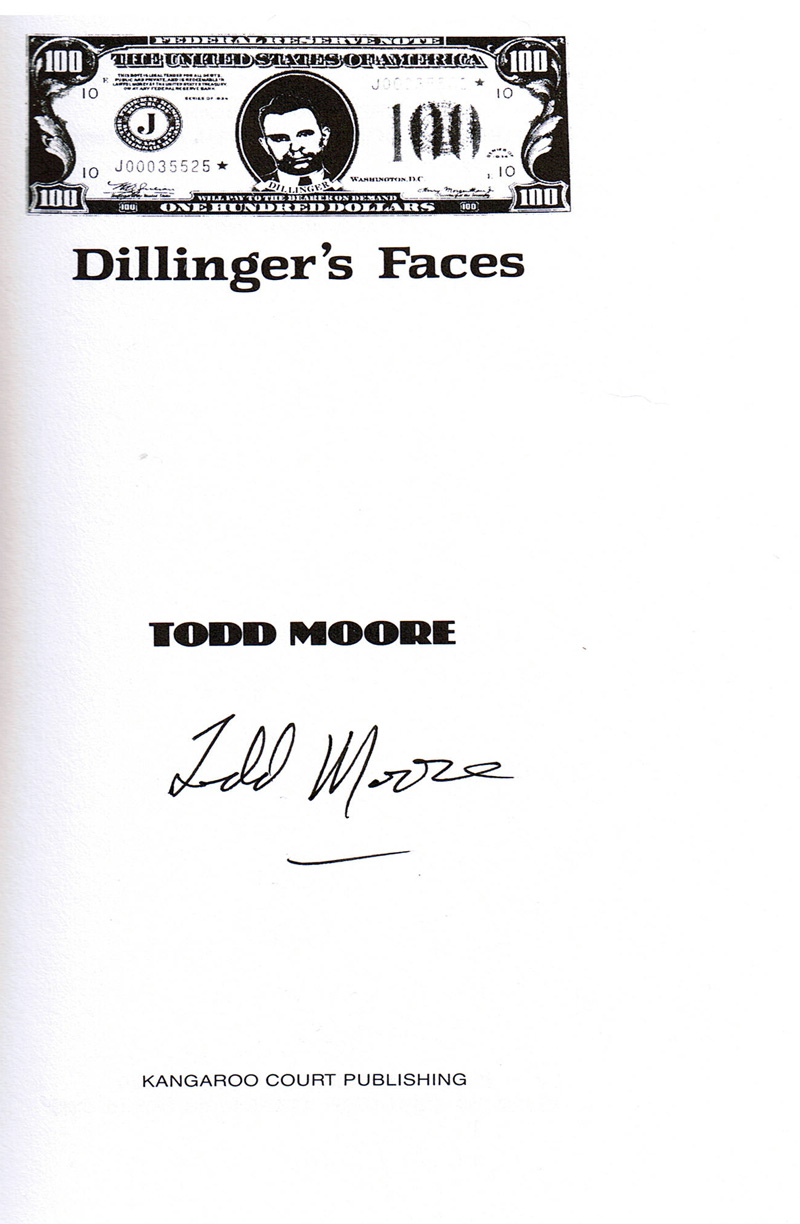
all live by the blood of our stories. We live by and through the blood of our stories. The blood of our stories, the myths of our dreams. My father lived off that blood for as long as he could and died wrapped in his dreams. He was my father when I loved him and my old man when I tried to distance myself from his whiskey lunatic schemes. And, I will never really know just how much he made up and what was the truth. He liked to talk about my great grandfather, who probably rode with Quantrill, though his name never appears on any of those rosters. He liked to talk about seeing Al Capone get off a train down in the Illinois Central yards and that very likely did happen. And, once or twice he talked about buying John Dillinger a beer in a Chicago speakeasy. Maybe that happened and maybe it didn’t, but the way my father told it, the incident somehow became the kind of cinema I couldn’t get out of my head. Then or now. It just kept coming back in all of my psychic movies.
Later, when we were living in the hotel, I remember a cop coming by to see my father. The cop always carried a silver flask inside his coat. And, he and my father would kill the bourbon contents of it out behind the hotel. After they finished, the cop would motion me over and say, wanna see Dillinger’s automatic? I’d seen it before but I never got tired of looking. My father would take a long drag off his cigaret, flick it into the gravel and say, tell me how you got it, again. Poker game in Dodge City, Kansas, the cop said. I was out there visiting my uncle and one night we all went to this private club, got into a poker game and it was my lucky night. This retired bank guard from Mason City, Iowa, lost all his money and the only thing he had left to bet with was this automatic. Said he was a guard when Dillinger and his gang robbed the bank there. The guard said, I was on duty that day. Dillinger and his boys were on their way out and Dillinger was trying to juggle a bag of money, a Thompson machine gun, and the 45 auto and the 45 just came out of his hand and slid across the floor. I heard him yell, no time, just leave it. Once they were out the door, I picked it up. The head cashier said, you’d better turn that in to the police. I just smiled at her. I never told her it was just the kinda dream I was waiting for. The cop let me hold it.
The 45 felt a lot heavier than a cap pistol. I looked at the cop, said, what did the bank guard say when you put the winning cards down on the table? The cop grinned and said, what do you say when your dreams are all gone? Before I could hand the 45 back to the cop, my father took it out of my hands and stood there awhile running his hands up and down the barrel. Sonofabitch, he said after a few seconds. He had sweat beads forming all over his forehead. Maybe it was the whiskey. Maybe it was the pistol. The sweat beads were starting to run down his forehead when he said, kinda feels funny holding Dillinger’s automatic. Yeah, the cop said. Almost like touching the man himself.
Years later, the first time I saw THE WILD BUNCH, I was reminded of my father, the cop, and Dillinger’s automatic. Near the end of the movie, just after the Battle of Bloody Porch when Deke Thornton removes Pike Bishop’s single action 45 from the dead outlaw’s holster, that scene behind the hotel rushed back into my memory. And, I understood just why Thornton took Pike Bishop’s revolver. It all has to do with a variation of the American Dream. This dream is all too american, but it is also outlaw right to the core. Nobody takes Jay Gatsby’s pistol at the end of the novel, probably because it was probably hidden underneath all his fancy shirts, his handkerchiefs, his ties. That is, if he had one. This form of the American Dream conceals the violent implications inherent at its center. However, Dillinger’s guns are achingly desirable because they are so much an intimate part of his image. Dillinger posed with that Thompson standing in his father’s yard is maybe the all time most famous snapshot of the man. It not only defines Dillinger, but it also defines the whole nature of what it means to be an outlaw in america. The original photograph is most likely a rarity. So, whoever owns Dillinger’s Thompson possesses the total darkness of the man, possesses his black lava burning core.
And, the total darkness of Dillinger is what continues to fascinate me. Dillinger fascinates me the way that McCarthy’s Chigurh and Judge Holden fascinate me. The way that Heath Ledger’s Joker fascinates me. The way that Cagney’s Cody Jarrett fascinates me. The way that Lee Marvin’s Liberty Valance fascinates me. The way that Humphrey Bogart’s best bad guys will always fascinate me. Fascinate me in the nightmare and the longing of their rage and desire.
Not long ago I was having lunch with a friend who said, tell me why you’ve been writing about Dillinger for almost forty years. I thought about it for a few seconds and had to admit I didn’t know. It’s not like I’m in love with him. It’s more like I’ve been hypnotized by him, witched into his everlasting dream. It’s like he’s talking to me but every time he says something he has to one up himself and say something else. And, I can’t get away from him because Dillinger might just be the most interesting character in american poetry in this part of the century. [please click on the following book cover if you would like to enlarge the images]
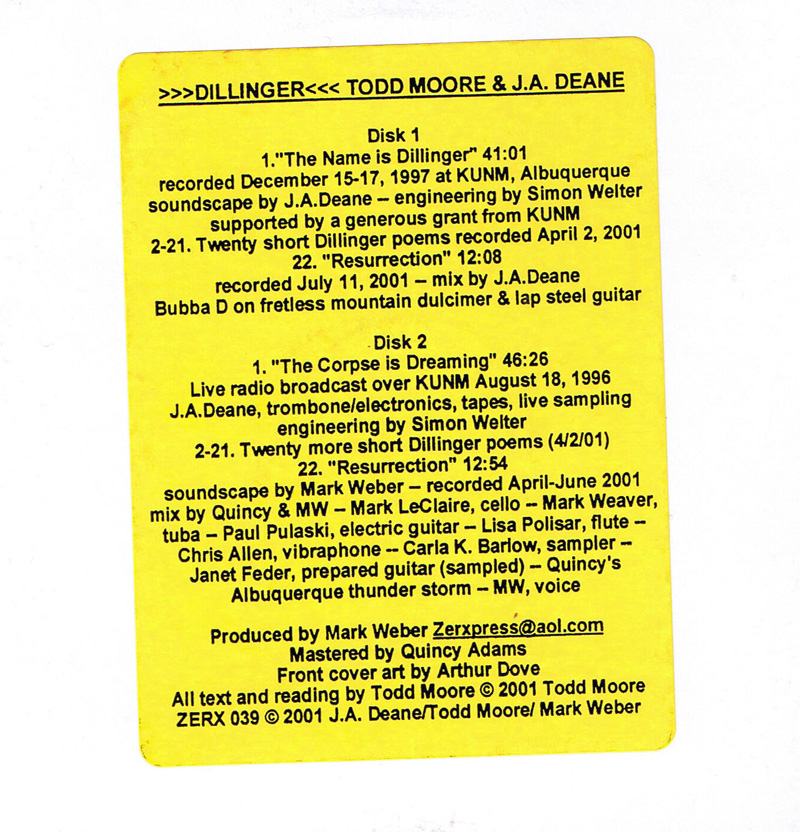
But, that really doesn’t explain Dillinger to me, to my private self. It goes beyond what one critic has called a focused obsession. If Dillinger is anything, he has become part of my exploration into the realm of violence and death. American violence and american death. The Corpse Is Dreaming is my attempt to journey to the underworld of death. I saturated myself with death books to get there. THE TIBETAN BOOK OF THE DEAD, THE BOOK OF REVELATION, THE EGYPTIAN BOOK OF THE DEAD, MOBY DICK, HAMLET, THE BLIND OWL, THE INFERNO, THE WASTE LAND. I wanted to write a death book to rank with those death books. I knew I couldn’t but I tried anyway the way some guys will try to hit eighty or ninety home runs a year the way somebody is going to try to hit in fifty seven or fifty eight or sixty consecutive games so who knows you have to try you have to go up against impossible odds you have to take that shot no matter what and even if you lose you win. As a section of DILLINGER, The Corpse Is Dreaming is unique as a contemporary poem. There is nothing else like it in poetry and the only work that comes close in its final ambition is William Faulkner’s novel AS I LAY DYING.
More than that I wanted to write one of the defining american books, I wanted to write a book that, if it doesn’t exactly explain american darkness, then it does the next best thing and becomes that darkness. DILLINGER, the sum total unfinished epic of it, is an outlaw expression of america at its darkest. Dillinger and DILLINGER, the man, the legend, the dream, and the poem. DILLINGER is the molotov cocktail that I am throwing at god.
Pushing the envelope. And, in poetry, that’s the name of the game, isn’t it? Trying to see how far you can go before you fuck it up. Because, in poetry, there is a very fine line between writing a poem of pure genius and just fucking it all up classic trainwreck style. Lorca never touched on the subject of fucking up in The Play And Theory Of The Duende. But, the implication there is that if you refuse the duende or if you squander it, then you will fail, you will fry in the heat and the energy of the duende. You will burn, baby, burn.
Strangely enough, there is some kind of peculiar death wish allure to fucking up as a poet. The trick, if you can pull it off, is to come to within inches of oblivion and still write that one all time poem that makes your bones and then sends fracture lines all the way through them, both almost at the same time. The trick is to write ARIEL before sticking your head in the oven. The trick is to write THE BRIDGE before diving toward the sharks. The trick is to write POET IN NEW YORK before the fascists come to rub their rifles all over your body. The trick is to paint GUERNICA, have the canvas rolled and be long gone before the stormtroopers pull up to your house wearing black shirts, driving black cars, black rage, black guns, black everything.
The temptation in poetry is to fuck up and fuck it all up in the epic manner. And, this coexists right along with the ambition to write the greatest poem ever. And, lets not be coy here. If you are a poet, you are probably the most arrogant son of a bitch on the face of the planet. You are the equal of Whitman, Shakespeare, Homer, and you are a hundred times better than the poor bastard on open mike night who is signed up to read just before you. If you are a poet, you have an ego the size of the Grand Canyon. And, if you don’t, then you are already finished though you may not know it. And, nobody is going to tell you because the sweetest revenge of all against mediocrity is to just let you swing and kick in the wind.
Almost anyone can fuck up and most of us do at one time or another but it takes a towering genius to fuck up in the grand beyond grand manner. Only Jack Micheline could have died on a BART train. Only John Berryman could have taken a header off a Mississippi River bridge with DREAM SONG Henry talking to him all the way down to the ice. Only d. a. levy could have danced his 22 rifle across his apartment floor before giving us the ultimate poem and blowjob of death.
The trick, the real trick is to write a masterpiece of a poem while balancing a razor blade on top of a vein. The trick is to play russian roulette with Mayakovsky’s nerve and Mayakovsky’s style. It almost seemed as though the gesture of putting the gun barrel against his chest was a kind of performance poetry that, if he didn’t invent, he sure as hell perfected. The trick is to drink as hard and as long as Charles Bukowski or Kell Robertson and still be able to write something as solid as BURNING IN WATER, DROWNING IN FLAME, or A HORSE CALLED DESPERATION. The trick is to do eight through Raton Pass in the dead of winter across black ice while writing the poem to end all poems about Billy the Kid Tony Moffeit style.
The trick is to have style in the first place. When the fascists shot Lorca, the one thing they couldn’t kill was his style. And, I’d like to think that at least one of those mothers had to know that. Had to realize that no matter how many bullets you fire into a corpse you can’t kill a poet’s style. The trick is to have style even in the face of death. Death has no distinctive sound but a great poet does. The trick is to have style because no matter what that is your sound, no matter what that is your look, that is your swagger down the corridors of oblivion. And, it doesn’t matter how many third raters, how many envious wannabes try attacking you for who you are, where you came from, or what you have become. Because style is the essence of your authenticity, style is your armor, and style is the very core of what you can do when nobody else can do it as well or with as much courage and grace.
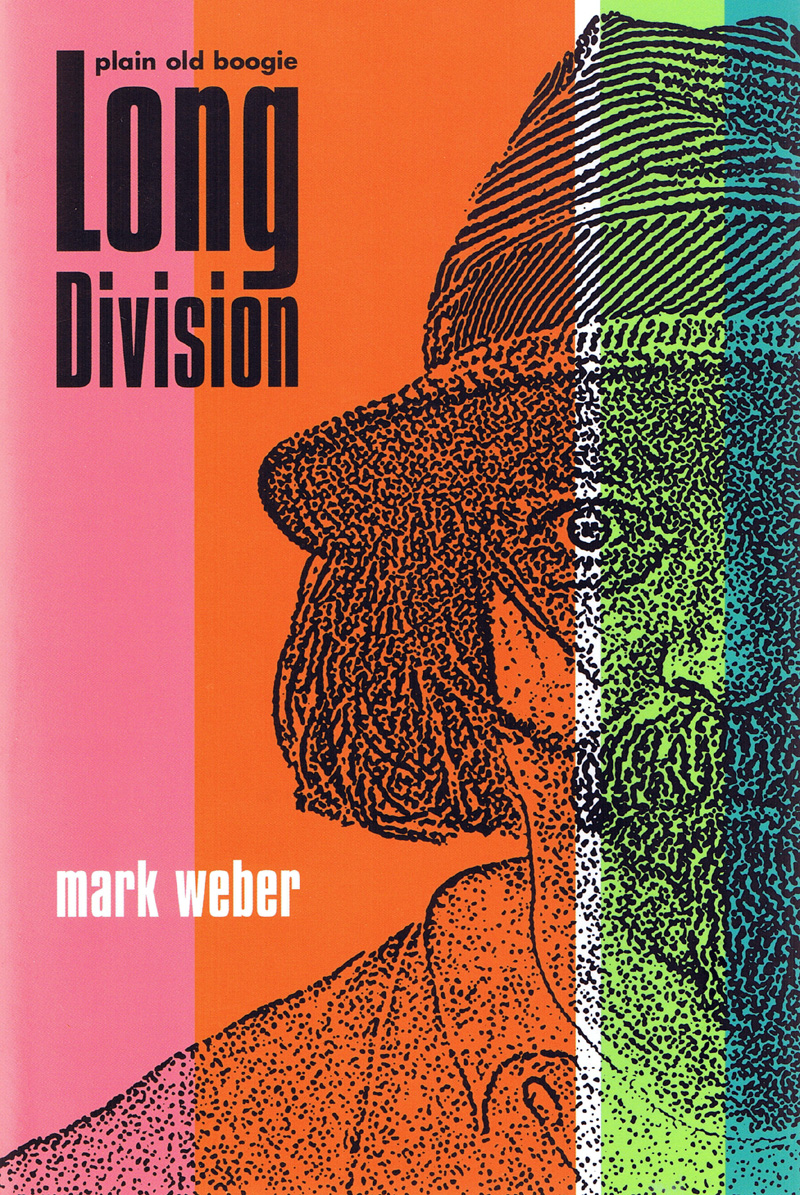
Style saved Lorca when nothing else could. Style gave Micheline the permission to die en route from nowhere to nowhere. Style made Bukowski really look like somebody while he was drinking and strolling down Sunset Boulevard or Rodeo Drive or some no exit broken down skidrow street in deathtown L. A. Style was Slinger Ed Dorn wearing that kickass cowboy hat while leaning into the camera. Style is the gutbucket gravel going way back inside Tony Moffeit’s voice while he belts out Voodoo Casanova. Style is Mark Weber reading anything from PLAIN OLD BOOGIE LONG DIVISION. Style is all about Dennis Gulling writing a death trip poem at the bottom of an insurance claims form. Style is Dillinger who was nothing but style.
The thing about style and fucking up is that they are intimately and recklessly entwined, related, the blood idiot twins who can make you look way beyond wonderful or they can exile you to the shithouse of the ho hum, the boring, the furiously banal. One thing to remember is you can’t make yourself have style. It doesn’t work that way. It just comes as a byproduct of the madman inside you. Just as you cannot will yourself to write a great poem, you cannot fake style. If you try to fake style in a poem or in the way that you live, you are truly done for. All of your poetry cred and all of your street cred are gone, sayonara, bye by, and don’t let the door hit you in the ass on the way out.
The interesting thing about style and fucking up is that they somehow balance each other out. You can die like Plath with your head in an oven and still survive through the powerhouse poem. You can die like Mayakovsky, with your blood swimming all over your blood and still make it clean because you taught Frank O’Hara how to write some of the best poetry ever. And, you can die like Berryman whose DREAM SONGS have somehow become part of our death songs. This is when the poem becomes a truly unbeatable style.
And, fucking up becomes the darkest of all myths. Mayakovsky died in a flash of gunfire at the age of thirty six. He looked good, he looked very good. The cameras loved his scruffy streetfighter fuck you demeanor. And, now his Rodchenko face appears far more interesting than Pasternak’s which took a savage beating from dealing with Stalin. At the other end of the spectrum is Bukowski’s face which survived a teenage bout of acne and god knows how many rights to the jaw. Which makes him look ugly and makes him look alive with electric charisma.
The trick is to fuck up and become a living legend. The trick is to fuck up all the way to the fame.
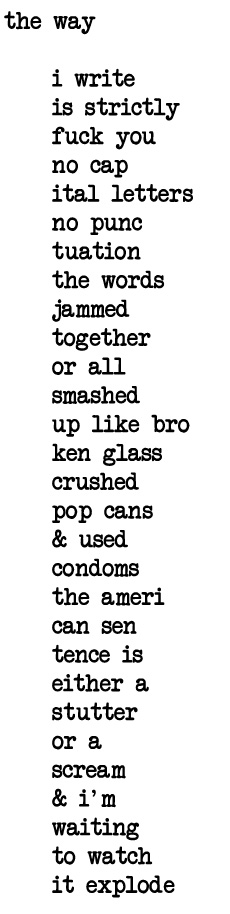
i write
is strictly
fuck you
no cap
ital letters
no punc
tuation
the words
jammed
together
or all
smashed
up like bro
ken glass
crushed
pop cans
& used
condoms
the ameri
can sen
tence is
either a
stutter
or a
scream
& i’m
waiting
to watch
it explode
What are the stakes in american poetry? What is the writing of poetry really all about? Is it about getting the prizes, is it about lucking into all that grant money, is it about those cushy teaching positions? The real stakes have nothing to do with awards, fellowships, paid readings, or who kisses who’s ass. What are the real stakes of american poetry?
Which implies risking something, which implies gambling and if you are a poet and you haven’t figured out that the raw blood visceral act of wrestling the words onto the paper isn’t a huge gamble then you are fucked from the beginning. You are not only fucked but you are finished because when you write a poem you are betting with all of your skin and blood and guts and dreams that what you are writing will somehow surprise the cosmos and maybe just maybe tease a poetry editor somewhere into publishing it in a hard copy zine or posting it on an internet website. That’s the minimum. Jacks or better for openers.
Maybe if you are lucky, if you are very very lucky you will write something as powerful as Miklos Radnoti’s The Angel of Dread. Or, maybe if luck and arrogance and a dash of genius visit you in the cellar of your nightmare, you will write something almost as good as Vasko Popa’s Burning Shewolf. Luck and arrogance and a dash of genius. Maybe bourbon if you need bourbon or a piece of ass if you need a piece of ass. Writing poetry has nothing to do with how well read you are. You can have books pouring out of the windows of your house and never ever write a great poem. Mediocre poems yes, but great poems, no. Reading helps but reading alone does not give you the visions. Reading alone does not arm you with language. Reading alone does not plug you into the power circuit of the universe.
According to an old story, while Picasso was painting GUERNICA an acquaintance dropped by and watched the artist at work on the horse. After a few patient minutes, the acquaintance said, Excuse me, but what is the secret? After all, aren’t you just simply using paint? Picasso paused a moment, applied a few more brush strokes and then without turning around said, I always shake three drops of my own blood into the paint before I begin. Then, once I start painting the electricity pours out. Picasso waited a few moments before turning around and said, But, this doesn’t work for everyone.
Not long ago I was sitting in an Albuquerque coffee house writing a poem. I was seated near the window and had a clear view of the mountains from there. And, even though I was not looking at the mountains while I was writing I could somehow sense them out there and that made me feel good and the poem was coming very quickly. It was about the way that I write. In fact, I had the first couple of lines even before I started writing. It went, the way that I write is strictly fuck you. I don’t usually write poems about writing poems but this one felt raw and edgy and jagged all the way through and that somehow let me write the poem. It only took a couple of minutes to get it all down and as I recall I didn’t cross out many words in the process. When I was finished a poet I knew walked over and said, I noticed you were writing something. Is it a poem? I said, Yes. And, he said, it looks like you got maybe two dozen good lines. I should let you alone so you can finish it. I smiled and said, It is finished. He said, how can you work so fast. It always takes me days before I know I have a poem I can live with. I grinned and said, Because it pisses death off that I can write so quick.
What are the stakes in american poetry when you want to be an Outlaw Poet? What are the stakes then? Do you think you will be interviewed on NPR? Maybe maybe not, but your chances are better at not. Do you think Garrison Keillor will feature you reading a poem on Lake Woebegone? Not unless your name is Billy Collins and Collins doesn’t even come close to being an Outlaw Poet.
What are the stakes in american poetry when you know you are not just competing against Charles Bukowski but you are also going up against Walt Whitman, Federico Garcia Lorca, Ezra Pound, T.S. Eliot, Pablo Neruda? What are the stakes then when you realize that this is an all or nothing gamble. A fight to the finish, a throw of the dice, a shove of the chips, an all in bet the farm motherfucker because what really matters is the gesture and if you can somehow go completely crazy and write the everything poem and don’t get me wrong writing that big poem is intimately sutured into the gesture so well the whole thing the whole act the whole ritual is one and the same then this is something that takes everyone on and comes this close like Hart Crane with THE BRIDGE only even just a little closer than he ever could, then it’s the bet that counts, the bet and the poem because isn’t that what all ballsy poets do?
I showed a friend of mine a rough draft of this essay and he said, You were wrong to compare yourself to poets like Lorca and Whitman and Neruda. They’re so far above us, they’re giants. I could never think of grandstanding like that. I could never be that arrogant. I replied, That’s where you and I are different. As for arrogance, that’s just my game.
What are the stakes in nightmare american poetry where you can write your guts out like Jack Micheline and die on a Bart Train, what are the stakes in trainwreck american poetry when you have risked your whole life on maybe a dozen or so chapbooks, a hundred plus page perfect bound book, and you end up living in a renovated chicken house with no plumbing and a potbellied stove like Kell Robertson. Only everything, only what passes for a life and a bet on the poem. And, I’m not supposed to compare myself to Pablo Neruda. Well, amigo, fuck that.
What are the stakes in gun them down america for a poet to just go out there without the benefit of workshop, classroom, craft spin, and bullshit? What are the stakes for a poet to just guts it out, just write the poem like it was the first and last blood testament of an american outlaw? And, it needs to be a blood testament or else it is nothing. It needs to bleed out of you and it needs to bleed off the page.
What are the stakes here where poetry has been hustled, pimped, and swindled beyond recognition, where nobody reads it because it sounds like more spin doctors working the same language con? What are the stakes now in an america where poetry is little more than noise, theory, and erasure? We’ve hit the cul-de-sac, the proverbial dead end and the stakes are high, they are very high.
All of my poems appear like blown off fragments of the night which somehow show up the next morning like damaged children. All of my poems surface like the remnants of some kind of horrific shipwreck. Or, they float in the air like bits and pieces of an aircraft’s fuselage that refused to go down with the rest of the plane. They just float and wait like metaphors in a painting Magritte never finished. I am and have been surrounded by an ocean of wrecked metaphors, awash and flowing toward some kind of psychic catastrophe.
The long poem that I have been callingDILLINGER for more than twenty years is simply and precisely an ocean of half formed, peculiarly shaped, carefully composed, and at the same time almost irretrievably wrecked metaphors. I began with Dillinger the man and then progressed to Dillinger the legend and finally Dillinger the archetype. Dillinger is still the historical Dillinger but he has morphed so much more than that. Dillinger has always been a celebrity outlaw, but the implications are there for his becoming the universal, the ultimate american outlaw. And, because of this, the implications also point to DILLINGER as becoming the ultimate american outlaw poem as well.
Bukowski never wrote the ultimate american outlaw poem unless you consider his whole body of work as a kind of extended poem. Micheline never wrote the ultimate american outlaw poem unless you consider his entire body of work as the ultimate summing up american outlaw poem. Kell Robertson never wrote anything that comes close to the ultimate american outlaw poem unless you want to make the case that his entire body of work be considered as an extended american outlaw poem. Ditto Bremser, ditto levy, ditto Ginsberg, ditto Burroughs, ditto Kerouac. A good case could be made for thinking of all these poets and novelists as Outlaw Poets. But, even as good as they are and they are among the best all time Outlaw Poets who ever lived in this country, I don’t think any of them ever wrote the ultimate american outlaw poem.
The question is has Cormac McCarthy written the ultimate american outlaw poem? And, yes, this is a strange question in light of the fact that McCarthy has worked almost entirely as a novelist and whatever poetry he has written has very little to do with the issue at hand. However, if, for a moment, we consider McCarthy to be a poet in the very broadest sense of that term, then has he written the ultimate american outlaw poem? The obvious answer is yes, BLOOD MERIDIAN; still, it must inevitably share the stage with DILLINGER. Hold your ears folks, there may be some yelling. I’d be monumentally surprised if there isn’t. But, for a moment, lets consider what Harold Bloom has written about McCarthy’s novel in his critical work NOVELISTS AND NOVELS. “The fulfilled renown of MOBY DICK and of AS I LAY DYING is augmented by BLOOD MERIDIAN…” So, in the widest possible sense, BLOOD MERIDIAN is an ultimate american outlaw poem, but in the accepted critical sense, it is actually a novel.
Back to the idea of the ultimate american outlaw poem. Except for DILLINGER, there aren’t any. None that I know of, amigo. HOWL is anarchically mad, but it really isn’t outlaw. LETTER TO AN IMAGINARY FRIEND is political, populist, and outside the margins but it really isn’t outlaw. The fact of the matter is there was nothing before and nothing after DILLINGER that could come anywhere close in comparison. And, when I say outlaw I mean OUTLAW with all the weight, the menace, and the explosiveness that the word implies. I am talking about any long poem which has as its central character a wanted man, a bankrobber, a felon who is also the representative dark american hero. Michael Ondaatje’s THE COLLECTED WORKS OF BILLY THE KID is clearly a hybrid. It has been called a novel and it has been called a poem. Either way, it is a miniature. It does not possess the heft or the authority or the depth or the vision of DILLINGER.
Now, lets ask the same question but leave out one word. Where is the ultimate american poem? I love and have always loved THE WASTE LAND but it’s a little poem, a vest pocket epic. And, yes, I will grant that it is a small poem, one with huge ambitions, enormous layers, and undeniable vision. But, it is not the ultimate american poem. Its opposite is THE CANTOS. Which is a huge poem, sprawling, thick with language and languages, opinionated, cantankerous, attempting to be all encompassing, but somewhere inside its myth and its intelligence THE CANTOS is not the ultimate american poem. Though it desperately wants to be. If any poem ever wanted to be the great american poem THE CANTOS is it.
The problem with THE CANTOS is that the central figure is Pound and Pound ultimately damaged himself. THE CANTOS is great because of its unfinished quality and the deep probing sense of its darkly sublime damage. Maybe that is what really lies at the heart of the great american poem. That sense of irreparable brokenness.
BeforeTHE CANTOS, there is LEAVES OF GRASS. And, also Dickinson, but she doesn’t mean as much to me as Walt Whitman does. And, if I have to pick just one poem out of LEAVES OF GRASS it would have to be Song Of Myself. When I was writing The Name Is Dillinger I was thinking of Song Of Myself. I was also thinking a little bit about the bible and about an old time fire and brimstone preacher I’d known in the fifties. And, I was also thinking the old idea of oratory, maybe of the Lincoln Dougleas Debates which I only knew of through books, maybe of the way the old time medicine men might have sounded while they were hawking the best of all possible tonics. I had all those ideas going around in my head. Also Carl Sandburg’s voice, though I had never met him, had only heard his recorded readings. I wanted something that sounded old timey biblical, smartass wise guy, and primally dangerous.
However, if you compare The Name Is Dillinger to Song Of Myself, what you will almost certainly discover is that these two poems are situated at opposite ends of a tangled national epic spectrum. Whitman may have been an outsider but he was never an outlaw. He may have stood at the edges of society in 1854 but he had no criminal intentions. In 1976, while I was writing The Name Is Dillinger I was still a street thief, at least in my head. Once you step across that line you are on that other side for always. And, what I was stealing while I was writing this poem was the language of a culture. Stealing all the smashed and broken pieces of it and reinventing my own dark vision of america. Whitman’s Song Of Myself was a gift to the culture of 1855. This kind of national epic is always a gift. Undeniably, The Name Is Dillinger is an anti national epic. It is a stick of dynamite, it is a hand grenade, it is a molotov cocktail. What it is, what it has to be is a smart bomb directed at the american culture of the late twentieth and early twenty first centuries. A long poem like The Name Is Dillinger is always a weapon the same way that Picasso’s GUERNICA is a weapon, the same way that Baudelaire’s FLEURS DU MAL is a weapon, the same way that MOBY DICK is very likely, among other things, also a weapon. These are the kinds of weapons that are meant to wound a culture into greatness and change. Any work of art that can achieve this, though it may take a hundred years, is by all means Outlaw.
So, the ultimate american outlaw poem is obviously DILLINGER. And, DILLINGER is also one of a very very few ultimate american long poems. Do I sound arrogant? I hope so. I know I sound Outlaw. These days the Outlaw Poet is required to be half horse half alligator. Because there are no major critics willing to explore the work of Outlaw Poets, then the Outlaw Poet must become his own critic.
If you are an Outlaw Poet, you not only need to steal the fire, but you must steal the shadow of the fire as well.
If you write poetry you are haunted by faces. And, I am haunted by faces. If you write poetry you are haunted by the faces of both the living and the dead poets. Allen Ginsberg talking to d. a. levy. Ed Dorn all cowboyed up looking a little like Gunslinger. Charles Bukowski drinking a beer while he wanders aimlessly down some Los Angeles boulevard. Tony Moffeit right in the middle of belting out his own gravelly rendition of Give Me The Night. Kell Robertson walking around with a big drink in one hand and a big revolver in the other. John Macker summoning a bone duende just before reading from ADVENTURES IN THE GUNTRADE. Alex Gildzen holding a single black dahlia.
If you write poetry you are haunted by voices. And, I am haunted by voices. I am haunted by the voice of Leo Connellan reading CROSSING AMERICA. I am haunted by Dave Church reading poetry with his tough taxi cab voice. I am haunted by the Okie voice of Mark Weber reading from PLAIN OLD BOOGIE LONGDIVISION. I am haunted by the wise guy voice of S. A. Griffin reading out of the heart and the night of Los Angeles. I am haunted by the voice of Lonnie Sherman reading about Rita. If you write poetry you are haunted by voices, you drunk with the voices, you swimming with all the electric the outlaw voices.
And, all the electric outlaw voices somehow meet and merge in John Dillinger. Some nights I can see them come together and join and entwine in the blood and muscle and bone nexus of John Dillinger. But it isn’t just nights. It’s mornings, afternoons, evenings and smack in the middle of the outlaw night. Because I am and have been obsessed by Dillinger since 1976. I am obsessed with Dillinger the way that Mark Twain had to have been obsessed with Huckleberry Finn. The way that F. Scott Fitzgerald had to have been obsessed with Jay Gatsby. Gatsby was there waiting in all of Fitzgerald’s blackest and drunkest of nights. The way that Charles Olson had to have been obsessed with Maximus. The way that Cormac McCarthy had to have been and maybe still is obsessed with Judge Holden. For all that McCarthy knows the Judge remains out there in the Valley of Fire, still waits out there along the Jornado del Muerte, still sits out there on some ten thousand year old scorched black obelisk hoping to ambush the author for one more night of lightning burnt talking.
I see Dillinger everywhere. I see him standing on streetcorners, I see him waiting outside pool halls and bars, I see him hanging around alleys, I see him buying a ticket to a movie, I see him drinking a beer in a good seat behind home plate at the local ballpark, I see him with a blonde on his arm at the kind of casino where you could lose your soul. The thing is I always see him. He’s part of the air I breathe. In fact, he is the air.
And, no matter what other poems I write, it’s doesn’t matter if I write a novel or an essay that isn’t really about Dillinger, the problem is it’s always about Dillinger, somewhere down in the heart and guts of the text. Just as every poem, every novel, every short story that Bukowski ever wrote was really about Chinaski. Chinaski was Bukowski’s true self and you can never shake off or lose that true self no matter how hard you try.
Just as Huck Finn was Mark Twain’s truest and darkest self, just as Billy the Kid is Tony Moffeit’s truest self, a self he can never deny, can never shake. Just as Melville could never deny, never completely rid himself of Ahab. And, even though Ahab is lashed to the white whale and they go down into the depths of the ocean together, somehow Melville has to understand that Ahab is still down there, that his rage causes the ocean to
tornado back into itself.
I’m sitting in a diner that never closes. The joint is almost empty. It’s three in the morning. Maybe it’s the Edward Hopper Night Hawks joint. It’s one of a thousand dives I’ve been in and out of for most of my life. The walls are almost too red to look at. And, instead of sitting at the counter, I’m sitting at a booth having an ice tea and a slab of blueberry pie. Dillinger is sitting across from me. He’s drinking the blackest coffee I’ve ever seen. It looks like death syrup. Right now, he’s quiet. But, I can feel the stories moving around inside him, they feel like dark green storms with funnel clouds in them. He never talks about that but he doesn’t have to. His storms talk to me.
After awhile Dillinger takes his hat off, slides a 45 auto underneath it so the counterman won’t see, and pushes it across the table toward me. We sit like that for awhile. Dillinger is smiling, waiting for me to stick my hand underneath his hat, and pull the 45 out. I wait for the counterman to turn his back before I remove the automatic and hold it underneath the table. The pistol is heavy. It’s heavier than I thought it would be. It’s loaded with Dillinger’s dark american dreams, his longing, his bank robbery dreams his rolling murder. He says, How does it feel? Okay, I tell him, hefting it a few times. Finally, he reaches under the table and takes it back.
Later, on our way out, Dillinger smiles at the counterman, points a gunfinger at him and says, Bang. The counterman smiles and uses his gunfinger to return the sign. Outside, Dillinger whistles up a black taxi cab with yellow stripes on the side. When he gets in I get a good look at the driver. It’s Death. The way Death says hello is he clicks two bones together, then hits the gas.
I’m having lunch with a skinwalker. I know that I am having a dream but at the same time I know there is the outside possibility this could be real because the light coming through the restaurant’s window is extra heavy with sunlight. The air sags with all that bright gold. The skinwalker looks like he could be a friend of mine but at the same time I know he is not. He resembles one or two gangsters I knew in the past. He says, You are not going to get away with this. I say, What are you talking about? He says, Dillinger. I say, What about Dillinger? The skinwalker leans way back in the booth and says, You’ve opened a door you no longer have any control over. I start to say something, he puts his hand up and says, Nobody gets to play with this kind of energy without paying the price. His eyes appear normal but when I try to look into them it feels like I am burning. I look away for a few seconds and then decide to look back and make a wisecrack but by then he’s gone. The air where he was sitting is a little bit scorched.
I’m driving. Dillinger is sitting in the suicide seat. He says, What did that guy tell you? What guy, I ask, pretending not to know what he is talking about. The guy, the guy, don’t fuck with me. I wait a couple of seconds just to the black air settle. Finally I say, He said I was going to pay the price.
Dillinger stares out the car window for several seconds, then says, We all pay the price. It doesn’t matter if you open the door or don’t open the door. You pay just the same. So, you may as well open the door and let everything out.
no one knows how dark the wolf is until the night begins to move
Outlaw pushes buttons. Outlaw starts fires. Outlaw gets some people really excited. And, Outlaw also makes other people angry. Three or four years ago I had lunch with a poet who I just naturally assumed was an Outlaw Poet. However he let me know in no uncertain terms how offended he was with the label. As a label the term Outlaw can be offensive, maybe even deeply offensive. And, in some cases the more offensive, the better. I love the label Outlaw. I love it right down to the bones of its letters, I love the sound of it, the implications of it, the sheer aggression of the word. I love Outlaw in the brightest of New Mexico noons when the sunlight shimmers like hammered gold in the air and I love it in the New Mexico midnight when the skinwalkers are out and they want to fuck with your mind. I love Outlaw and I don’t give a damn who it troubles, offends, or just plain pisses off.
The Beats pissed people off. The Dadaists pissed people off. The Futurists pissed people off. The Surrealists pissed people off. However, they also changed the way that we look at poetry and art. Each movement changed the way that whole cultures hear language, see images, write poems, dream. This is where Outlaw is headed. This is where the Outlaw Poem is going, this is both the direction and the destination for the Outlaw Revolution. Outlaw is all about changing the kind of stale academic poetry appearing in the mainstream journals and the academic publishing houses. Outlaw is all about opposing the special interests, the huge foundations which award the lucrative prizes to all the writing degree darlings, mainstream press poets who have lost the juice, the mojo, the magic. Or, maybe never had it.
If pressed to admit it, I’d have to say that we’ve always had prizes reserved for certain poets. We’ve always had mainstream publishers more predisposed to publish a safe poet over a dangerous one. That held true for when Rimbaud and Whitman were alive and it holds true today. Maybe more so, for the twenty first century. It’s a risk free effort to publish the work of a Seamus Heaney and to neglect the work of a Kell Robertson. Heaney is a Nobel Prize winner with all the correct university teaching credits behind his name. Kell Robertson was on the road by the age of thirteen. He never graduated from high school let alone college. Yet, if given the choice, I’d rather read Kell Robertson’s poetry any time. He possesses one of maybe half a dozen truly authentic voices in american poetry during the last part of the twentieth century and the first part of the twenty first century. You don’t have to go to Harvard or Yale to acquire that. But, what you do need is damage, genius, and courage to write the great american poem.
Which also, currently, translates into the great outlaw poem. The great american outlaw poem. The great american outlaw damage courage genius poem. You want a poem like that, I’ll give you a whole book full of them by Misti Rainwater-Lites called DANGEROUS HAIR. I’d like to see what the Nobel Prize or Pulitzer people would do with that. You want damage, genius, courage, then read Joe Pacinko’s THE URINALS OF HELL. Damage, genius, courage? Read POET HEAD by Ron Androla or NUMBSKULL SUTRA by S. A. Griffin.
Damage, genius, courage is the bio for every Outlaw Poet I know of. Damage, genius, courage is what propels Raindog Armstrong’s FIRE AND RAIN, what gives the short circuit wham to Christopher Robin’s FREAKY MUMBLER’S MANIFESTO. Damage, genius, courage is what most Outlaw Poetry runs on. It’s like a form of black electricity and white hot duende zipped to the max. Damage, genius, courage was David Lerner’s alias. Damage, genius, courage should have been the subtitle for Albert Huffstickler’s WORKING ON MY DEATH CHANT. Damage, genius, courage is what fuels Tony Moffeit’s BLUES FOR BILLY THE KID.
I can’t think of any academic poets who deserve the words damage, genius, courage. Not one. But I know Mark Weber deserves them. Damage, genius, courage. I know that John Macker deserves them. Damage, genius, courage. I know that Dennis Gulling deserves them. I know that Theron Moore deserves them.
Poetry somehow damages you in subtle ways if you write it for very long. Little pieces of you crack off and get sucked into the poem. And, Outlaw Poetry damages you in the rawest and most savage of ways. Partly because there are no rewards, monetary, or otherwise. And, partly because the Outlaw Poem demands the rawest of scrapings from the skin, the blood, the dream and the soul of the person who writes it. However, in spite of all this, the Outlaw Poem offers, more than any other kind of poetry currently being written in this country, an opportunity to somehow alter or change the way we listen to the american voice, the way we get that voice down in words, and the way that we fundamentally talk to each other in the dark apocalyptic rooms of the republic. Outlaw is the way we tell our stories to the void and to ourselves. Outlaw because these are the dark stories, the ones we all long for.
A couple of years ago I had a dream about Dillinger. I was writing poetry in this old hotel room. It might have been the Clifton. It was the middle of the night and I was bent over an old typewriter at a rickety night table. The machine I was using was hard to work and wobbled every time I struck a key. I couldn’t go fast the way I like because the keys would stick together every so often. It was an old black steel Royal like the one in my office and now that I recall it seemed as though the story was coming right out of the core of the typewriter. The dark center of it where all the keys were all crouched and waiting for that ultimate swing up and back. The voice was pouring out quickly and the action of the typewriter was grindingly slow. But, somehow I was able to finish the poem.
I sat quietly on the edge of the bed a few moments just staring at the pages of the poem I’d spread out on the bed. After a little while there was a knock at the door. When I opened it Dillinger was standing there. When I invited him in he said he could only stay for a moment. Once inside the room, he said, “I brought you something.” He pulled a Thompson sub machine gun out from under his coat and said, “I think you deserve this.” I tried giving it back but by then he was already gone. Outside, the wind sang of the hotel’s twisted iron and nearly wrecked bricks.
Every time I write about Outlaw Poetry I discover that I am defining it all over again. All I can do is begin once again all over with myself. I’m an Outlaw Poet. I was an Outlaw Poet even before I could write a decent poem. I’m still an Outlaw Poet. But, maybe I’d better explain. I was practically raised on the streets. I was a street thief and a damned good one, too; it was a matter of survival. And, I lived in a run down skid row hotel for nearly twelve years before I was able to escape with a college education. Even after that I never really became middle class. You can’t automatically become a non outlaw after you’ve spent eleven or twelve years of your childhood with shoplifters, hookers, alkies, drifters, and sociopaths. It just doesn’t happen.
And, it just doesn’t translate into nice people poetry. The poems I read in high school and later at the university didn’t have any switchblades in it. Didn’t have any automatics in it. Didn’t have any gangsters in it. Didn’t have any winos or cue sticks or blackjacks in it. I remember when I finally got interested in poetry, it sort of felt like I was running on one leg. I was looking for poets who looked and sounded like Bogart and what I ended up with was guys like T. S. Eliot and William Carlos Williams. I did like Hart Crane because he was a wild man. But there weren’t many like him.
And, later after I graduated from the university I kept looking for poets who could write about the life I knew as a kid. Bukowski came close but he didn’t write about the stuff that I knew. He wasn’t a kid when he was living on skidrow. He wasn’t a street thief. What I finally realized was that I could never be a Robert Lowell or a John Berryman though I admired their achievements. I could never be a T. S. Eliot or an Ezra Pound. I was born too late but I also admired their achievements.
And, I could never sell out by getting an MFA degree. I knew even back in 1970 that a writing degree was the ticket into the academic world and was pretty much what you did to get the fancy awards and prizes and I didn’t want any part of it even then because the whole process had a corpse smell to it. I could’ve called myself an outlaw then but I hadn’t earned it. I personally believe you have to earn the word Outlaw the way that gangsters become made men. You have to do something above and beyond just writing a few skinny chapbooks. Though Rimbaud earned it by producing not much more than that. And, in this mix you can include d.a. levy, Ray Bremser, and Jack Micheline.
In 1973 I became an Outlaw Poet when I first started to write about John Dillinger. I became an Outlaw Poet in spite of the fact that it would be three more years before I would write a Dillinger poem that essentially became an archetypal depth charge on the poetry scene. The movement now known as Outlaw Poetry began in 1976 with The Name Is Dillinger. Before that time there were maverick poets writing at the margins of the small press scene. Micheline was known as a Beat poet but he was more outlaw than Beat. By 1976 levy was dead and Kell Robertson was writing his own brand of outlaw poetry in here in New Mexico.
The fact that no one was calling this Outlaw Poetry at the time does not diminish the fact that this kind of work was coming out of an Outlaw life style and an Outlaw way of seeing things. But, the fact remains, and this is fact is irrefutable. When I wrote The Name Is Dillinger in 1976, Outlaw got started even though I didn’t refer to that kind of writing that way. Then. The whole thing got its conscious start in the eighties. Midwestern Writers Publishing House brought out The Name Is Dillinger in 1980 and I began to write to Tony Moffeit in 1983. In fact, my small press Roadhouse brought out his chapbook Outlaw Blues that same year and that was also when we began calling ourselves outlaws.
In the eighties I also discovered pulp writing. The best of Black Mask Magazine. Writers like Dashiell Hammett, Raymond Chandler, Ross MacDonald, Jim Thompson. This is because I was looking around for a raw way of saying things in poems. I was looking for raw where nobody had thought of looking before. I was tired of the aesthetic distance. I wanted a poem to be up close and personal. I wanted the gloves off. I wanted a poem to draw blood. I wanted a poem to be as lethal as a 45 auto. And, I still do. Nothing works as dangerously as a declarative sentence stripped to its bones. There was a time when I referred to my poetry as Noir. I still think of it that way. But, overall what I wrote then and what I write now is Outlaw through and through. The next watershed year in Outlaw Poetry occurred when Floating Island Publications brought out Tony Moffeit’s book of poems and essays entitled POETRY IS DANGEROUS, THE POET IS AN OUTLAW. This marked Moffeit’s first comprehensive attempt to define what had been, until then, really a kind of dialogue that he and I had been having for a little more than ten years. This was maybe the first time if ever that anyone had ever suggested in prose that poetry was dangerous. We all knew poetry had been dangerous in the Soviet Union. And, poetry had been dangerous in South America. That poetry is dangerous wherever there is a dictatorship. But no one in america had ever really taken seriously the idea that poetry is, by its outlaw and primal nature, dangerous. With the exceptions of Ted Hughes’ essays and Lorca’s Play And Theory Of The Duende, nobody thought it necessary to point out the wild energies hidden in the dark lines of a poem. At least, nobody here.Then in 1999, Thunders Mouth brought out maybe the most important poetry anthology ever. THE OUTLAW BIBLE OF AMERICAN POETRY has pretty much broken the record for poetry anthology sales. And, it has also solidly put the words Outlaw Poetry out there. Argue as you might that key outlaw poets were left out. Bukowski for one. Bukowski was a one man show. He was unrepeatable. Tony Moffeit and Kell Robertson and Mark Weber were also left out of this landmark collection. But, what OUTLAW BIBLE did was blow an enormous hole in the american psyche regarding Outlaw Poetry. Because of that anthology no one will ever think of Outlaw Poetry the same way again.
When Tony Moffeit and I finally decided to found the back in 2004, it wasn’t a spur of the moment thing. We’d had more than twenty years to talk about Outlaw Poetry. We had both written key books both about and of Outlaw Poetry. So, this wasn’t something new. This was not a fluke.
However, if none of that matters, if none of that is relevant as to what Outlaw Poetry is or should be or could never be, then lets bring it all down to this. As an Outlaw Poet, I’m putting it all on the line. All of it. Every chapbook, every poem, every essay. It’s all out there the way Doc Holliday might shove his chips to the center of the table on the strength of the cards he is holding. I’m holding DILLINGER. Bukowski is holding Chinaski. He has a helluva hand. And, Cormac McCarthy is in the game even though he’s strictly a novelist and doesn’t give a shit about other writers. Which is maybe the way it should be though I never played it that way. He’s holding BLOOD MERIDIAN. The literary gods love him. The movies love him. The smart money is on him for the Nobel Prize.
Is it humanly possible to know what was going through Walt Whitman’s mind when he was writing SONG OF MYSELF? And, yes, we have the lines from the poem. We know he was thinking of them but what else was he thinking about? What was he dreaming, what was he talking about to friends?
Is it humanly possible to know what was going through Allen Ginsberg’s mind while he was writing HOWL? The lines of HOWL are there for everyone to read. We know he was thinking them and putting them down, but what else was on his mind? He had to be thinking about what the poem would sound like. He had to be thinking about how the words would feel in his mouth, how they would resonate in a room. He had to be thinking about all the alternate words. He had to be constantly making choices. And, he also was talking to other people during this time. What was he saying to them, what kinds of conversations was he having and were they somehow ghost parts of the poem, sections that hover above the chanting and talking of them poem?
Is it humanly possible for any poet or any writer to recall what he was thinking during the writing of a novel or a story or a poem? What else did Shakespeare do while he was writing HAMLET? What else did Dostoevsky do while he was writing THE BROTHERS KARAMAZOV? What else did Baudelaire do while he was writing FLEURS DU MAL? Maybe he walked. Maybe what he mostly did was walk. Walk and look at the streets and the people who went up and down them. Maybe that’s what he did because that’s what he had to do. FLUERS came out of his obsessive walking.
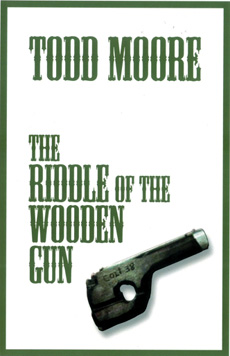
I don’t know what I did when I wrote THE NAME IS DILLINGER. I don’t know what I was doing while I was writing RELENTLESS, THE RIDDLE OF THE WOODEN GUN, or RUSSIAN ROULETTE. I don’t know exactly what I was up to when I was writing DEATH SONG, DILLINGER’S THOMPSON, or THE CORPSE IS DREAMING. All I can say is that I know I did the things I normally do. I worked when I had to work. I drove places when I had to drive. And, I always have to drive even when I’m not going anywhere in particular because motion is always important, poems live on motion, I eat it like candy. I guess I ran errands, I made small talk with strangers, I performed small chores around the house. I let my ghost self do all those things while the dreamer inside worked on the big stuff. And, the dreamer inside is always dreaming. The night is scarred with all of my dreaming.
The dreamer inside is always dreaming even though I don’t always know what the dreams are about. The dreamer inside is always dreaming and I think that is why it is so easy for me to slip into the rhythms of a poem like DILLINGER TOOK HIS NAME OFF or THE NIGHT CORPSE. No matter how many different ways I might start or write a poem, the essential rhythms of a poem are the way that I talk, the way that I dream, the way that I see, and the way that I breathe. I am not exactly sure how they work, I just feel them. And, I know I had them and that they were all working when I started to write THE NAME IS DILLINGER. In fact, these essential rhythms had probably been there inside me all along. Maybe from the very beginning. They just needed to be teased into the dream and the explosion of a poem like DILLINGER.
And, yet, the fact that they are there, that they all somehow work like some kind of psychic engine I can start almost any time I want to, does not explain what goes on when I am writing a poem. Writing THE NAME IS DILLINGER was definitely an explosion. Writing THE NIGHT CORPSE was more like listening to a whisper. It came very quickly but the voice I was listening to, and I do listen to some kind of inner voice, was speaking so low and strangely, I had all I could do to pick up all the sounds and nuances of that voice. But as low as it was and as strange as it was, it was as insistent as the voice in any poem I’ve ever written.
While I was writing THE CORPSE IS DREAMING, it occurred to me that the poem was dreaming as well. In fact, almost all the long poems or sections of poems I’ve ever written were dreaming right along with me. And, as peculiar as that sounds, I know that it is true. Poetry is language conjured to the max. Once you start calling that kind of language down into a poem, the poem begins to assume its own personality and it starts to tell you things you never really knew before the writing began. That’s why almost all major poems are double dreams. A poem’s first dream is the way that you write it. A poem’s second dream is how it knows what it is.
And, when you create a huge character for a poem, you are thrust into the center of starting a fire. You are thrust directly into the center of starting a fire and you have no idea how big that fire will be until it blows the hurricane wind of itself into the heart of the poem. This makes me think of the great characters like Achilles, Odysseus, Hamlet, Lear, Faust, Ahab. These are the fires that have been burning almost since the beginning of time. These are the fires that, independent of their creators, continue to burn.
I’m not sure how Cormac McCarthy felt when he created Judge Holden for BLOOD MERIDIAN, but I know how I felt when I realized all the implications for a character like Dillinger. I knew in my dreams and I knew in my blood and I knew in my soul that Dillinger was not going to be any ordinary criminal. There was something in this man and in his violences and in his lunge toward celebrity that somehow defined america darkly. I knew even before I wrote THE NAME IS DILLINGER that he was mythic, that he was legend, that he was archetypal, the stuff that the dark side of america was longing for, is still longing for. If Russia’s dark side begins with Raskolnikov, if France’s dark side is illuminated with writers like Villon and Genet, then america’s dark side is nothing without Dillinger.
Not so much the historical Dillinger. That’s what biographers and cultural historians do. The Dillinger I write about, the Dillinger I create, comes directly out of america’s dark night of the outlaw soul. I may include some history when it is convenient but what I want is Dillinger’s essence. His style, his vision, his skin, his blood. I want his version of the american dream. I want his fantasy and drive toward american fame. I want his energy, I want his movie star lust, I want the fires that consume him. And, I’ll take nothing less than the sum of all these.
The entire time I’ve been working on DILLINGER I’ve been sitting at the center of the biggest bonfire ever. I sit there writing and the flames can’t burn me.
Maybe every forty or fifty years something happens in a culture, something so mysterious and subversive and fucked up it almost goes unnoticed at first. Every forty or fifty years something happens; it might be an earthquake but you can hardly feel it at first because it comes from some place deep down in the earth and deep down in the psyche. Something like a kind of bone cracking longing. You can feel it but you can’t hear it. You can feel the earth’s tectonic plates move a little, just a little, but a little is all that’s really required. You can put your ear to the earth and maybe hear it coming like some kind of crazy freight train that no longer needs any tracks. But you know it’s coming. You know in your blood that it’s coming and nothing can stop it.
And, at the same time, you know that it’s already here. What you have been listening to is your own ghost dance death song to the universe. It’s a song that doesn’t have any words but you somehow know that it’s going to get words, it’s going to get words that will work with a vengeance and with horrific ecstasy. This is what makes it Outlaw. This is what makes it dangerous. This is what makes it quintessentially american, bad to the bone blood honest and we haven’t had that kind of honesty in this culture or in poetry in a very long time.
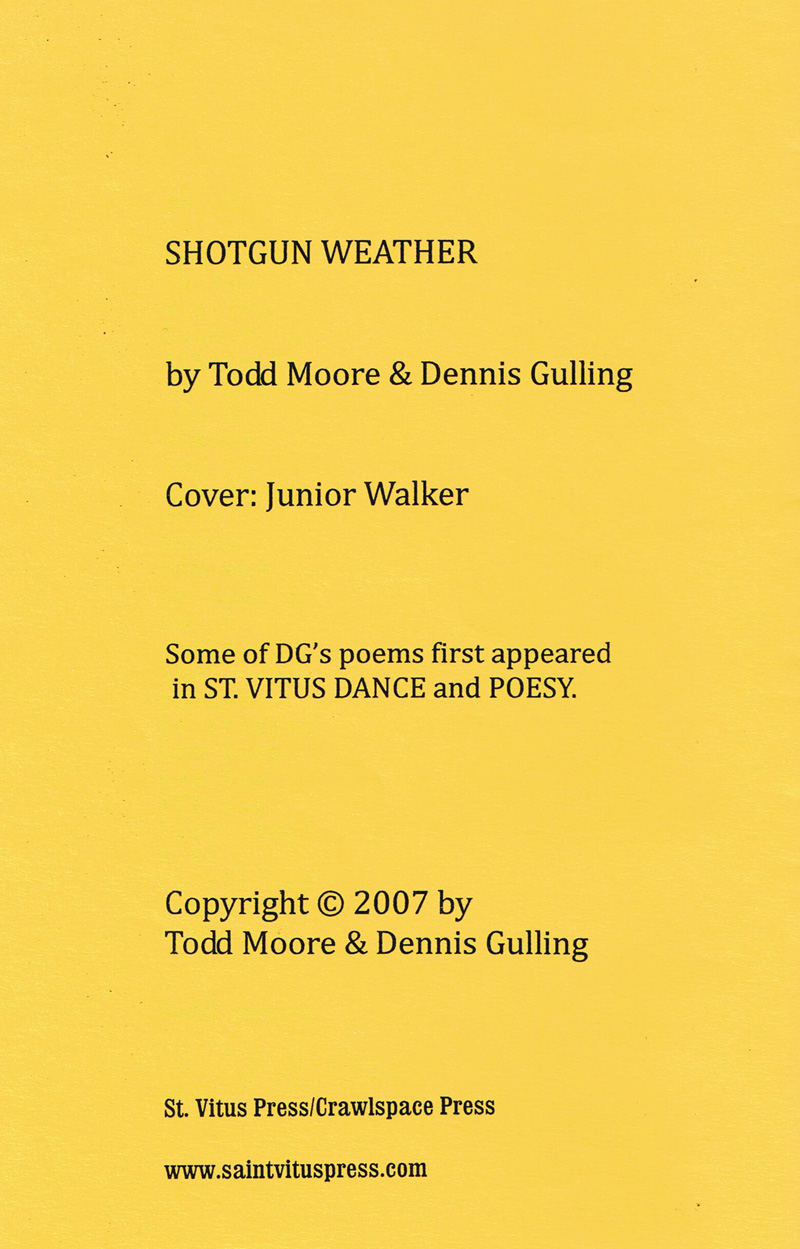
Danger is the key and danger is the dream and danger is the Outlaw alphabet. And, all of this is the essence of Outlaw. And, it is so badly needed in the white bread culture we find ourselves trapped in. White bread because the poetry has gone whiney tame cowardly dishonest and stutteringly sour. Cowardly because the writing degree schools have had a lock on it for so long, so boringly so achingly long. The only thing that can cure it is a good dose of Outlaw Poetry. A good dose of Dennis Gulling. A good dose of the visceral from his opening poem, Burning, from SHOTGUN WEATHER, where a woman has just set fire to a car with her boyfriend in it. Gulling’s poems work like sound bytes from Jim Thompson’s novels. Gulling’s poem is a soul camera aimed right at the heart of the psyche.
About 2 in the morning
Marlene’s mama
Unloaded her shotgun
Into Harlan’s guts
by Dennis Gullin from Harlan.
What Gulling knows is that we all live in an irrational universe. A place where you can get laid or get killed in a car, shot to death in a kitchen, beaten to death while taking a shit or you can find a blown off arm in the street. Gulling’s world is never nice but it’s honest and that is what Outlaw is all about. Baudelaire would have loved Outlaw. Maybe Baudelaire invented Outlaw. Gulling knows where the town is. Garrison Keillor doesn’t live there. Maybe never did. Billy Collins doesn’t live there. And, probably never will. Robert Pinsky doesn’t live there. Very likely doesn’t have the guts to. But I do. I know those cars and I know those streets and I have heard the sounds of those guns.
We live in a time when the official stance is to keep the Outlaw locked away in the cellar. He’s good to go down there just as long as the cellar door is padlocked and that bad boy never gets out, we don’t want his scurvy ass out and free in society because you don’t know what he’s capable of. The problem is we have lived in a latte world so long we don’t really know what white lightning is. The problem is we have lived in a polite movie thriller world so long, we have denied the real Outlaw. He’s been shoved down in the mud of the id but I dare you to keep him there.
The question is what’s going to happen when the Outlaw can no longer be denied? The problem is what’s going to happen when that Outlaw in the cellar becomes so dynamite powerful, so homicidally so darkly irresistible he blows the padlock off the cellar doors, he blows the cellar doors to smithereens, he blows the doorway off the house, and then he blows the house to hell and gone. Then what? That’s when you build the big bonfire out of the timbers of your house. You scorch somores on splintered sticks that came off your bed. That’s when you get the ghost dance going full throttle. And, yeah I know, I stole part of this idea right off Allen Ginsberg, but so what? I’d steal Ginsberg’s eyes right out of his skull if I could. I’d steal Slinger’s pistol if I could find it. I’d jack Chigurh’s quarter but Cormac McCarthy has already stuck it into a hundred and fifty year old tree crotch where Doc Holliday used to have long conversations with Death somewhere down in Old Town, down in Deadstown where all the ghosts hang out and play.
The darkness in america is so juicy rotten ripe you can pick it off the trees and eat it. The darkness in america is so lethal sweet and badass nasty you can smell it even before you get to the tree. The darkness in america is there for the picking but the mfa poets are mostly too chicken shit to venture a taste, it takes an Outlaw to give it a try, eat it root, juice, and all.
Because that’s where we are right now in america. We live a culture where what passes for poetry could easily be flushed down the toilet along with all the other shit on a daily basis and never missed because it stands for nothing. And, when a culture’s poetry stands for nothing, that is a sign that the culture itself is already starting to take an apocalyptic slide toward the shithouse of oblivion. It’s already tanking and the pundits are just waiting for it to go it’s an apocalyptic joke and the fuckers wanna see it take the ultimate fall.
And, that ladies and gents, is why it’s time for Outlaw. That’s why it’s almost past time. That’s why I read Dennis Gulling and that’s why I read Miles J. Bell and that’s why I read Tim Wells and that’s why I read John Dorsey and that’s why I read Misti Rainwater-Lites and that’s why I read Raindog Armstrong and that’s why I read Christopher Robin and that’s why I read S. A. Griffin and that’s why I read Ron Androla and that’s why I read Kell Robertson, and that’s why I read Theron Moore, and that’s why I read Tony Moffeit.
virus history flickers
incurably
inside my heart.
by S. A. Griffin from The Apes of Wrath
beam. straight shots. pieces
of my teeth are breaking
off…
by Ron Androla from Hangover Ode
Step out, gunslinger cool
sharp personal killers
by KellRobertson
from Blues After A Western Movie
The girl in the Playboy interview said,
“I like doggy with a finger in the butt.”
by Joe Pachinko
from Doggy With A Finger In The Butt
I’m walking down the deadline in Dodge City, Kansas. For the uninitiated, that’s the railroad tracks. It was the line between the good saloons and brothels and the bad saloons and brothels. On a good day you can smell the deathshit odor blowing in off the stockyards. On a bad day you can smell the deathshit odor blowing in off the stockyards. And you can walk wrapped in a Dodge City dead man gunfighter blackwind stinking of cyclones, ghost dance shirts, gunfire, and blood. It’s still there and it’s full of Outlaw which is also american mythic and american haunted and it is blowing just for you. Because, this amigo, is your america whether you like it or not.
“Test me, see if I can take it, lay your language on my/sandwich and I will most assuredly eat it all, paper, too…” This a line from Scott Wannberg’s poem entitled “I’m just a gangster at heart.” And, apparently, he took the title from an HBO movie. Which is entirely appropriate because the lines from movies are there and ripe for the taking. They’re begging for it, they’re screaming for it. If it weren’t for fabulous those movie lines there would be no conversation in america, there would be no poetry in america. Maybe there would be no america. If it weren’t for Outlaw Poetry there would be no psychic risk in america. Nada, zip, the everlasting zero added to the zero. Just more stutter to add to the stutter. Outlaw Poetry is here to change that. Or, at least to kick safe and polite language in the ass just to hear it squeal. Like the man says, oink, oink, motherfucker.
John Macker’sADVENTURES IN THE GUNTRADE opened a second front for Outlaw Poetry in america. DILLINGER has always been the first front. Along with Tony Moffeit’s Billy the Kid cycle, Kell Robertson’s A HORSE CALLED DESPERATION, and Dennis Gulling’s Illinois Death Trip poems. (My designation, not his.) GUNTRADE is Macker’s bid for long poem recognition. WOMAN OF THE DISTURBED EARTH is an interim work. Mythically the poems operate on something like the same level, but these poems are more personal, work autobiographically in a landscape that he knows well and dreams of often. His predecessors and influences show up in these poems. Ed Dorn, Sam Peckinpah, Gregory Corso, Ted Berrigan, Robert Creeley, they’re all here, the usual, the extraordinary suspects. My favorite poems are Peckinpah’s Typewriter and the title poem, Woman Of The Disturbed Earth. To borrow a few words to describe Peckinpah’s Typewriter, the poem is really a snake bit tequila lyric with all the energy flowing out and away to the land surrounding Macker’s house and then back. Whether or not that old typewriter Macker found in his back yard actually belonged to Peckinpah doesn’t matter. The fact that that chunk of rust and shattered keys could be raised to the level of myth and even archetype makes the poem the masterpiece that it is. John Macker is one of the original Outlaw voices in america. And while he writes in and of the southwest, Macker’s work is ultimately american and absolutely Outlaw.GUNTRADE is only the beginning.
Mark Weber’s poetry mines a vein somewhere between Mark Twain and John Steinbeck. His body of work teases and flaunts the whole idea of writing school craft and English department allusion. Weber’s tradition is a combination of feisty celtic, L. A. moxie, jazz joint hip, Bakersfield Okie. He reminds me of a guy I used to know who liked to slug down the Beam and every so often say, “Fuck you, I’m an Okie.” Not that Mark Weber drinks anymore, he doesn’t. But he doesn’t take shit off of anyone. Especially the second raters who use poetry politics to promote themselves rather than concentrating on the writing of the poem.
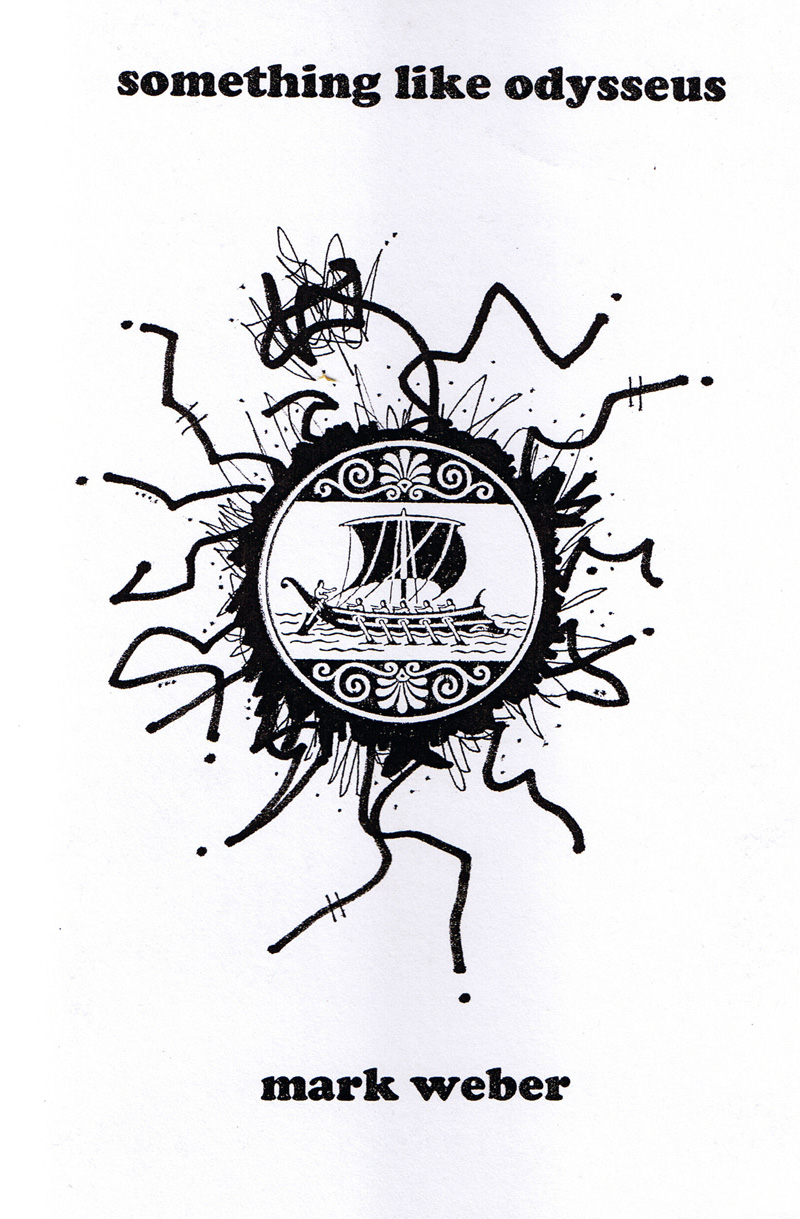
Weber’s masterwork isPLAIN OLD BOOGIE LONG DIVISION. I can’t think of another contemporary book of poetry in america that even comes close to it in style because nobody sounds like Mark Weber. If that’s style, then he has it in spades. If that is voice, then Mark Weber’s sound is so totally sideways fantastic and so wonderfully american that it is gorgeously unmistakable. As unmistakable as Charles Bukowski or Ernest Hemingway. If I had to quote one line of Mark Weber’s, it would be, “he said, while hawking a loogy into the cuspidor with exactitude.” That’s from “SOMETHING LIKE ODYSSEUS, one of Weber’s recent chapbooks. Every time I read that line I crack up.
Mark Weber has played and continues to play a major role as the producer of theZerx recording label and press. If anyone ever attempts to write a history of music composition and production in the southwest, that historian will have to deal with the huge part that Weber has played as a musician, song writer, composer, photographer, jazz and blues historian, laid back deejay and ultimately a kind of super human clearing house for whatever american music is in the latter part of the twentieth century and the first part of the twenty first century. His contribution is mammoth. It registers somewhere around the promethean and genius level. His contribution to jazz and to Outlaw Poetry is without a doubt incalculable. The only way I can approach what Weber has done is to say imagine Frank O’Hara as both an important poet and an important visual artist (not) and you will understand where I am going with this. Because of Mark Weber, the axis, the focus, the energy of the L.A. jazz and poetry scene has somehow shifted from L.A. to New Mexico. That doesn’t mean that there isn’t any poetry or jazz action in L.A. anymore. There is and it’s always at the top of its game. But, the Outlaw action is nearly solidly located in the american southwest. And, that Outlaw action is becoming one of the defining moments for american culture. Because the Outlaw Poet spreads his energy and his genius and his shadow over everything.
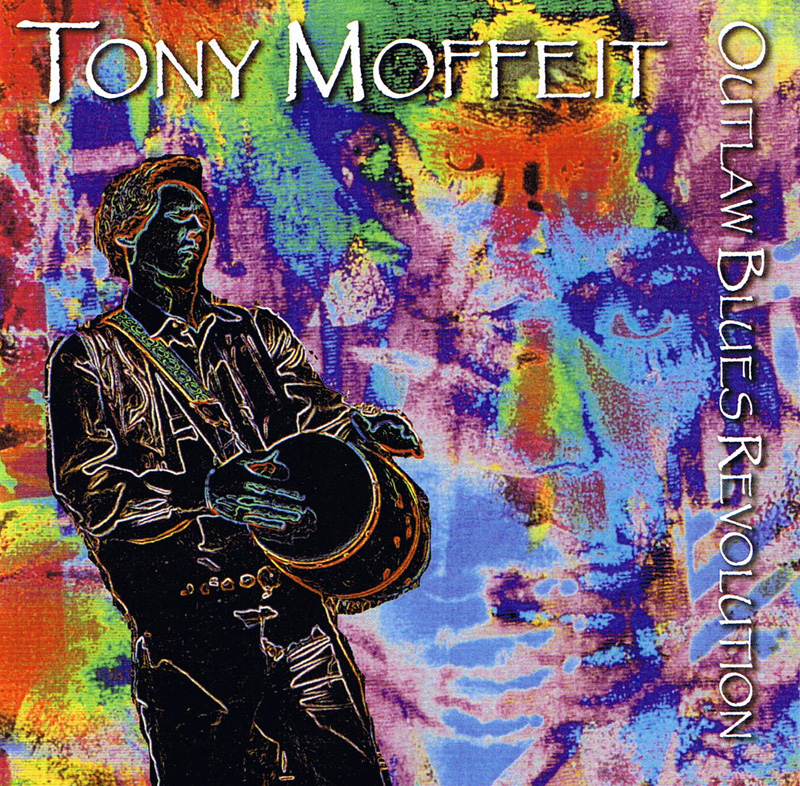
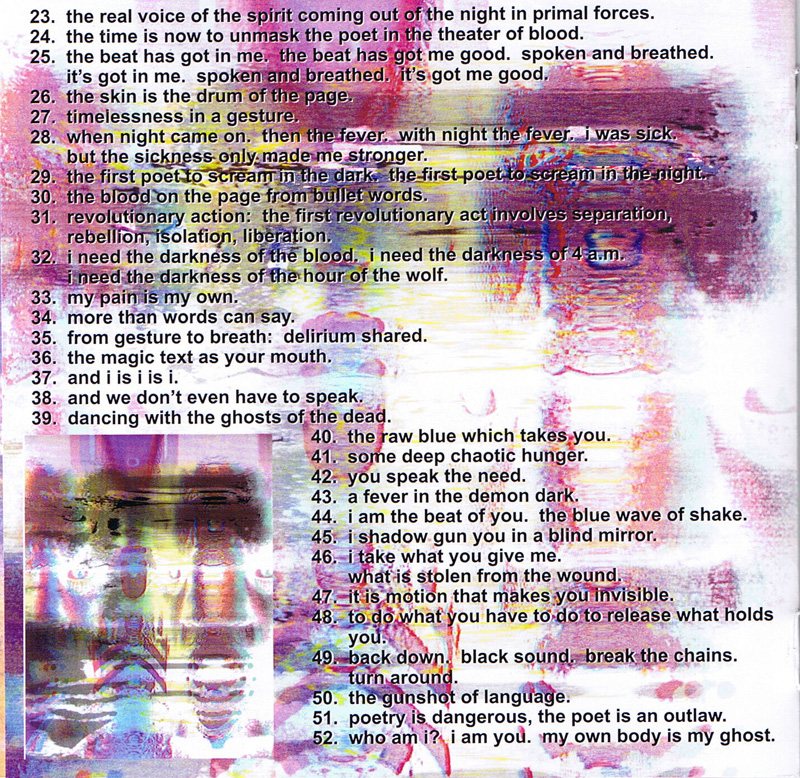
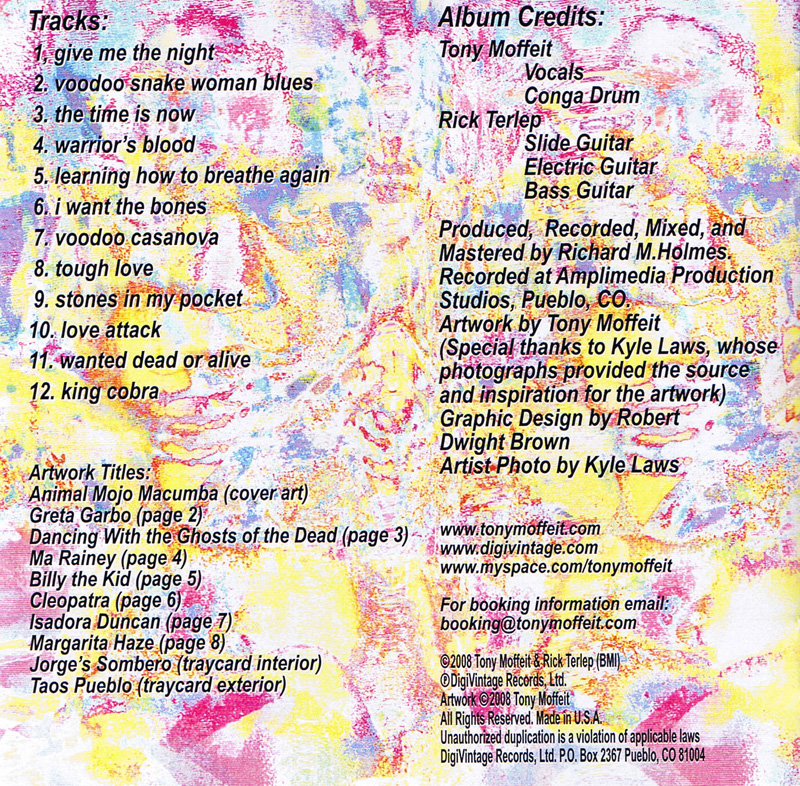
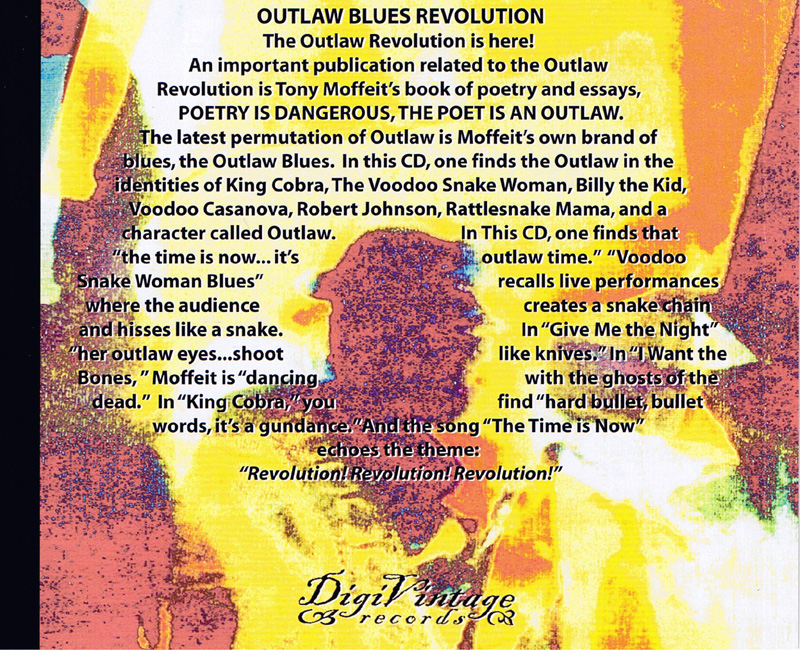
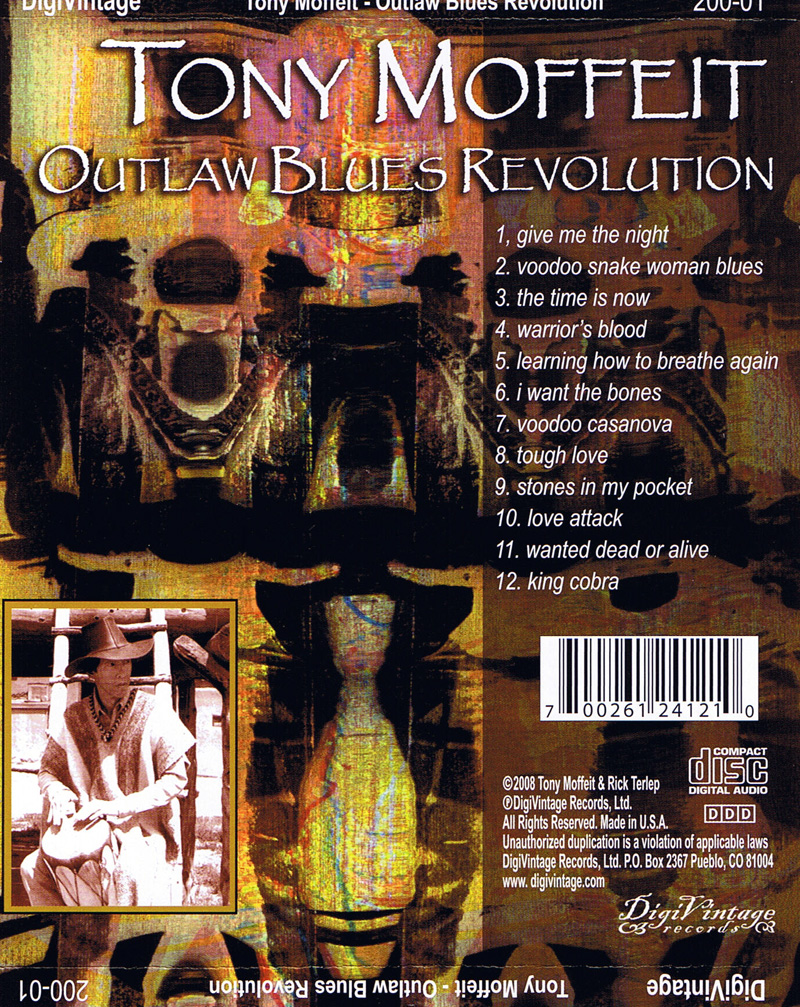
The portrait of the Outlaw is not complete without the necessary image and duende of Tony Moffeit. I could mentionPOETRY IS DANGEOUS, THE POET IS AN OUTLAW, as being one of the important founding texts of Outlaw Poetry. I could mention PUEBLO BLUES, LUMINOUS ANIMAL, NEON PEPPERS. I could write that BLUES FOR BILLY THE KID is Moffeit’s ongoing apocalyptic novel journey into the interior of the darkly affable Billy and also himself. If Vladimir Mayakovsky were writing a novel about The Kid this would be it. Because it takes a kind of hyper punk duende to produce a book like this. And, it takes a hyper punk duende souped to the max to make a cd like OUTLAW BLUES REVOLUTION.
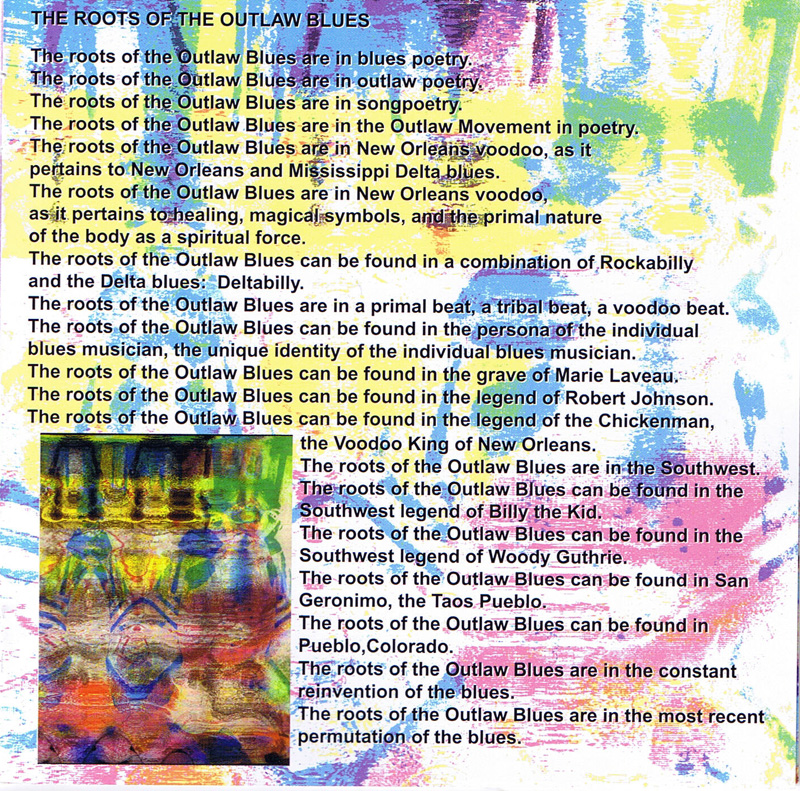
For as long as I’ve known Tony Moffeit, I’ve also been very much aware that as well as writing poetry, Moffeit performs his poems and writes original songs as well. His influences are almost too numerous to mention but try Hank Williams, Johnny Cash, Elvis Presley, Robert Johnson, Bob Dylan and you’ll almost certainly come close. However, Moffeit is no wannabe and I think he masterfully demonstrates that with this cd. OUTLAW REVOLUTION BLUESconsists of twelve very tightly written blues songs and they are all sung in the fire scorched voice of Tony Moffeit. It’s difficult to accurately describe the way he sounds. But, it reminds me of the way burnt blood would sound if it had a voice to describe what it was. Burnt blood, seared blood, scorched blood, the stuff that Lorca was puking up when that last slug hit him. The spit coming out of Hank Williams’ mouth when he died in the back seat of that caddy. This is the human voice sand papered, sliced, diced, and all scratched to hell.
listen to Tony Moffeit | give me the night
If
you asked me to pick out a favorite cut on this cd I couldn’t do it, though I do love “I want the bones,” “voodoo casanova,” “wanted dead or alive,” “give me the night,” “stones in my pocket.” But the energy level for the entire cd holds up all the way through. This is the kind of music that just doesn’t play itself out for you to be entertaining. It’s not wallpaper music, it’s not casual listening. This is the kind of music you can drink to in a nearly dark room. And, darkness really is the way you should listen to this music because it is all about darkness, it is all about Outlaw, it is all about driving right to the edge of the edge of america.
The key to OUTLAW BLUES REVOLUTION is that it really isn’t just about itself as a blues cd. What it is is a blues duende, a gravel on gravel sound of where america is right now. Where we all are. The shit and the glory. The railroad track deadline in Dodge City, Kansas, Pirates Alley in New Orleans where Chicken Man has conjured himself back for one more go round, lightning bolts streaking adobe walls in Taos. “The real revolution lies deeper.” This is a line from the Tough Love cut. And, this is also the essence of Outlaw.
OUTLAW BLUES REVOLUTION, like ADVENTURES IN THE GUNTRADE, like PLAIN OLD BOOGIE LONG DIVISION, like DILLINGER, is a watershed moment in the Outlaw Revolution, one of the definitions that america has been waiting for all of its badass drifter history. Rick Terlep plays his heart and guts out on Outlaw guitar. He burns down the songs. Fifteen bucks is a small price to pay for all the dark miracles on that Outlaw ride.
The sound of the gunfire was more like a firecracker going off, a quick sharp crack and then nothing. A second before the bullet cutting the air near my ear was a discourteous whisper, not so much a hiss as a low whistle. I turned around to see who shot at me and either saw a blurred darkness or maybe a large dog cutting through the narrow space between two garages. I ran back to get a better look and saw nothing.
Death was there standing in the shadows. Not the skeleton image of death that we all know but something other maybe wearing ripped jeans, something with the face of a drifter, its hair partly ripped away and hanging sideways, just off the eyes. Maybe Death as an archetypal image but not the kind usually thought of. This image of Death is also so real.
The skin on the forehead is torn straight across and has a place where I could stick my finger in if I wanted, but I don’t because once I give in to that temptation who knows what could come next. The archetype of Death just standing there as I walk past, smiling with all of its front teeth pouring through its lips. It holds its hand out to offer me a bone. I almost accept it.
Somebody once asked me if maybe DILLINGER was a long nightmare I’d been having for the past thirty five years. Maybe he was right. Maybe what I’ve been doing is dreaming of Dillinger and then putting him into a series of poems. Pound is reported to have said that THE CANTOS was a long poem with some history in it. With me, DILLINGER is a long poem with a great deal of mystery in it. But, it isn’t the kind of mystery that a private eye could solve.
If DILLINGER is anything it’s been a history of explosions. And, it has also been a saga of creation myths. The writing of DILLINGER encompasses the explosions. Writing about DILLINGER includes the creation myths. And every time I write something new about the writing of DILLINGER I add a variation to what I’ve already written. An interviewer once asked me which story is true about how I started to write this poem. My answer was they’re all true. Or, maybe they’re all false. Some days one version seems truer than the others. In some ways, the writing of DILLINGER became a poem unto itself.
Maybe the greatest mystery of DILLINGER is the one surrounding the archetype of the american outlaw. Dillinger the man may have been many things in his life, but the one thing that he became in this poem is an archetype, the representative american outlaw. Dillinger’s career as an outlaw lasted just a little over a year. And, Dillinger as an archetypal outlaw has lasted for more than seventy years and the reason for that is that somehow in this culture he has become a cultural as well as a historical outlaw.
I’ve lost count as to the number of films that have been made about Dillinger’s life and the number of novels and biographies that have been published about him, not to mention the articles, stories, and references to him in books not necessarily about him. This alone would be enough to ensure Dillinger an infamous immortality.
Many, but not all, great archetypes were once figures from history. Tolstoy’s Napolean from WAR AND PEACE is certainly an archetype as well as a fictional character. Judge Holden really was a southwestern scoundrel and scalp hunter who lived along the U.S. Mexican borderland back in the 1840s. Cormac McCarthy hijacked Holden and transformed him into an american super demon for his novel BLOOD MERIDIAN. Richard Hughes’ portrayal of Hitler in THE FOX IN THE ATT IC works in about the same way. He is both fictional character and certainly the archetype of evil in the twentieth century. Some archetypes are strictly fictional invention. Huck Finn, Captain Ahab, Jay Gatsby fall into this category. And, as archetypes as well as fictional characters, they somehow become more than just figures in their respective novels. They become catchwords, easy phrases, signals for something else. If you say you are going to pull a Huck Finn, then you are telling me that you are getting ready to Light Out For The Territory. In a way, these kinds of archetypes are not just products of a culture. They mysteriously have a way of summing up that culture as well.
Enter Dillinger. Time for another creation myth. If you asked me just how I had decided to write about Dillinger I wouldn’t be able to tell you. All I could say is that I’d been looking for someone like Dillinger for a very long time. Maybe all my life. I’d experimented with Custer but the chemistry wasn’t there. I’d thought about Harry Houdini and didn’t feel the mojo, but just as soon as I thought of Dillinger, I realized that he was the perfect fit for whatever it was I wanted to do and I really had no idea, no plan for exactly what that was. May I wanted to rob the First National Psychic Bank of America. Who knows, but was just the blue volt jump of it that got me going. Got me all worked up, ghost danced me into the biggest truth or dare of my life.
And, I didn’t know if I could do it, let alone be any kind of poet at all, but I was sure as hell going to give it a try. This was my white whale, this was my raft on the biggest river of all, this was the scalp to end all scalps. The one thing that I did know then more with my gut than with my head was that Dillinger had and continued to have a very powerful charisma that had not gone away with his death. He was sort of like Jesse James or Butch Cassidy. Death had been unable to erase them from the american memory. From the collective american outlaw dream. This is the power that the poet has over Death. Death can claim you, fuck you skin you, kick your diseased and bony ass, but if you are a poet you can create a new archetype that Death can never kill.
It took me a little over three years to tap into that place, that collective. It took me three years of playing a kind of Death Tag with Dillinger before I hit that underground ocean. It took me longer than I thought it would before I was able to take a cold dark drink from the waters of the collective unconscious. And, it was better than any shot of whiskey I ever had, including a jar of white lightning I once shared with my father in law on a sub zero winter afternoon in a hundred year old farmhouse not far from the place where Jesse James passed through on his way to Northfield, Minnesota.
When you drink from the waters of the collective unconscious you almost instantly discover everything. You earn your psychic PHD, you find Maria Sabina’s secret book, you discover the Lost Dutchman Mine of the american soul, you locate Orpingalik’s breath, you earn the ghost dance shirt that was meant just for you, you invent your own personal alphabet, the secret language of who you are. You uncover all of the origins for the greatest of movies. You discover the places where all the nightmares have their beginning. You discover enormous longing, you discover the first garden and the first snake. You discover the face and the voice that you know you should have and you find a way to steal them because they are yours, they have always been yours and theft is the primal ritual for becoming heroic. This is what makes you a poet and this is most certainly what makes you an outlaw.
And, that is where I stole all the lines for The Name Is Dillinger. I stole them at night in a fugitive dream, I found them sticking out of the waters of the collective unconscious like the roots of a tree and I bit a little of that root off and ate it and that’s when the lines started coming, that’s when Dillinger walked out of the shadows and started telling me poems. And, if you don’t believe that story, believe this. When I drank from those waters, Dillinger swam out from a big black wave, fully formed and more than ready to be in my poem. To take it completely over, blood, breath, soil, iron, and stem.
There is no doubt in my mind that Dillinger is an archetypal character and somehow his very presence is a primal definition of what it means to be an american. Dillinger summed up this culture when he was shot down in 1934 and he continues to sum up this culture even today. Up until now, he has somehow eluded his own definition. No film I know of, no book has ever really summed him up. Until now. Most books and films have gone for the easy strokes, the simply lurid, the quick action sequences, the pulp without soul. Just as no book has ever really summed up Hamlet. No book has ever really summed up Ahab. No book has ever really summed up Judge Holden. Or could even come close. Both Dillinger and the Judge are psychic densities, black holes, impenetrable dreams. Just as no book has ever really summed up either Homer’s or Joyce’s Ulysses. Archetypes like these just are. They are the storms that surround us. They exist like lightning, like the wind, like the blackest hurricanes in human memory, like all the sacred mountains of the world. They are undeniably the densest enigmas of themselves, of the darkness plus themselves. Theirs is the darkness that gives poets breath.
After thirty five years I still don’t know Dillinger but I can feel him. I can feel his life force and I can feel his death mojo. Some nights I wear his dreamface and let his dark blood flow through me. I am the song that he sings, he is the skin that I wear. And, those days when I am writing a long section for DILLINGER I know I am lunatic crazy with the way that he talks. The long poem DILLINGER demands nothing less than lunar language with the wild talk so visceral I could put a knife through it just to hear it scream. Somewhere out there in the waters of the collective unconscious Dillinger swims with his BLOOD MERIDIAN brother, Judge Holden. They dive with the sharks and swim in the murder and the ecstasy of the everlasting dream.
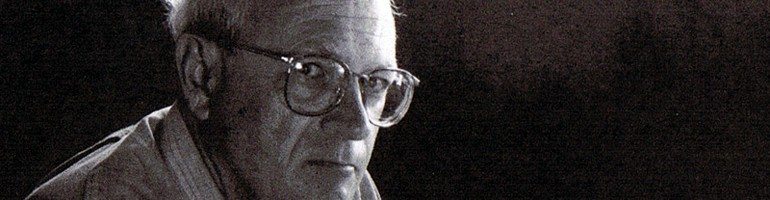
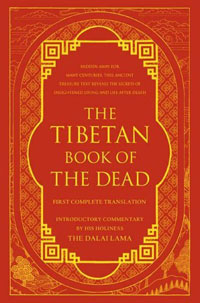


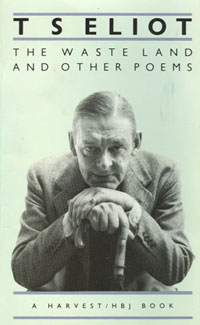
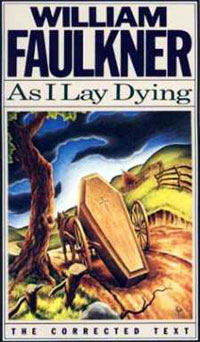
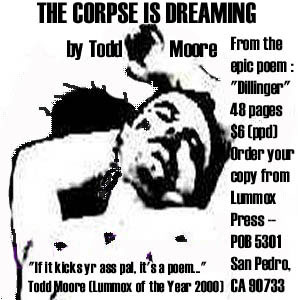 But, that really doesn’t explain Dillinger to me, to my private self. It goes beyond what one critic has called a focused obsession. If Dillinger is anything, he has become part of my exploration into the realm of violence and death. American violence and american death. The Corpse Is Dreaming is my attempt to journey to the underworld of death. I saturated myself with death books to get there. THE TIBETAN BOOK OF THE DEAD, THE BOOK OF REVELATION, THE EGYPTIAN BOOK OF THE DEAD, MOBY DICK, HAMLET, THE BLIND OWL, THE INFERNO, THE WASTE LAND. I wanted to write a death book to rank with those death books. I knew I couldn’t but I tried anyway the way some guys will try to hit eighty or ninety home runs a year the way somebody is going to try to hit in fifty seven or fifty eight or sixty consecutive games so who knows you have to try you have to go up against impossible odds you have to take that shot no matter what and even if you lose you win. As a section of DILLINGER, The Corpse Is Dreaming is unique as a contemporary poem. There is nothing else like it in poetry and the only work that comes close in its final ambition is William Faulkner’s novel AS I LAY DYING.

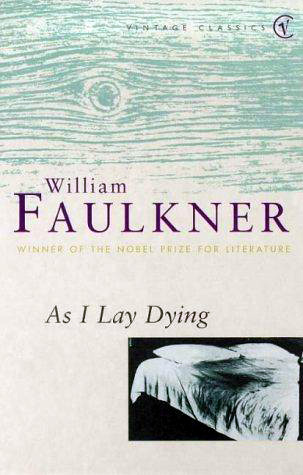 The question is has Cormac McCarthy written the ultimate american outlaw poem? And, yes, this is a strange question in light of the fact that McCarthy has worked almost entirely as a novelist and whatever poetry he has written has very little to do with the issue at hand. However, if, for a moment, we consider McCarthy to be a poet in the very broadest sense of that term, then has he written the ultimate american outlaw poem? The obvious answer is yes, BLOOD MERIDIAN; still, it must inevitably share the stage with
 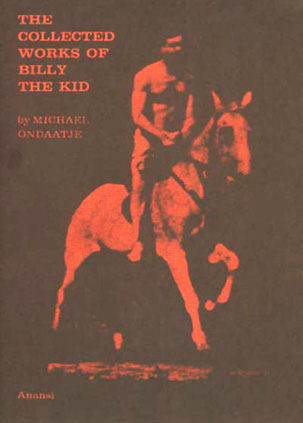 Back to the idea of the ultimate american outlaw poem. Except for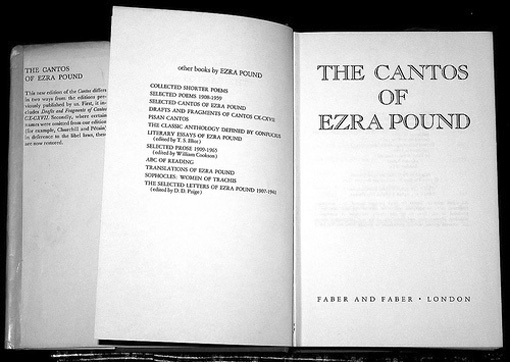
 Before THE CANTOS, there is LEAVES OF GRASS. And, also Dickinson, but she doesn’t mean as much to me as Walt Whitman does. And, if I have to pick just one poem out of LEAVES OF GRASS it would have to be Song Of Myself. When I was writing

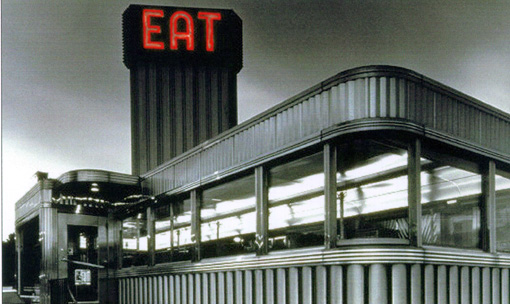



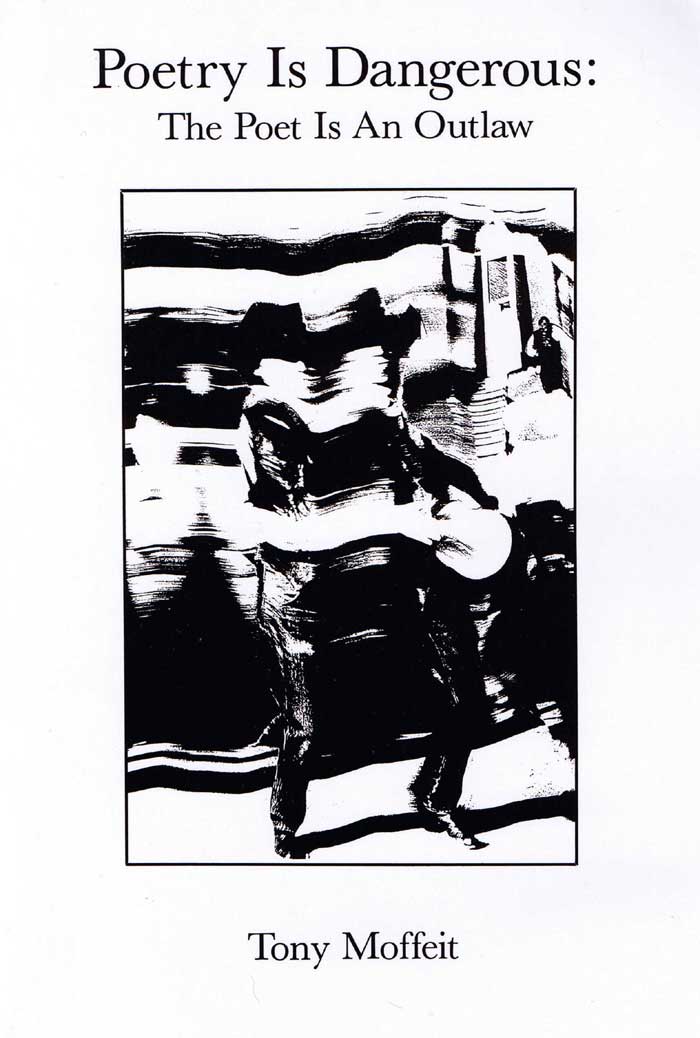
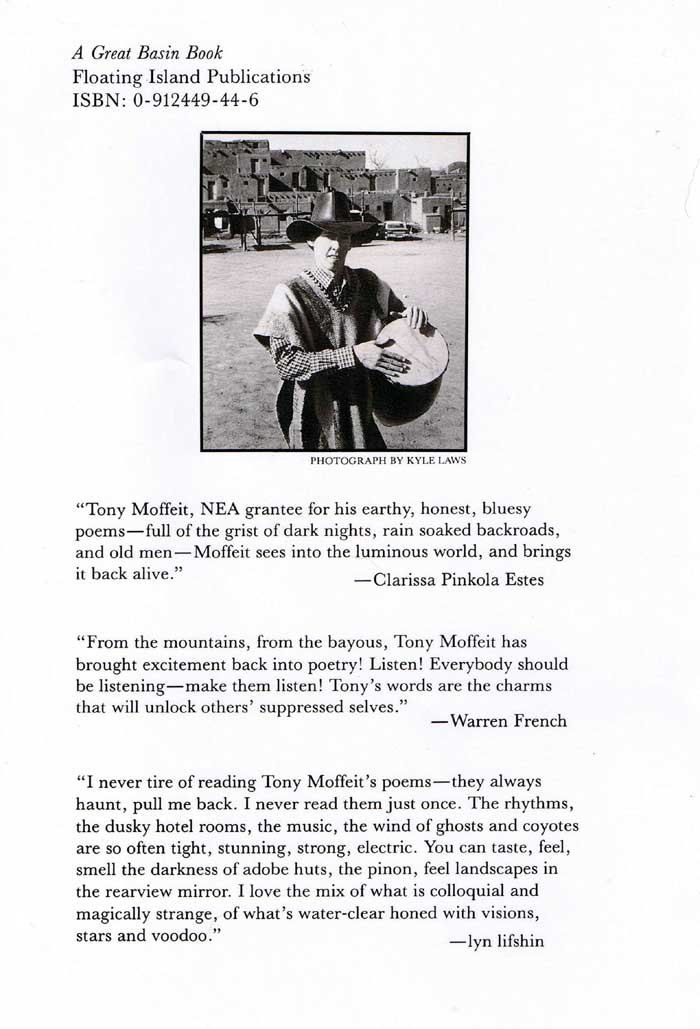
 back in 2004, it wasn’t a spur of the moment thing. We’d had more than twenty years to talk about Outlaw Poetry. We had both written key books both about and of Outlaw Poetry. So, this wasn’t something new. This was not a fluke.