Category Archives: essays by todd moore

scratching it out street level for the poem

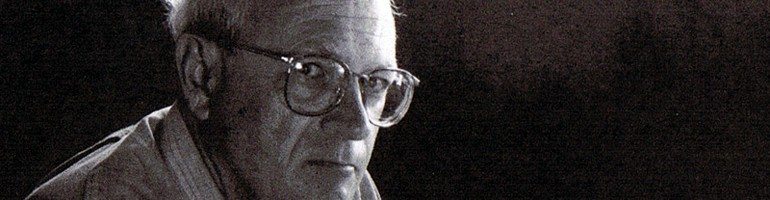
Todd Moore | Photo: Brian Morrisey | manipulated by Monsieur K.

There is nothing more unnerving, nothing more existential, nothing more exhilarating and depressing than reading poetry to a roomful of strangers. I think I can safely say that after having given poetry readings in almost every conceivable situation for nearly forty years. And, the reason I can make such a claim is that no two readings are ever the same. Every reading is different and differs to the extent according to the locale and the room in which it is given.

When Raindog suggested we do a road tour to promote both our books, I thought, why the hell not. It’ll be an adventure. Translated to mean, easy easy easy. But, I didn’t factor in where the readings got booked, the distances between places, the kinds of audiences we might have once we arrived. I was only focused on what I was going to read and how I was going to do it.

At this point I really need to publicly thank Raindog for all of his efforts in putting this road trip together. I also need to thank my wife Barbara for all of her behind the scenes efforts. Without her crucial help, advice, patience, intelligence, and coordination, my part of this tour really wouldn’t have gotten off the ground.

The one thing to keep in mind is that all poetry readings are local. It doesn’t matter if you read poetry in Sitka or in Sacramento, Peoria or Pittsburgh, Milwaukee or The Mill Gallery in Santa Cruz, you are reading in a locality and you are reading to people who mostly live and work in those places. You are also reading to people who, in most cases, are struggling to create a voice and a vision, sometimes at great odds. They may or may not have reached a level of mastery that the visiting poets have attained, but their work their efforts and their love of poetry is often unmatched anywhere. And, everyone I met on this tour was more than friendly in the ways that they reached out to strangers.

Reading poetry in america is like running the gauntlet. Reading poetry in america is like trying to perform Mozart on streetcorners with pennywhistles. Reading poetry in america is like trying to discuss art or aesthetics in a pool hall. It’s tough. It’s tough because american culture is essentially redneck roughneck and not at all conducive to polite conversation. America’s conversation is anything but polite. It’s rough house, it’s kickass, it’s balls out, it’s risky, it’s visceral. And, it’s where the best poetry comes from. The streets, the alleys, the gin joints, the whore houses, the dives. Raymond Chandler tapped into it, Elmore Leonard is still tapping into it.

Book Soup is one of the quintessential indy bookstores on the Sunset Strip in Los Angeles. I’m told it’s very difficult to get booked to read there. It’s a great place to get lost in. I love the way the store reeks of books. You can’t miss it when you come through the door. It’s my kind of bookstore. The only problem was that the minute I walked into the place I saw a couple of familiar faces so I had almost no time to get ready for the reading or look for books. Which is really something I have no business complaining about because I have never been good at getting ready for a reading. I might look at a couple of poems and maybe mark off a dozen or so poems I plan to read, but rehearsal has never been my forte. I like a reading to be of the moment. My excuse has always been, well, I wrote the goddam book, so why shouldn’t I know it. Call it arrogance or call it just simply being lazy.

Half an hour before the reading Barbara, Raindog, Geoff Farr, and I retired to a coffee shop across the street for a little more small talk. Situations like that always loosen me up. I knew what was coming anyway. Whenever I give a reading it always comes down to getting out of my chair and somehow making my way to the podium or whatever serves as the center of the reading area where hopefully I will be able to stand up straight and pray to god or whatever demons may be in possession of the room I might just somehow deliver my lines. It’s not a matter of nerves. I never get stage fright. What it comes down to is just simply putting myself in a zone where I can handle the language. Most good poems are filled with a kind of rapacious ungovernable power. You either gain control of that power during a reading or you will not be able to read. It’s really as simple as that.

This is that part of a poetry reading where you struggle to gain mastery over your own psyche. It never changes. It didn’t change in Berkeley, it didn’t change in San Francisco at the Amnesia Café where the whole thing could have gone sideways into a shot and beer disaster, it didn’t change in Luna’s Café or at the Mill Gallery. The way this whole thing works goes something like this. Imagine that you are a jockey and you are riding a thoroughbred and you are plunging out of a gate in a horse race. The horse is the poem and you have to gain control of the poem. Once you have control, that horse which is the energy will do anything you want it to.

The Book Soup reading went smooth to a small audience. The Berkeley reading had more power in it and I worked to the silence of that crowd in Priya’s Cuisine. I always know when a reading is going well because the room gets so quiet I can almost hear what people are thinking. And, I can make it get quiet. Bukowski worked his room through his heckling and schtick. I work my room by just letting the primal power of the poem take the audience where I want it to go. And, I never think about whoever else will be reading because when I am reading I own the room.

And, then there was the Amnesia Café. Amnesia is a bar. It’s the kind of bar my old man might have hung out in. Strictly, beer, mixed drinks, shots. Part of the trouble was we arrived a little late. The readings are scheduled for seven p.m. and last until seven thirty. No deviation from these rules. I entered first and was met by one of the bartenders who asked who I was and said I better get up on the stage because the clock was running. I climbed the few steps to the stage with Raindog right after. Pale light, red walls, black air. The photos reflect a larger space than I thought and now that I think about it the walls aren’t red but they felt like it at the time. Raindog read first.

I was next and by the time I finished I hated myself, the joint I was reading in, and practically everything else. It wasn’t that I fucked anything up. Instead, it just felt like a goddam train wreck from the second it started. It just felt off, wrong, goofy, dicey, and fake. The crowd must’ve liked it because we were asked to read a little longer, but I couldn’t wait to get the hell off that stage. And, I’m not talking about Raindog’s reading. His went fine. I’m talking about mine. Sometimes when I do a reading, I can read all the lines just right, get the feel of the poem out there, and still I know that somewhere in that mix I blew it, I pissed it away, somewhere the darkness ate up all of my words and there was nothing I could do about it.

Outside, someone introduced me to Neeli Cherkovski and I thought, this is one helluva way to meet this guy. Not long after, we went back to the little greek tapas place where we had a light dinner. I wanted to slug down a large glass of wine in the worst way but stuck to some shitty orangeade.

The next reading up was Luna’s Café in Sacramento. We got to Luna’s half an hour before the reading started and sat through three hours of open mike and contributors reading from a zine called WTF or What The Fuck. I think I finally made it to the stage around ten.

Like I said before, I never get stage fright but there is that moment while being introduced or during those seconds when I am on my way to the mike that I want to be somewhere else. I want to be driving someplace out in the mountains or I want to be halfway down the street or I want to be at the movies hunched way down in my seat. It isn’t so much panic as it is a kind of disgust about the way I just might fuck it all up. I could be that white rap poet who fucked up everything he read just before me. But I also know that won’t happen. At the crucial moment something from way back inside takes over and then I’m just the driver waiting for the directions.

Luna’s was filled practically to capacity though some of the WTFers and their friends left once they’d read. I consider these kinds of people tourists, they really have no fucking idea of what poetry scraped off a human vein really is. This was the fourth reading on the tour and I was beginning to feel it. And, I’m not exactly sure how but once you are out there on whatever tour you are on, there is a feeling of grayness that begins to permeate the atmosphere. It’s almost like psychic poison, or maybe the strontium 90 of nightmare exhaustion. You’ve read the same poem four or five times and no matter how you change the phrasing, it’s still going to fuck with you. It’s going to play it’s little head tricks with what’s left of the mush of your brain.

That night I slowed the pacing down a bit and really looked out at the audience. I took my time in glancing around. I took quick and yet prolonged looks at people’s faces. I let each poem have its own little carved out space. And, when I read a poem I let it settle its weight down in the air. I was taking larger risks now. I even had a few people tell me later they’d never heard poems read that deliberately before.

Friday after a leisurely breakfast at a local restaurant, Raindog, Barbara, and I set out for Santa Cruz. This was the one reading I’d been looking forward to since I knew so many of the people who’d organized it. But somehow during that car trip back, I began to grow deathly ill. I’m not sure if it was something I’d eaten or if this was some illness I’d caught along the way or if it was a really nasty ulcer attack or if it was possibly all of those scenarios with sheer exhaustion thrown in for good measure. Whatever it was, the moment I got to my room I went to bed and slept until the reading.

A half hour before the reading, I somehow stumbled into my clothes, grabbed the briefcase where I carried my books and lurched out. The Mill Gallery is one of those stark modern galleries filled with all kinds of fascinating images. Normally I would have walked around and looked at everything. Not this night. Instead, I was trying to decide if I would vomit shortly before or after the reading. Or, would I puke during the reading and if so which way should I turn so that I wouldn’t hit anyone or get anything on the video equipment scattered around the space where I was to read. And, the toilets were on the main floor and I was on the second floor, far too long a distance to run in case I had to.

I tried to say something to Joe Pachinko and Christopher Robin but it felt like all of my words were dropping on the floor like so much spit leaking out of my mouth. I had to lean on the balcony railing to support myself and wondered what the fuck I was going to do.

I asked Brian Morrisey if I could read first and he was kind enough to let me go on. And, somehow, I don’t know how I was able to get through the entire reading without vomiting. That came much later that evening. I can only guess what I looked like. I realized that I had to change the whole style radically, so I read sitting down. If I hadn’t I think I would’ve fallen down. I know that Bukowski always ritualistically threw up before every reading but not me. I hate throwing up. It messes with all the body’s natural rhythms. And, it can even fuck with the voice.

When I started to read I slowed everything even farther down than the night before. I’d pretty much decided I wanted to hear myself this time so I read to myself. I could hear all the cadences slowly come out of my mouth. Every word lingered right in front of me in the air like a piece of half rotten fruit. And, I almost milked the sounds even as sick as I was. It was almost like doing a cheap version of reader’s theater. Now, I had become my own interpretation of a third rate actor. Still, somehow I made it. I sprawled into the car that took me back and then spent the night dreaming I was reading fragments of poems to all of the hotel room’s resident demons.

Was the tour a success? Hell, I wouldn’t know. I took a piss at Vesuvios, bought some books at City Lights, briefly looked at the Pacific and puked my guts out at the Dream Inn. Otherwise, I was scratching it out street level for the poem.

Todd Moore | Photo: Brian Morrisey

Leave a Comment

Filed under essays by todd moore

dillinger, outlaws, writing, and murder


I’m holding a large push dagger made from an old file blade. The grip is wood and it is beginning to rot where it attaches to the sides of an iron knuckle bow. Jutting out of the knuckle bow is an eight inch flat dagger and the weapon is so fashioned that it could be used to punch through the softest part of the gut, the throat, the eye. or the crotch. There is no doubt that this is a murder weapon. It has the word primal written all over it, forged into the corded heart of hammered steel.

And, just what does a push dagger circa 1850 have to do with poetry? Superficially, nothing. Aesthetically, everything. When I read a poem I want it to be something that could scalp me and leave me for dead. I want it to be suffused with the beauty of language and the power of murder. I want it to own me every time I read it, I want it to be unique, unrepeatable and yet absolutely surprising every time I dive into it. I want it to have the same kind of power as a Goya or a prehistoric cave hunting scene. I want it to make my blood shake, monstrously and always.

I want to make it shake homicidally into a coded strut frenzy. I want to make it shake in the heat of the reading because the ritual of writing is symbolic of the ritual of killing. If you want to write you have to get close to the big fires, you have to give yourself up to the big fires of creation and destruction, the blood bubble caught in the dead man’s mouth.

Just the thought of death and poetry and weapons and love sloppy love starts it all going, again. The image of a machine gun gets it all cranked up and then Dillinger is talking. Maybe this is a form of conjuring, I don’t know. What it feels like is a lunatic dancing inside the blood stillness. And then I am trapped in that flogged moment and suddenly I am burning.

I have heard it said that there is a difference between the outlaw and the outlaw poet and that difference is the actual commission of a crime. And, that probably is true most of the time. But there are odd moments when the difference between outlaw and outlaw poet can be less than the width of a single strand of human hair.
I can’t speak for the others here but I know that once I am inside a poem I am lost to the real world. Once I am inside Dillinger’s Thompson or Russian Roulette or The Sign of the Gun or The Riddle of the Wooden Gun I am in the outlaw. I should also add that I am writing the outlaw as well as inside him. That may be the ultimate distinction. However, I should also clarify that when I am both inside the outlaw and writing him I am also reinventing the whole idea of the outlaw. Which permits me to enjoy the violence of the outlaw during the whole process. Which is totally subversive. But, don’t kid yourself, Shakespeare loved it when Hamlet stabbed Claudius. Camus was ecstatic when Meursault blew that Arab away.

What happens is in the fury of the glory and the scream of the writing you get away with it. You actually get away with it. My guess is that Dostoevsky was standing right at the core of R while he brought that axe down on the old woman pawnbroker. Camus stood just inside the opening of Meursault’s black heart while he emptied his revolver into that Arab. And, McCarthy had crawled inside Judge Holden and was sitting all curled up in a fetal position while Holden crushed the kid in the outhouse slop.

Does that mean that as a poet you are truly an outlaw, a felon as well? No. But, you are a kind of metaphysical accomplice. You do two things at the same time. You write and you watch. And, it all gets mixed together into something like CRIME AND PUNISHMENT, THE STRANGER, THE MAN WITHOUT QUALITIES. Moosbrugger is the song of pure murder, an anthem to darkness and you write because you have to watch. You watch because you have to write. It is like a slow waltz with the angel of death. But you can’t help it. And, you wouldn’t even if you could.

In some alternative universe, Dutch Schultz is writing The Killers while Ernest Hemingway puts a point blank slug into Jack Legs Diamond. The only crime the Outlaw Poet can be held accountable for is dreaming the dream for a century of darkness. For a thousand years of nightmares packed into a bullet.

When I wrote Relentless which is the section in DILLINGER about Baby Face Nelson, it was a tight squeeze where I was standing inside him. Each time he breathed his lungs pressed against my chest. Each time his heart beat, it knocked against my rib cage. I could feel the demon flies that he kept trying to brush away. I could feel the way his skin tightened against the bones of his face because his blood swam hard against my cheekbones. I was his claustrophobic shadow, but a shadow that leaned inside him rather than toward the pavement or the floor and away from him. He may not have felt me, or maybe it was only that murderous closeness but I could feel him. I could taste his furious paranoia.

Can you be hanged for inventing a murderer? I don’t think so. But you can be pursued by the Furies. Can you be sentenced to death for creating a paradigm for a whole generation of would be Raskolnikovs or Meursaults or Dillingers? There is no law on the books that would condemn you for this. Could Robert Louis Stevenson even be tried for creating a Mr. Hyde? Not on this earth. And, yet the paradigm or maybe I might get closer by saying the archetype of the murderer still lives on in archetypes like Raskolnikov and Hyde. The archetype of the murderer, the outlaw is the source of all outlaws. There is no escaping this problem. And, if you are an Outlaw Poet then you have to submerge yourself in the outlaw if you want to know anything about the black demonic energy of murder. If you want to drink the sweet swill of violence so you can slam through the dream.

Tony Moffeit knows the taste of Billy the Kid and John Macker knows the sharp stink of scalp hair and the sound of sand in Geronimo’s shaman song and Kell Robertson knows the taste the Gunfighter gets in his mouth just seconds before he gets his gun into play.

Wyatt Earp is shooting Indian Charley Cruz in the forehead and everything goes slo mo while the Indian’s brains blow out the back of his head and in that exploded second while the dead man’s brains are painting the air, Earp knows this is better than a winning poker hand, a gold mine that pays off, or coming inside a pair of night legs. He has already written a poem that he will never write.

In THE GODFATHER when Al Pacino shoots Sterling Hayden in the throat and then the forehead, the entire theater gets very quiet, even more silent than at a communion.

Either as a bit of gossip or maybe the source was an unpublished memoir, Dora Maar is reported to have said that when Picasso was painting Guernica he could experience two things both at the same time. First, he could feel the intense burning of the bombed city and he could hear the screams of those victims who were running on fire through the streets of that furnace. Second, sometimes it felt as though he were flying. He was an enemy pilot looking down on the city and he had that exhilarating moment when the bombs were dropping beneath him and he could seem them disappear through the clouds and emerge on the earth as blown roses. And, each time a rose appeared his skin quivered and his blood shook. But, he kept that part out of the painting. He didn’t want propaganda, he didn’t want to make a political statement. He was able to erase all of those feelings and just keep it completely focused on the blown up part. He wanted to make a painting where the earth was blowing into itself.

And, the ritual of writing is the dreamt performance of murder and the ritual of murder is where all poetry comes from.

Maybe the thing I like most of all about writing DILLINGER is that he gets away with it even though he gets killed in the end. The most liberating thing about this poem is that when he gets away with it, I do too.

Todd Moore | Photo: Pete Jonsson | click to enter Todd Moore’s book store.

2 Comments

Filed under essays by todd moore

taking on bukowski

fistfight

When I was

a kid I used to know a guy who was good with his fists. In fact, I never saw anyone up close as good as he was. He had the footwork, a regular Gene Kelly, he could dance just beyond anyone’s right cross, he never got caught in an upper cut trap. He could see a left coming from a block away. But the real magic was in his fists. He worked them the way Picasso worked the paint brushes, he worked them the way Houdini did padlocks, he worked them the way Hemingway worked the shotguns. And, this guy took on the neighborhood and the best part of it was there was no one who could take him. The only problem was he was a sucker for the easy score. He got caught up in some kind of stick up and got sent to the pen. After that I lost track of him. But while he lasted he was good, he was the best I’d ever seen.

Just like Bukowski.

And, how do you take on someone like Bukowski? I have no doubt that every poet in the small press who has had fantasies of becoming a famous poet has asked himself this question. Because, if you are going to take on Bukowski you have to do it on at least two levels. First, you have to literally take over his style and write better than he does in the way that he does. Second, you have to become even more famous than he is. And, by taking on Bukowski, you also have to dig far back into your own nightmare blood to do it, because taking on Bukowski means this will be the battle of your life.

Now, this sounds

as though you really have a choice in the matter and you don’t. Any old wannabe, even the second raters, can tell you that. Bukowski’s is the kind of influence that is absolutely toxic, once it hits you, you are done for, you are cooked all the way through to the marrow and the neurons. You are his, lock stock and twitch and unless you are strong enough to realize this, you will never have a voice of your own no matter how minor you may become. Getting a taste of what Charles Bukowski could do at his killer best is also like getting a little taste of what you can’t do. It’s a double whammy, like getting bitch slapped with a ten ton truck.

The irony here

is that alive Bukowski was really too good to beat, but dead he is impossible. And, the reason he is impossible is that during the last fifteen years since he died, he has become immortal, one of the poetry gods. Which literally means you can’t beat a dead man, because a dead man can become your very worst demon.

Right now I

can hear the wannabes asking, but how good was he? The first thing to keep in mind is, if you have to ask, you haven’t got a prayer. How good was he? When he was alive had had a lock on the small press. If you weren’t a Buk disciple, and there were more than I could count, the best thing you could do was work on what you were good at and stay focused on your little square of the dirt. Now, that he is dead I’ve noticed that even the establishment has tacitly accepted him as important. And, if you don’t believe me check out some of the more recent poetry anthologies and literary encylopedias. Chances are you’ll find his work and bios more often than not. Which means he has become canonical.

The other question

is how good are you. So far, what have you written that will even get you in the door of small press poetry. Have you written enough important poems that will get you compared to people like John Yamrus, Lyn Lifshin, Mark Weber, Tony Moffeit, John Macker, Raindog Armstrong, S. A. Griffin, Kell Robertson, Gerald Locklin. Have you done anything as supremely outstanding David Lerner’s THE LAST FIVE MILES TO GRACE, Kell Robertson’s A HORSE CALLED DESPERATION, Tony Moffeit’s BLUES FOR BILLY THE KID, Mark Weber’s PLAIN OLD BOOGIE LONG DIVISION, or John Macker’s ADVENTURES IN THE GUNTRADE? If you haven’t hit that level and that level is where the best of it all is, how can you expect to take Bukowski out?

These days I

can pick up almost any small press magazine and immediately find those poets who write like Bukowski. The strangest thing of all is not long ago a young poet sent me a poem about Charles Bukowski. But here is the kicker. He wrote the poem in my style, all short lines, words abbreviated or all broken up. And, I don’t think he even realized it. But, the thing that he indicated is that there are really only two choices with some variations available to most young poets in the small press these days. There is Bukowski who mostly wrote long lined poems with some short line variations or there is me and I write in extreme short lines with a few slightly longer line variations.

In my case,

I’ve never tried to take Bukowski out. Because I know it can’t be done. Just as you can’t take Hemingway out. Just as you can’t take Cormac McCarthy out. What it all comes down to is this. You have to create and then concentrate on your own story and you have to gamble with that story against the void. And, you have to go into this knowing full well that you are fated to lose that fight but in that gamble in that struggle in that dice throw against the bones of the universe, you win because you lose. You win because you made it all a good fight, a brave fight in spite of the zeroes showing against your name.

Someone out there

is asking, what about fame. Yeah, well what about it? Fame or the longing for fame will fuck you worse than anything that I know. Some people get famous and some people don’t. Some poets sweat out their worst fame nightmares at three o’clock in the morning fantasizing about the kind of fame that will never appear, that will never belong to them. If you are human and you write poetry, you also think sometimes about fame. You can’t help it. And you think about Bukowski and his money and his racetrack escapades and his parties and the fact that everyone knew him and he was a celebrity and you think that maybe even if you can’t have fame you can imagine tasting the swill of Bukowski’s fame but in the end if you are the least bit honest you know that doing something like that is nearly as impossible as becoming famous and you resign yourself to dying like Dave Church behind the wheel of a beatup Checker or like Jack Micheline alone on a Bart train or maybe walking out of a bar at one a.m. with that last poem you wrote while the bartender was closing up. Because if you can’t be Bukowski, then maybe you can die the way you have lived, always a little fucked up and against all odds.

1 Comment

Filed under essays by todd moore

the machine gun blood of the poem

I tried

everything I could think of to get a wanted poster of John Dillinger off a kid called Keys Gunther but he wouldn’t budge. The second he showed it to me I wanted it, I wanted it so bad that I broke out in a sweat just thinking about it. Nights I’d go to bed trying to figure ways to get it away from him. Maybe he’d go for a switchblade. Maybe if I upped the ante to two switchblades that might do it. Every time I went over to his house I’d make him get it out. I never got tired of looking at it. He used to say you can look at it but you can’t touch it and all I really wanted to do was touch it, again and again. I wanted to hold it in my hand and run my fingers across Dillinger’s face for luck. Then Keys would add, this belongs to my old man and if he knew I was showing it off like this he’d kick my ass.

Not long

after that, Keys and his old man disappeared. Just skipped town without paying the room rent. My old man said they left a beaten up cardboard suitcase behind with a lot of waste paper inside and I asked if there was maybe a wanted poster mixed in with the junk and he said no but he did find a live 38 round that he gave me. He was tossing it in the air with one hand and catching it with the other when he said, I wish I had the gun this belongs to.

My old

man always wanted the gun and the book. For as long as I’d known him he wanted it all. Once he told me he envied Hemingway but it wasn’t for his books. He was jealous of Hemingway for all the guns he owned. Especially that Thompson that Hemingway used to carry on board the Pilar when he went deep sea fishing. He said he’d seen pictures of it in some big time magazine, maybe Life, and he wanted one, too. I remember my old man fingering a stiff shot of whiskey when he said, if you have a gun like that and you have the book to end all books then you’ve done it, you’re at the top of the game.

I wanted

to write a novel so bad that some nights I’d break out in a very cold sweat. I was twelve years old and I’d seen how thick my old man’s novel was and I wanted one that thick and that important and that magical. I wanted a novel that would knock everyone sideways. I wanted to write a novel that would make a million bucks and take us out of that fleabag hotel. I wanted a novel that I could sell to the movies. I wanted a novel that Humphrey Bogart might star in. I wanted a novel that would be the beginning and the end of all novels. I didn’t know who Faulkner was but if I had I would’ve wanted to knock him on his ass.

I’d watch

my old man take his novel down from a shelf. He kept the manuscript in a red folder that had strings on the sides and he’d untie the strings and lift the typewritten pages out and he’d let them spill across the table like they were cards from a lucky deck that he could shuffle and reshuffle and then he’d square the manuscript into a neat pile and sit down and study it, his cigaret half sprawling half dangling out of the corner of his mouth. And, he’d pull a bottle of Beam across the table almost casually, along with a shot glass and while he was pouring himself a shot he’d say, this is the one, this is numero uno, the number one baby. We’ll all make it big with this one. That never happened.

And, I

wanted to write a novel so bad that even during the day I could feel the heat and the sweat and the desire of that longing flash all the way through me like lightning my blood generated.And, when the dream of writing the novel went south, it got focused on the poem. I wanted to write that one monster mother fucker of a poem, I wanted to write something I didn’t know what but something and it wasn’t until I got Dillinger back that I thought there might just be a ghost of a ghost of a chance. You know the drill. All that underdog shit. That was my story. Maybe it still is.

And, getting

Dillinger back was like getting that wanted poster back only this time it was a thousand times better because I didn’t need to have the wanted poster itself; I had that Dillinger face fried so deeply into my nerve endings and dreams I didn’t need the paper anymore. I could conjure it, I could call down whatever dark energy that Dillinger had and type it out on the page. Like molten lava, like nitro spilling across a sheet of paper before blowing. And, it was much better than all the second rate novels or screenplays swimming around in the culture because somehow I had cracked Dillinger’s voice straight out of the void and it was talking to me. And, it was every bit as good as HIGH SIERRA because it felt like I had hit some kind of raw tornout vein in the nightmare of america, I had hit the big one and it didn’t matter that most people don’t read poetry, this was still the bone on bone raw stuff that most poets don’t even come close to, except for maybe someone like Charles Bukowski.

And, when

I did hit it with DILLINGER, hit it meaning having the knowledge that I had lucked into something, I realized that there was no need to write a novel. Not after writing The Name Is Dillinger. Not after writing Dillinger’s Thompson. Not after writing The Sign Of The Gun. Not after writing Russian Roulette. Not after writing The Corpse Is Dreaming. Not after writing Night Chant In The Shooting Gallery. And, especially not after writing The Riddle Of The Wooden Gun. Each of those sections functions almost like a skeleton novel, a novel written entirely in codes. A novel with all the excess words blown away from the spine of the story. And, all that remains is the force and the essence of the story itself. Distilled from the void. The biggest shot in the dark ever.

Because the

essence of story is the blood of the poem and if you have that then you have the full force power of any poem. And, that is all I have ever been after. The blood and the magic and the power of the poem. If you don’t have that, then all the rest is just meat on meat, desperate noise, shit stuck in the throat.

It’s late

at night. I’m writing The Riddle Of The Wooden Gun. The lines are coming fast. The words seem to be flying right off my fingers. Something I don’t know what is telling me that this is the novel I always wanted to write even though it isn’t a novel. And yet, it is still a novel. This is the kind of logic that flies against logic.

Right at

the end of Riddle where I have Hemingway asking Hammett just what the significance of the wooden gun is, Dillinger appears in the doorway of my office holding a Thompson sub machine gun. I almost ask him what he wants but realize he is waiting for me to finish Riddle. As though, something about this is mysteriously important to him. As though he is waiting for this version of Riddle to be played out.

And, right

after I got those last few lines down, Dillinger stepped into the room and handed my the Thompson. He didn’t say anything. He didn’t need to. He just handed me the Thompson and then walked out and disappeared into the shadows of the hallway and I was left holding the machine gun. And then the machine gun got all mixed up with Riddle and blood and dreams and longing and when is a poem a novel and when is a nightmare a movie and I let the machine gun dream pure murder back into the heart of the song.

Leave a Comment

Filed under essays by todd moore

i write in the blood

I write in the blood.

Right now, this moment, in the chaos and disaster of my office which is also a library which is also the room where I conjure which is also the room where my demons lay in wait, which is also the room where I lose everything, which is also the room where I find everything, I write in the blood. I write in the blood of my great grandfather who may have ridden with Quantrill’s Raiders. I name it, I call it up out of the american darkness, I claim it, I nightmare it out of the american vortex the way a rainmaker might sing for the tornadoed black green clouds to rise in the west.

Willy Harlow used to talk about how his old man kept a beaten up piano out in the barn that had the numbers 1856 painted in white over the wide doors and when I asked him how come that piano was out there he said whenever his father got to drinking white lightning he’d go out to the barn and roll that piano out into the open where he’d play Amazing Grace, but what he did was play all the dark notes of the hymn play for where the nightmares were which did funny and magical things to the sky. What funny things, I asked. Willy always hawked a big stream of tobacco juice out in the snake grass just before he said anything important. Said, one minute the sky would be so blue it would hurt your eyes. The next minute I’d start to see dark bruises all along the horizon. And, then they’d start getting bigger and bigger and pretty soon those dark clouds would have ziz zag lighting all the way through them. And, then the air would cool and the rains would come in hard torrents that swept everything before them. The best thing of all is my old man would roll that wrecked piano back into the barn, then stand out in that downpour and slug down the white lightning and dance. Goddam, he could dance. He liked to say you gotta dance with the wind or the blood is no good.

I write in the blood.

I write in the blood of my grandmother who lived in a sod house on the Kansas prairie in the 1870s. I write in her blood. I write in the blood of her husband, my paternal grandfather who spent most of his life building wooden boxcars for the Illinois Central Railroad and when they buried him my old man dropped a small piece of wood from an old boxcar on top of the casket. My old man said it looked like a club. Or, maybe he made that up, but if he did then the dream was better than anything real. I write in my old man’s blood. He taught me about words and he taught me about fire and he taught me about guns and he taught me about failure and hardscrabble loss and he taught me about death. Once, when he cut himself with his black handled jack knife he said hold out your hand and when I did he smeared some of his blood into the palm of my hand and I waited a little before I wiped it off because I wanted to feel it, I wanted to remember the feel of it. I write in the blood.

I write in the tall grass blood and I write in the deep woods blood and I write in the hayfield blood and I write in the snowstorm blood and I write in the sweet corn blood. Tell me a story that has blood in it because I want to touch the skin of the void.

Maybe the best fistfight I ever saw happened in front of the Clifton Hotel. Two drunken section hands got into it in the grass strip out in front of the hotel and each time one of them connected with a hard right or a quick left I could hear the sound of knuckles on meat and pretty soon both of them were starting to bleed and when they got out on the sidewalk and were stagger dancing around each other some of their blood went down on the sidewalk. I don’t remember who won. Maybe they both stopped out of sheer pain and exhaustion. I know they both headed for the bar just a block away. I also know that my old man walked over and put his shoe in the blood. And, I said what did you do that for and he said I want to wear their blood because it’s good for the dreams.

I write in the blood

of Homer or whoever the hell it was who wrote THE ILIAD and THE ODYSSEY. I write in the blood of Virgil and I write in the blood of Dante and I write in the blood of Shakespeare and I write in the blood of Cervantes and I write in the blood of Goethe and I write in the blood of Melville and I write in the blood of Dostoevsky and I write in the blood of Tolstoy and if you don’t believe I have been writing in that blood and in the shadows and intensities and the energies of their books then you haven’t been paying any attention.

I write in the blood

of Walt Whitman. He has just cut himself on a straight razor. I have just cut myself on a small dirk that a friend assures me used to belong to Edgar Allan Poe. Whitman holds out his hand and we shake hands in the blood while I ask how Song Of Myself is coming along and he smiles and says that sometimes while writing it he almost feels as though he is going over Niagara in a rowboat and his bones are getting ready to shake out of his body. And, then, he asks me what it is like to be writing The Name Is Dillinger and I say that it feels like driving a fast car while a bullet is just beginning to tear through my arm. Then, right out of the blue Whitman asks if I’d be willing to trade a sentence of Dillinger for a sentence from Song and we make the trade under a huge oak tree where someone has painted the first letter of the alphabet in blood on dark tree bark and it looks red enough to taste.

I believe in the passion of the blood, if I can’t taste the blood I can’t dream. And, if I am lying through the blood and with the blood I am dreaming the truth. And, if I am lying without the passion of the blood, I am fallen among stones and lost.

I am thumbing through a red bound book of MOBY DICK published by Grosset and Dunlap in 1925 when the bookstore owner walks over and says, let me show you something I’ll bet you’ve never seen before. So, we go back to his impossibly cluttered desk where he pulls out a dark blue volume and holds it up as though it is some special flag of honor. This is the first american edition of MOBY DICK published by Harpers in 1851. Only three thousand were brought out as true firsts. Then a fire at the warehouse destroyed most of that printing. A few have survived. The bookseller walks around his desk which serves as a makeshift counter and says, take a closer look. He still holds onto the book as though it is the Holy Grail but lets me get closer. It’s beautiful isn’t it, light wear, a little light fraying. But, it’s the title page I want you to see. He opens the cover and points to the place below the title. See that dark red thumbprint. The story goes, that’s Melville’s bloody mark. He was preparing to inscribe a copy for Hawthorne and somehow had cut himself on a small pen knife that he had borrowed from Hawthorne to cut a loose piece of skin off his thumb and it was only after he had handed the knife back to Hawthorne that he discovered he had touched the title page and inadvertently smeared blood on it. Naturally, he apologized and realized that he couldn’t give a book in that condition to a friend so he substituted it with another copy. The bloody thumbprint copy he kept for himself. And, after Melville passed away his wife sold that copy of MOBY DICK along with most of his library to some bookseller, noting the blood on the title page and the story of how it happened. I have the whole account in a letter of provenance that goes with the book. I looked at the bloody thumbprint for a few long moments and said, would you mind if I touched it. The bookseller made a face, thought about it for a while, and then said, only if you don’t mind writing a short note that you touched the print. Why I ask, after a short silence. The bookseller grinned and said Dillinger. Think of the possibilities.

The last time I read The Name Is Dillinger in Chicago it was at a bar called The Red Dress Saloon out on Wells Street and a woman approached me after the reading and pulled me aside. She said, I have something I think you should see. She pulled an old soiled white envelope out of her purse and said, the night John Dillinger was shot down outside the Biograph Theater my mother was in the crowd coming out of the theater and when she saw his body lying face down on the sidewalk and found out who it was, she took the spare handkerchief she always carried tucked inside a sleeve and ran over and dipped it in his blood. And, I thought you might like to have a look at it. She took the handkerchief out of the envelope and held it out and I touched the dark red places. Then I looked at her and said, would you be interested in selling it to me and she replied, oh I couldn’t do anything like that. We’ve had it in the family all these years and it was part of my mother’s life. It would be almost like selling her blood.

Now that I look back, I really can’t be sure if that was Dillinger’s blood or not but it doesn’t matter. I write in Hemingway’s gulf stream blood and I write in Huck Finn’s big river blood and I write in Stephen Crane’s coughed up blood and I write in Hart Crane’s fifty fathom drowned blood and I write in Faulkner’s stinking bear blood and I write out of Bukowski’s blood on the floor.

Everything I write I write through the blood. Either I write in the blood or I am nothing.


1 Comment

Filed under essays by todd moore

hustling for drinks, praying for lines

Charles Bukowski

was a great dark force, a black mountain of fire in the world of writing. And, when he died he left a huge, gaping hole in that world. I never had the pleasure of meeting the man though there are a few stories around to the contrary. He worked the L.A. scene pretty much the way Raymond Chandler did. He made Los Angeles his stomping grounds. And, I worked the midwest. Rockford, Chicago, the alleys, the diners, the creeks, the flea bags, the bars, the ditches.

During his life time, and even more so, during the ten years since his death, Bukowski has become an American legend. He has passed into the mythology of American writers the same say that Hemingway, and Fitzgerald, and Faulkner have. Somehow in America, we have a way of loving our legends more than we love our writers while they are still among us. I’ve never been able to quite figure out why. I think it has something to do with that fact that they are no longer around to be threatening some how makes them so much more easier to worship, a joy to enshrine.

I suppose the one question that haunts most writers of Bukowski’s generation is, was he the greatest American writer of the second half of the twentieth century? I know there are some people who would automatically hand him the mantle. Personally, I think he was right up there, but he did have some formidable competition. First, there was Hemingway. And, as damaged as Hemingway was after FOR WHOM THE BELL TOLLS, he still was very dangerous for any writer to go up against. Hemingway was a monster and was incredibly famous while he was still alive. And, you know, un less you want to be broken, too, you don’t try to fuck with the man.

Then, there was Faulkner. He wasn’t nearly as famous but he was enormously talented. Nobody I know of can even now come close to AS I LAY DYING or THE SOUND AND THE FURY. I take that back. Maybe one guy can – Cormac McCarthy. Both Faulkner and Hemingway were still alive and writing while Bukowski was just getting started in 1955. And, if anyone thinks that this is an unfair comparison, just remember, we don’t compete against the poet or novelist across town or in what passes for a region. We compete against everyone writing during our life times and in a broader sense every one writing for all time.

For all time. That’s the catch. If you write and say you are not writing for all time then you are just kidding yourself because everybody I know writes for all time even if it’s murder mysteries, even if it’s THE KILLER INSIDE ME, even if it’s THEY SHOOT HORSES, DON’T THEY. Nobody with half a brain writes for fun. You jack off for fun. You get laid for fun. You get wasted for fun. When you write, it’s always for the blood or nothing at all. And, if you end up with nothing, at least you played for what was on the table, you played for the blood.

Scott Fitzgerald knew that with Gatsby. Without Gatsby, Fitzgerald would be in the abyss with the rest of the wreckage out of the twenties. He’s probably in the abyss anyway, but he’s well remembered in that wreckage for creating somebody like Jay Gatsby.

And, the point is you can make it with style, like Bukowski, or you can make it with a big book like WAR AND PEACE or THE MAN WITHOUT QUALITIES, or you can make it with a character like Ahab, Judge Holden, Huckleberry Finn, Jay Gatsby. Make it meaning, nailing it down, getting it right. Along with style, Bukowski created Henry Chinaski. Only time will tell whether HC holds up against Gatsby and the crew. But it’s a crap shoot. Even claiming your own style and putting your own special im- print on it is one hell of an achievement. It’s like batting 400 in baseball.

Which makes the whole idea of writing some kind of game all tied up with love and hate and skin and pride and hope and despair and energy and anger and envy and howling and blood. Mostly blood. Because that is the fuel we all use to get the poem, the novel, even the bare electric line, down on the page. Blood is the fuel and the dream and the hope for every single thing that we write. And, I’m absolutely dead certain it was no different for Charles Bukowski. He may have resembled a huge damaged flesh rug unrolled for the party, but when he wrote, he wrote with all of his blood and all of his bones, full out.

Charles Bukowski wasn’t a handsome man. You couldn’t even call him ruggedly good looking, though I think in his moments of high fantasy he might have seen himself as a poetic version of Humphrey Bogart. Maybe if you looked into his eyes you might see some Bogart, but Bogart even in his most broken moments was never as broken in both body and soul as Bukowski looked, swilling booze in his shorts on the couch, or standing next to a fridge in a black t shirt holding a bottle of beer.

Bukowski, like Lorca, had a head that was slightly too big for his body. But Lorca was a kind of pretty boy. And, he especially had a boyish look. Bukowski never looked like a boy even when he was younger. Bukowski always had a tinge of the old man about him. Maybe it was that bout of acne he had in his teens. Or, maybe it was the result of the war he had with his father. But, it seems to me, he never looked young.

Bukowski had some kind of influence on almost every one of his contemporaries. And, I use the word influence in its broadest application. The poets who were most easily influenced were the young, kids who had never lived on skid row or worked shit jobs a day in their lives were suddenly trying to drink and write like Charles Bukowski. I’m sure Bukowski regretted seeing so many lost young poets trying to be, drink, and write just like him. It’s like getting back bad echoes of your own voice.

Then, there were his contemporaries. Poets who were either his age or slightly younger who saw in him something to be admired and almost worshipped. Some time around the seventies, correct me if I’m wrong, but I’m not far off, Bukowski became the poet to get drunk with. All you have to do is thumb through Howard Sounes’ BUKOWSKI IN PICTURES to get the idea. Hemingway was no longer around so Bukowski was the next best bet. I’m just guessing, but it seems as though Bukowski put these guys under the table and out wrote them to boot. But, they were his disciples, make no bones about that. They loved him and maybe hated him a little but had to be close to get a little piece of him because if you don’t have it and can get a little piece of it from somebody you know it’s almost like having it. In the realm of wannabe poetry it’s like getting laid.

The last group Bukowski influenced, this one is tough to pin down, is his contem- poraries who already had developed styles and voices of their own. I’ll start the show by admitting I’m probably one of these people. I knew about Bukowski when I started writing poetry in the late sixties early seventies but it wasn’t until I had created my own individual style of writing poetry that I finally took a good look at what Bukowski was doing. I couldn’t help but get a good look because his work was appearing along with mine in many of the eighties mags. By this time, I knew where I had come from, I pretty much knew what I sounded like, and I had a kind of half assed idea of where I thought I was going. Maybe more than a half assed idea. I had my own style and if you don’t have your own style you haven’t got shit, Dashiell Hammett notwithstanding.

And, I had Dillinger. Finding Dillinger was like lucking into the big one, hitting the gusher, finding the main vein, locating the huge treasure way back in the pscyhe. And, it’s kind of funny but it was only after I was well into the poem that I found a poem Bukowski had written about Dillinger but this was only after I’d written “The Name Is Dillinger” and by that time i’d gone so far back into Johnny’s darkness I found his guns. I found his guns and I found his fire and I found his breath and I found his blood.

That doesn’t mean I wasn’t paying attention to the way Buk was putting poems together. Forget about the novels. Let somebody else worry about them. I’m not a novelist. As far as I’m concerned or have ever been concerned it’s been the poetry. It’s like I’m standing at a roulette wheel and the poetry numbers are all out there red and black and I’m betting the ones that I think will work best. I can feel the play in my finger tips and it shoots energy all through me. As it had to for Charles Bukowski.

Bukowski was a gambler only instead of betting roulette, he bet the ponies. Same thing different setting. The poems became the horses and he bet them heavily. What Bukow- ski lacked in range he more than made up for with style. It didn’t matter whether or not he signed his poems. I could always tell if it was a Bukowski poem, the same way I can spot a Mark Weber poem, or a Kell Robertson poem, or a Tony Moffeit poem, or for that matter a Gerald Locklin poem. Style is where it all begins and style is where it all ends and if you can’t ante up style you ain’t even going to get into the game.

And me? It wasn’t so much Bukowski’s gab or brag or risk in a poem as it was just simply the way he put the line down and the voice he packed into each and every poem. The page was his painting and I studied his brush strokes. And, it doesn’t mean that I tried to write like him. I never had to do that. All I had to do was look at what he was doing and look at what I was doing and then look what somebody else was doing and from that I always knew that only I was doing what I was doing. That’s the way you work the poem and that’s the way the poem works you. That’s the way you stay focused and pay attention to the work.

And, who was influenced by Charles Bukowski? I’d say practically everyone in L.A at the time and very likely everyone else writing in the small press, too. And, if anyone from the period of 1970 through the early 90’s offers a strong disclaimer, then you know that guy is lying through his teeth.

Charles Bukowski wasn’t the only small press poet who will ultimately leave a powerful legacy. There are a few others but maybe only one or two who have written as authentically or as much as Bukowski did. Bukowski was one of those natural forces that come along maybe once in a generation. I can’t think of any other contemporary writer who was quite like him. If you compare him to Hemingway, he was to Papa what the Tasmanian devil is to Clark Gable. He had a speaking voice that was something of a cross between W.C. Fields and William S. Burroughs. He was the least likely candidate of his generation to become an important American writer and yet he did just that. In spite of the snobs who despised him.

Fifty years ago I used to know lots of guys like Bukowski, just as damaged and wrecked as he was but without the genius to get it all down on the page. There was this one guy in particular who used to sit in the Clifton Café writing down notes for novels he never got around to writing. He always had the burger and fries. The fries were brown and glistened with grease and he was always wiping his fingers on his pants.

He had one of those death mask faces. Broken on the outside and broken all the way in. He almost looked like a third rate version of Jack Palance but without the toughness. He just had that fragile haunted look like he was hustling for a drink and praying for a line.

So, once I went up to him and said, “Are you a writer?” and he shot me one of those killer looks and said, “Don’t fuck with me, kid.” He drifted on like a lot of the other guys who stayed at the Clifton. I never saw him again, but sometimes I like to think that maybe this was Bukowski before he became Charles Bukowski and I was a skinny assed little wise guy fuckup before I grew up and realized I could take a shot at being Todd Moore.

from: Last Call: The Legacy of Charles Bukowski. The Saga Continues. Edited by RD Armstrong. Lummox Press, PO Box 5301 San Pedro, CA 90733 www.lummoxpress.com

Leave a Comment

Filed under essays by todd moore

the sentences are burning

Have you ever noticed that the simple american declarative sentence looks like a fuse and maybe all you really need to do is light it, then step back? Some poets like to fool around with language. I like to fuck it up. Not cut it up like those fold and cut experiments of William S. Burroughs and Brion Gysin. I’d like to see the immediacy of the american sentence suspended in permanent explosion. The trick is to reinvent the sentence while it is still being blown to hell. It’s like trying to rewire the american psyche by pasting bits and pieces of it together with nitro.

The problem with the american poetic sentence or lets make that the american poetic line is that it has grown fat and lazy. It has vegged out on John Ashbery’s couch for far too long, it has become Robert Pinsky’s boring explanation of america, Robert Bly’s failed leap, Donald Hall’s aging whine. I look at these guys and imagine them and many of their generation as the broken down CEOs still sitting on the board of the fucked bank of the american sentence. And, forget about bailout. The fucked bank of the american sentence cannot be bailed out. It is too long gone for that. It is emphysemic, the oxygen desperately chuffing. So, isn’t it time for someone, say an Outlaw Poet, to go in and rob this joint? Or, if there is nothing in it to rob, then just shoot the everlasting shit out of it? Blow its windows out, level the walls. Isn’t it time to liberate the american sentence from this psychic loss of breath, maybe give it some semblance of life?

And, beyond that, how about making the american sentence/line/syllable something that is absolutely dangerous again? When was the last time you read a poem that got you so excited or scared you didn’t know what to do with yourself? Yeah, I know, a well written thriller can do that. The murderer is coming up the stairs and the heroine is looking for a weapon, something to stab him with, something to crack his skull with and the murderer can hear that and it gets his blood jumping and he is getting an erection and he knows that this time the act of killing is going to be visceral and nervous and sweaty.

When was the last time someone got that into a poem? When was the last time the narrator of a poem fired point blank into someone’s head and the blood got on the shooter and he went through a couple of bars of soap trying to scrub it off and then he got a rash on both arms and down his chest and he was so afraid that this would be a dead giveaway that he had pulled the trigger.

The answer to those two questions is probably never. Except for some poems that I may have written or will write soon. There are two basic things wrong with the american sentence, the poetic line. First, it thinks it is Whitmanic while in reality it is really only artsy blabbery in ways that are equally boring and embarrassing. And, two, it has lost the force, the drive, the vision, the velocity, the fire, and the ultimate power of its lethally dark potential. The thing to remember is that the american dream at its best is apocalyptic and the archetypal music of the apocalypse is raw poetry.

The american sentence which is really the heart, the blood, the lungs, the genitals of the american poem has been stripped of its heart, its blood, its lungs, and its crotch. Nothing is left except a cluster of empty and useless words. Filler for The Writer’s Almanac or endless pages of hohum hokum in The American Poetry Review.

The question that aches to be asked is where in the fuck has the american poem gone? Or, if it is still being written, who is writing it now? William Carlos Williams wrote To Elsie and PATERSON. Has anyone since expanded on those poems? Has anyone since gone into the darker poetic realms of the american psyche? Consider Ed Dorn’s GUNSLINGER, or Sylvia Plath’s ARIEL, or The Riddle Of The Wooden Gun. I could go on. The point is what happened to the essential american long poem or poetic sequence in the last thirty years? What happened to the incessant nightmare talk in the american dark? Since when did all of that go chicken shit and just stop being important? Since when did the poetry coming from the mainstream presses in america suddenly stop being the psychic equivalent of the great american novel? Or, was it ever?

I happen to believe that it was. But not now. And, because it isn’t now we are all thrown back on the origins of language born out of the tornadic american mythos. The language which is now reduced to sentences the size of cracked broken sticks. The language which is thrown back on all the old stories, the primal stories, the outlaw dreams of Dillinger’s america.

Suddenly, I am twelve years old again. I’m standing in front of a bonfire with a kid who has a stick I want. I don’t know why I want it, I just want it. The damned thing is crooked as hell and has all kinds of snapped off places where the nub ends are dried out and sharp and jagged. And, before I can say anything this kid who knows I want that stick throws it into the bonfire and I don’t even think twice about it, I just reach into the fire and grab that stick out. And, while my hand is in there, I can feel the heat go all over my hand and arm and even though my whole arm is in there for only a few seconds, when I take it out with the stick intact, smoke comes rolling off me and the hair on the back of my hand and all up and down my arm has been scorched off and I can feel places where the fire has stung my skin and I do a little dance for several seconds but the quick pain goes away and I have that stick, that goddam stick is mine because I bought it with the fire and the smoke and the wood and the sting.

I used to know this kid whose old man worked in a stone quarry. Sometimes he’d come home drunk with a couple of sticks of dynamite shoved under his coat and once when I went back to this kid’s house his old man was sitting with a bottle of Jim Beam on the kitchen table, a stick of dynamite in his left hand, and a cigaret lighter in his right and he was smiling. The kid whose name was Jerry said, he’s not gonna do anything. His old man heard him say that and said, watch this, and he clicked the lighter open, started it going, and lit the dynamite.

Jerry’s eyes got big when he said, you better put that out. His old man had an even wider smile while the fuse burned down toward the stick. Jerry grabbed me by the arm and dug his fingers into my skin. I swallowed hard and wanted to move but was afraid to. Finally, when the fuse had burned to within an inch or so of the whole thing exploding his old man cut the fuse with a butcher knife and the thing sputtered out between a plate of burnt toast and a sprawl of cold meat. The old man said, I dreamt I found my hand somewhere out in the yard. Jerry turned and whispered, he’s full of shit. Then he pulled a switchblade out of his pocket and said, lets so cut something. I gotta get out.

The sentences that I am writing now are long sticks of dynamite. I can’t take my eyes off them. They are lit and burning. Todd Moore

2 Comments

Filed under essays by todd moore

walking around in the blood

Poetry

in america should travel fast, like some getaway car, stripped down, tuned, the color of blood. Poetry in america should be as sleek as a spike heel, as deadly as a Smith and Wesson. Poetry in america should be covered with nightmare tats and Basquiat dreams. Poetry in america is a coyote howling on I-40 out along the malpais. Poetry in america is an outlaw dream. A poem in america is painted in blood.

a killer blonde

in a drop-dead dress
and Puerto Rican heels
crushed out a smoke
and flipped the bird
to some guy
who tried to
make time with her…

but,
she wouldn’t fall for it,
and she had
no intention
of inflicting
the cruel and unusual punishment
of her smile
on him,
because he was a punk
and the pavement was wet
and the color of the moon.

there’s also this guy
in a trench coat,
standing behind a t-bird,
throwing up.

and, even though
he’s ruining
the look and feel of his coat
he’s still trying
to make like Byron,

but it’s just not working,

and he knows it,

and you know it,
and i know it.

and killer blonde’s
got the kind of legs
that stick in your head
like the 23rd psalm,

only they make more sense.

and her spike heels
and her red lips
and red dress
and sad eyes
only make you sadder
and wilder
and crazier
as she walks away
in the middle of the night,
with the moon coming up
and the radio on
and a dog
on a street somewhere
barking at someone
who’s just managed
to do something
or someone
terribly
wrong

from NEW AND SELECTED POEMS by John Yamrus

The

guy waiting for a Greyhound to Denver is sitting on a bench reading NO COUNTRY FOR OLD MEN. Either the book is making him all scratchy and twitchy or this is just his general nature because he cannot sit still. He turns a page, makes a face, and then looks up to see if anyone is watching, Then he starts shaking his right foot so fast that it looks like his whole leg will come off. He slaps the book shut, puts it down beside him, sits staring at the broken tile floor, then picks the book up and starts reading again, even more ferociously than before. Finally, he is so far into it, that it almost feels as though murder is coming out of his bones. Sometimes in america the air is so thick with murder I could almost bottle it.

finley shot

the wolf
then gutted
it & shook
everything
out to see
if he cd find
the place
where mur
der slept
but all he
found were
entrails so
he sliced
the head
off &
wrapped it
up in his
coat

by Todd Moore

The

best poetry in america is pure noir along with a dash of unrelenting desolation. Because the most authentic places in america are unrelenting scenes of utter desolation. The best poetry in america starts a fire in the head and puts blood on the wall. The best poetry in america does not put you to sleep but slaps you awake. The best poetry in america is drinking a stiff shot of the bar’s best whiskey while sitting next to a good looking woman from anywhere. And, the night tastes sweet.

no bones but your bones. no flesh but your flesh. no face but your face. your body a broken piece of lightning. your words falling like rain.

from BLUES FOR BILLY THE KID by Tony Moffeit

The

pure poetry of america speaks in tongues. The pure poetry of america does not have a trained voice for giving poetry readings. The pure poetry of america is the sound of bourbon, blood, and fenzy. The pure poetry of america relies on the raw voice, the bone stuck in the throat voice, the knife poised at the jugular vein. The pure poetry of america conjures mayhem, the pure poetry of america calls down tornadoes, the pure poetry of america reeks of the burnt rain smell of lightning and scorched roses. The pure poetry of america is a killer elegy sung to a bonfire. The pure poetry of america is the murder ballad twang of outlaw pure outlaw.

As a boy I collected bullet shells and was obsessed with reptiles.

from PLAIN OLD BOOGIE LONG DIVISION by Mark Weber

I listened carefully & could hear a
scorpion cast its shadow on the bare
slickrock & a flute-voiced woman
singing in the river…
from Borrowed Time In Chaco Canyon

by John Macker

The

scorpion in Macker’s poem begins to show off his tail and I reach across my desk for an american bowie knife possibly made by J. Reed of Fresno, California, sometime between 1856 and 1876. I have no doubt in my mind the knife was simply made for shatter and mayhem. The blade is seven and a half inches long, darkly patinated and has a carved ebony grip with a beautiful horse head shaped pommel. What really draws my attention is the copper heart set into the blade. The heart emblem is imperfectly made which makes it fascinating. Perfection, except for maybe in Mozart, is never interesting. I love the nicks and dings of things and this copper heart has small ragged edges in all its curves but I love those edges as much as I love the way violence or nightmare or damaged love bleed through all the great poems. And, when I catch the faint odor of burnt rags in the air, I know that somehow a poem is coming.

FOR MY STEPFATHER

My stepfather drank
Louisiana Red Hot
straight from the bottle
& shot pop bottles
off of my head
for friends on weekends.

I still have a scar on my head
from flying glass

When my mother died
he hung himself

The sonofabitch
I loved him.

from A HORSE CALLED DESPERATION by Kell Robertson

The

pure poetry of america is outlaw to the bone, the pure poetry of america is not an exercise in hiding the wounds but of showing them off, the pure poetry of america is a dance down the killing fields of time, the pure poetry of america is a long walk into the dark places, it takes us all home. The suicide note carved into the attic wood, the faint bloodstain on the cement cellar floor.

after the

train hit
tonopah
somebody
found his
hand w/a
piece of
arm still
attached
spun off in
the weeds
& then
everyone
rushed over
& stood
there looking
at it while
bugsy was
up on the
tracks
walking
around in
the blood

by Todd Moore

Kenny showed me the rock he’d hit his old man in the head with. Said the old man was still breathing when he left and we walked down to the river and he said, should I throw it in and I said, his blood is still on it. And, he wiped the blood off on his shirt and said, now do you think it’s alright to throw it in. And I said, it doesn’t matter if you throw it in or not. You will always have it. It’s part of you now. And, he sat down in the weeds on the riverbank and started pounding the ground with the rock.

by Todd Moore

Once

while we were living at the Clifton Hotel I remember my old man pointing to a patch of grass under the big cottonwood tree at the front of the hotel and saying, For god’s sake don’t ever walk there. That’s where Texas Jack Paterson blew his brains out back in the late thirties. I should know, I was on the fire department then and had to help clean up the mess. Some of his brains went out into the street and got black from the car tires. When he finished telling the story I walked through that patch of grass just to see how it would feel and my old man said, Now, you’ve got his blood on you and it will never come off. I checked my shoes just to be sure there was no blood on them. The funny thing, though. Every time I walked by that patch of grass I would always check my shoes. Even now, in some of my dreams I catch myself wearing some of Texas Jack’s blood.

You can’t be an Outlaw without wearing the blood.

Todd Moore


1 Comment

Filed under essays by todd moore

the blood of america

https://www.youtube.com/watch?v=8nUyA4tfpyI

For a long time

I’ve wanted to write the equivalent of George Gershwin’s Rhapsody In Blue in poetry. For a long time now I’ve wanted to write something in poetry that was just as good as Aaron Copland’s Billy The Kid or Fanfare For The Common Man or Appalachian Spring or Rodeo. For a long time I’ve been writing toward something that isn’t just good but is somehow both self and generation defining. Something in poetry that comes close to Beethoven’s Ninth Symphony or Mozart’s Linz Symphony or the very best of Miles Davis. Yeah, I know, arrogant as hell, but I’m tired of fake humility, I’m just simply ready to take it all on. I look around and see so many people working the fame circuit. Fame without substance is poetry without soul. What I really want to do is write something that walks the breath right out of your mouth, then dances it back in ways that your breath has never been danced with before.

Beethoven, Larry said. You must be fucken crazy. Nobody can write as good as Beethoven. He had just finished reading The Corpse Is Dreaming. He threw it across the table at me, it knocked over the ketchup, and said, I get you when you write a poem about Linda who shoots Manny in the balls but when you do something like this, I’m lost.

Vinny laid the manuscript of The Riddle Of The Wooden Gun down on the foot stool and said, Jesus why weren’t you doing something like this twenty years ago instead of pissing your time away on those miniature thrillers where Fatso gets his head blown off in the crapper while he’s taking the best shit of his life. Don’t get me wrong, okay, I like the short stuff, it’s punchy and at least three drinks ahead of the world, you know what I’m talking about, the twenty liners filled with sex, vomit, and mayhem but fuckit Riddle is the mother lode.

Keeler hefted DREAMING OF BILLY THE KID then slid it across the table and said, Sorry, kid, I’d love to publish it, it’s the western to end all westerns but it’s…. He paused, fished a cigaret out of his pocket, got it going, and said, problematic. Come on, don’t gimme that face. I got a reputation to maintain, these are hard times. My distribution is all tied up with the university circuit. If I do your Kid novel I land in a jackpot loaded with shit. First, it’s experimental. You know who reads experimental. Nada. Second, it’s got words in it I wouldn’t want to think of let along put on a printed page that my publishing trade would be aware of. Know what I mean? Last of all, you are not exactly in solid with academia. Look, how can I publish Arthur Sze right along side DILLINGER. You wanna tell me that? And, I know this sounds fucked but if you can just wait until you are dead and even more famous than you are now, publishers will eat your stuff up with a soup spoon.

For a long time I’ve wanted to write the equivalent of Picasso’s GUERNICA. I wanted to blow the american sentence into so many pieces it would take a whole staff of CSI’s to put it back together. I wanted to demolish the polite shit that passes for poetry in all the slick academic quarterlies and then kick the cellar doors to america open, kick, axe, bludgeon, blow those motherfuckers right off their hinges and let all the repressed language of america out in one horrific black wind because for too long the dark talk of america has been hog tied, repressed, locked away in a coffin like some outlaw vampire. I want that version of the american vampire set free and I want all its words thrown into one hurricane of a wind. And, when I say vampire here what I am talking about is not someone who will suck your blood but a poet who will give your blood back to you in the form of the original american tongue.

I’m staring at an advance movie poster of PUBLIC ENEMIES. Johnny Depp is standing near the movie title. He’s wearing the kind of hat my old man wore in that classic photo my mother took of him in the early forties. Depp is also wearing a suit and tie and is holding a Thompson sub machine gun. The idea you have to keep in mind is that even though we are living in the first decade of the twenty first century, there is something about Depp as Dillinger that strikes a nerve. And, while Depp really doesn’t look at all like Dillinger there is something about his face that has a kind of lean, rugged look to it, the quintessential bank robber outlaw look. Enough of a look that will probably give him a pass and allow him to become Dillinger to everyone who sees the movie. Bogart would have been perfect but in the late thirties and well into the forties Hoover had warned the Hollywood studios off any such project. Warren Oates played Dillinger in the seventies and he really looked the part though the movie wasn’t very accurate and could have been much better written.

In the end, it really doesn’t matter who plays Dillinger because the faces of everyone who played him in the past just seem to merge into a kind of dream Dillinger, a Dillinger that Dillinger would have fallen in love with. And, that dream Dillinger then shape shifts into the Dillinger that I know. Into the Dillinger that I have known since the early seventies when I started writing the poem. And, I suppose that I need to confess at this point that I have never really been writing a poem about Dillinger’s history or even american history based on the events of the thirties. Instead, I have been relying on history only when I needed to, only when it was convenient. Also, the movies, because the movies have become our well of secret national archetypes, our library of nightmare mythologies.

When I saw that poster of Depp as Dillinger holding that machine gun, all of those old previous longings, memories, and dreams of Dillinger rushed back and it was then that I realized there was no need for me to create as well as Beethoven or Gershwin or Copland or Picasso or Davis. To say that I already have would definitely be arrogant and probably stupidly arrogant at that. But, to say that I already have created as ambitiously as they had would be much more accurate.

Ultimately, and usually around midnight, I find myself asking the question, just who the hell was Dillinger. I’m sure Melville asked the same question about Ahab and Cormac McCarthy may have found himself wondering just who Judge Holden was. You have to ask those kinds of questions about the major and ongoing mystery of your life, especially when you are writing that big book. Because, that’s the only way that an Ahab, a Holden, or a Dillinger remains a mystery.

Mysteries like that are the blood of america.


1 Comment

Filed under essays by todd moore

going to meet the outlaw

I

pretty much lived on, off, and from the street when I was a kid and I stole lots of shit and the things I loved to steal most were wanted posters right off the post office walls. They were always stapled to a bulletin board near the front door so I had to time the act of ripping one off just right so that I wouldn’t be seen by anyone entering or leaving the building. Usually, the clerks were so busy weighing packages they didn’t realize what was going on. The strange thing about this ritual is that those old wanted posters somehow reminded me of movie stills, guys with guns in their hands, women whose long hair was a long dark slash across the eyes. Some of those wanted men might have been Humphrey Bogart or Jimmy Cagney or George Raft wannabes. But, their eyes always seemed a little off center or cockeyed and the expressions on their faces were strangely frozen, maybe even a little grotesque, almost always fuck you. Maybe that’s really why I liked them so much. These were the poses of bank robbers and murderers and they reminded me so much of men who lived from time to time at the Clifton Hotel.

I can no longer recall the names of the outlaws on those posters anymore. Maybe I was never so much interested in their names as I was in what they did, the mayhem they created. It’s very possible that I stole a Willie Sutton handbill without realizing who he was. And, it seems as though I do recall seeing one of John Dillinger nailed on a wall somewhere. Maybe, in the police station where my old man used to hang out when he wasn’t on duty as a fireman. He more often than not had a bottle or a flask with him and he’d pass it around to the guys in the station and pretty soon everyone was feeling good. In those days, liquor was just part of a working cop or fireman’s job. It was the promise and juice of shit going up or going off.

I didn’t know it then but I was going to meet the outlaw. And, the reason I didn’t know it was I was also growing up around outlaws. They were everywhere, electric and anonymous. They were my old man’s friends as well as his enemies. They were the drifters who slid off the freight cars down in the yards. They were the ex bootleggers who had become cops or low level gangsters who ran slots, back room poker games, or hookers in the neighborhood. Yet, somehow stealing those wanted posters was my way of connecting gangster movies to the streets that I knew. The one thing I definitely figured out was the dark side even before George Lucas made it part of the lingo. I met the outlaws long before I wrote my first story. And, many of my early stories were really about outlaws. They were the meat and potatoes of all of my dreams. They bled out in the movies that were always looping around just inside my shadow.

Glenn Cooper reminded me of everything all over again when he recently emailed me of his intentions to go see Neddy Smith who is doing life in prison. Smith is Australia’s version of Dillinger and Cooper had written OUTRUN YOUR FATE: THE STORY OF NEDDY SMITH, a sequence of poems about Smith’s criminal adventures. What Cooper essentially asked me in his email was should he go to see Smith. He knew deep down that he had to go but believed that the experience might be difficult. Going to meet the outlaw is always trouble and suddenly I realized that Cooper was standing at the threshold to the outlaw world and was asking whether or not he should actually cross over, go inside, make blood contact.

Personally, I think I’ve spent my whole life crossing over, making blood contact. I crossed over when I was sixteen and ran with a kid who was destined to shotgun an Iowa sheriff. I crossed over when I used to hang out with kids who routinely burglarized homes in the area. I lost count of how many times I crossed over and back at that old hotel. I had already known the dark side by the time I was twelve. And, in ways I didn’t understand then or totally understand now, I was hooked.

What I told Cooper was he had to go, he had to meet Neddy Smith because by writing OUTRUN YOUR FATE, he had somehow formed a secret psychic bond with the man. He had claimed Neddy Smith as his nightmare twin, his shadow, his dangerous other. The fact is you can’t just simply write a book about a gangster, a desperado, an outlaw and walk away. What happens is you form secret and sometimes deadly alliances with them. You dance in the darkness of their shadows. You die in their fears and rejoice in their violences. I would be willing to bet that Warren Beatty still dreams of being Cyde Barrow and Bugsy Siegel. When you play them you are them. I would put money on the table that James Caan and Al Pacino are still Sonny and Michael Corleone. When you play them you become them dream them you can’t walk away. Ever.

The same thing holds true for writers and poets. Somewhere in his dreams Tony Moffeit is Billy the Kid. He even looks like the Kid. Somewhere in his dreams Kell Robertson is John Wesley Hardin. The interesting thing is that Kell has all the right outlaw moves. Secretly, I have often wondered if he might have killed a man. Maybe in Mexico. And, somewhere in his dreams Glenn Cooper is Neddy Smith. And, somewhere in his dreams Cormac McCarthy is Chigurh, the contract killer in NO COUNTRY FOR OLD MEN. The reason I can say this with such certainty is that the bargain with the dark side has already been made, there is no going back because this is an archetypal agreement which cannot be abrogated or broken in any way. You are locked into it all the way to the end.

This doesn’t necessarily mean that Tony Moffeit engages in gunfights or that Cormac McCarthy is an actual killer. What it essentially means is that the writer or the poet who writes about an outlaw, enters into a peculiar arrangement with his shadow. And, in that blood marriage, in that dance around the homicidal bonfire, he begins to endow his shadow with all of Billy the Kid’s or John Wesley Hardin’s or Chigurh’s deadliest and scariest qualities. In effect, he conjures and creates a special duende that connects with the Kid’s darkest of dark sides. He absolutely is required to do this. Otherwise, his character is going to become two dimensional, a comic book bad guy, a graphic novel creation. The only exception I can think of is Heath Ledger’s take on the Joker. Ledger came very close to transforming a comic book character into a tragic hero. Or, tragic outlaw. Take your pick. Either way, he will always be The Joker.

I’m listening to Kell Robertson read The Gunfighter, a poem from his book A HORSE CALLED DESPERADO in Silva’s Saloon. The voice is thick and slurred with booze but the slow and deliberate way that he reads gives the performance the kind of gravelly sound that the poem requires and this poem is the outlaw soul of Robertson’s work. While he reads, I am imagining the last gunfight in the film APPALOOSA where Vigo Mortenson kills the saloon owner. Mortenson stands across the street. He is calm almost relaxed. We know he is waiting for the gunfight to begin but he is also waiting for something else, maybe death is his gunfighter muse. The way Kell reads becomes a voice over for the film, the killer narrator a film like this needs. It has a bourbon back twang to it and sounds even more natural than music. In fact, it becomes the primary soundtrack for my version of the film.

& if he dies
he’ll shit all over himself
even as you or I
but while he lives
he’s clean
clean.

When Kell finishes the poem he steps away and walks toward the murderous dead center of his shadow where he crosses over.

I’m listening to Jerome Rothenberg read Murder Incorporated Sutra from his book POLAND 1931 and while he reads I get a picture of Robert De Niro shooting the fat Italian capo in the scene from THE GODFATHER. The gangster is standing just inside his apartment, De Niro is out in the hall. He has the revolver wrapped up in a towel and it makes me think that this is going to be a massage, the only difference is it’s a death massage. And, somehow I have mixed Rothenberg’s voice into THE GODFATHER except that this is my version now and Rothenberg’s voice builds to a crescendo while the fat Italian gangster is shitting his pants. And, when that revolver goes off, we all cross over.

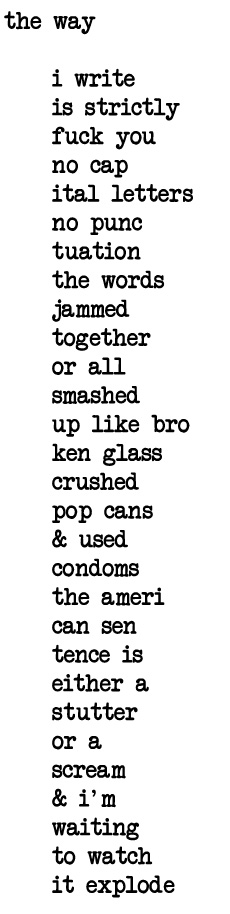
And, it’s in that moment which is all nitro glycerined with so much murder and heat that I realize this is really what the dark side of america is all about. A contract killing is the partial fulfillment of a national death wish. It’s a down payment, the homicidal coin pressed deeply into the shooter’s hand. The only thing is it has to be reenacted again and again in all of its infinite variations to complete the dark american dream. While inscribing a copy of THE BIG SLEEP for William Faulkner, Raymond Chandler wrote, The genius of America is murder. Chandler crossed over. Faulkner was waiting.

Once you have gone to meet the outlaw, you almost have to claim him. Either you claim him or he claims you. One way or the other, it’s a fifty fifty mix.. Because you can no more disown him than he can disown you. It is a jump over the witch’s broomstick and then the ride to hell.

Sometimes I like to imagine Dostoevsky going to meet Raskolnikov. And R already has the axe and Dostoevsky knows it and he’s getting this strange feeling in the pit of his stomach because he knows what’s coming. He knows that if he creates this man there will be blood on the floor and secretly Dostoevsky needs to have mayhem helongs for it and he can hear R sharpening the axe against the smooth surface of bone.

Imagine Melville going to meet Ahab. The Captain has rooms over a sailors’ taproom where a group of men have huddled around to watch two harpooners throwing bowie knives at each other’s feet to see who can come the closest to taking off a toe. Upstairs, Ahab sits staring out the window at the harbor. He is holding a harpoon fashioned from the steel of a meteor and the harpoon’s blade is so sharp that even its slightest touch will draw blood from the most calloused of skin. And, when Melville enters, he immediately offers Ahab his arm to test the harpoon on.

Consider the strange case of Isaac Babel, a Russian Jew assigned as a war correspondent for The Red Cavalryman to a Cossack cavalry unit. Imagine that when Babel hears this piece of news, he conjures up Commander Trunov who initiates Babel into the troop by placing a revolver to Babel’s head and pulling the trigger six times on empty chambers. Then laughing all the way to a fat piss in a ditch. And, subsequently, Babel has his main character Lyutov carry an unloaded revolver into battle. Babel may even have invented the men who shot him. Murder might just be the most natural fantasy of all.

Over the years I’ve often wished that Joseph Campbell had written a chapter in THE HERO WITH A THOUSAND FACES that covers the anti hero or the outlaw. Many of the hero’s trials and adventures can be manipulated and adapted to the outlaw’s quest as well but only with a certain amount of distortion. You have to keep in mind, Campbell was dealing with the archetypal hero, someone who never intentionally opposes the system. Billy the Kid, Don Corleone, Neddy Smith, Dillinger, Jesse James, Al Capone all opposed the system in their own individual ways. And, by opposing the system, they all invented worlds of their own. What is needed is for someone to write THE OUTLAW WITH A THOUSAND FACES, a complete archetypal study of outlaw heroes.

However, we don’t need a Joseph Campbell or a mythological investigation of the outlaw as a variation of the hero to explain the subterranean relationship between the poet and the outlaw. But, it is necessary to understand where the poet fits into this mythos, what his role is in the criminal wreckage and the natural anarchy of things. The poet provides the electricity for a Billy the Kid or a Dillinger to continue to exist. The stories about the Kid will always be with us but it takes a Tony Moffeit or a Michael Ondaatje to give those stories fire, form, frenzy, and meaning. And, by meeting this test, the poet gambles his blood and psyche against god’s blow hole in the void.

Going to meet the outlaw is one of the great archetypal challenges in the history of poetry. It is the big throwdown, the ultimate test for any poet. However, before you set off for that fateful meeting, the thing you need to ask yourself is are you up to it and is the outlaw mythologically large enough to encompass all the stories that you will be required to tell about him? And, do you possess the requisite genius to tell them and survive the telling? If he contains all the dark dreams of the world and you fall head over heels in love with that darkness, then he’s your man.

1 Comment

Filed under essays by todd moore