Category Archives: essays by todd moore

the outlaw poet and those killer eyes

I’m staring

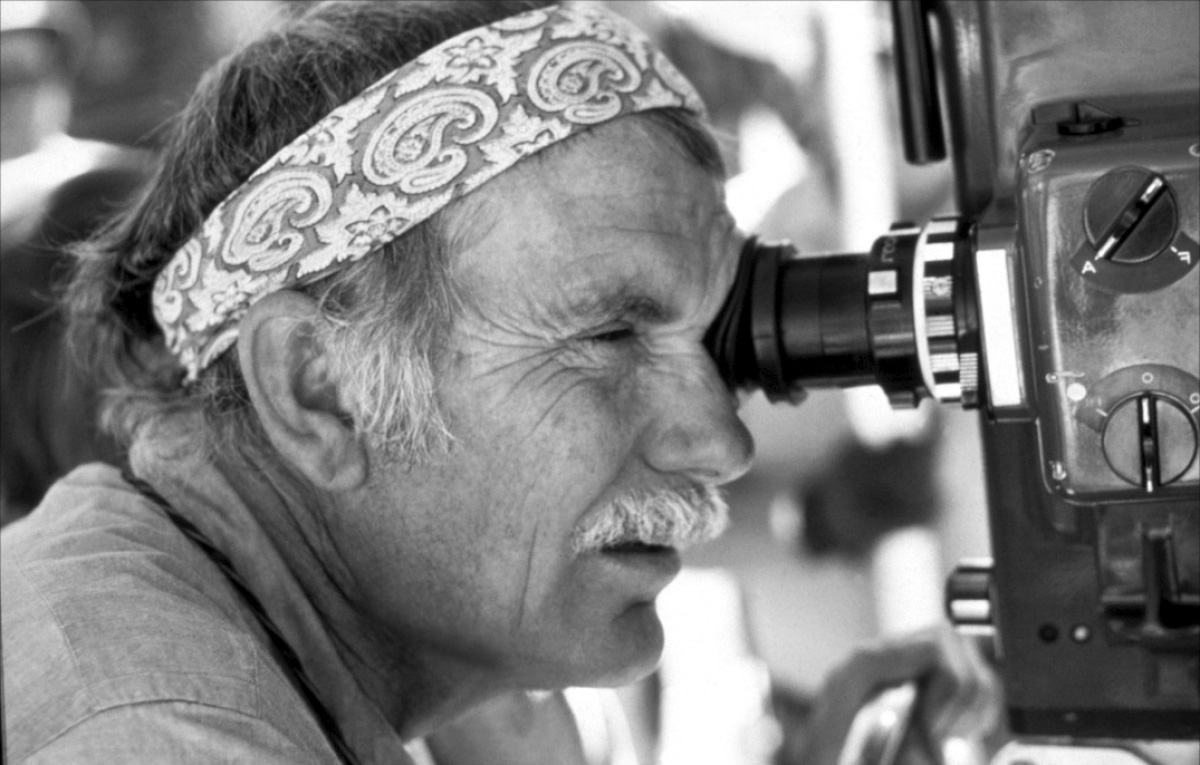
at the cover of BLOODY SAM: THE LIFE AND TIMES OF SAM PECKINPAH by Marshall Fine, published by Donald I. Fine, Inc. Peckinpah is staring into a camera lens. He has a bandana wrapped around his head. His face has that look of a thousand psychic train wrecks. The lines around his eyes look more like half a dozen knife scars rather than age wrinkles. I can just barely see his eyes in that shadow. That head shot of him, taken by Michael Jacobi, swims in the deepest shade of blood red I think the publisher could find. Every time I look at that cover I’m swimming with wounds.

When I open the book, written on the endpaper are the following words. Kell Robertson, Box 581, Raton, NM, 87740. Mark Weber gave me the book. Kell gave it to him but I don’t know what Mark had to pay for it. Kell rarely gives anything away unless there is liquor involved. I’m betting Mark gave him two sixpacks of beer for it.

I’m looking at a snapshot of Kell Robertson. On the other side of the image are these words. “Recorded at Mitch Rayes house. I was living in a tent behind his house with his dog named Picasso. 2002/03.” In the photograph Kell is turned sideways, has his hands thrust into his jacket pocket. He’s wearing a black cowboy hat and it looks like he is trying to say something. Maybe he’s telling Mitch to go fuck himself or something to that effect because it’s just the way he has his head cocked, the way he has his lips placed like he’s making some kind of wise crack out of the dark corner of his mouth.

I’m studying the face of Dillinger on the cover of Elliott J. Gorn’s DILLINGER’S WILD RIDE, Oxford University Press. The image is credited to the Dayton Daily News. In the shot Dillinger has his head cocked slightly to the side. The face is expressionless though there are times when I could swear there is a slight smirk playing about his lips. The eyes are dead level and appear as though they are staring straight through you.

Years ago I used to know a guy who collected old time photographs of famous gunfighters. Once when I thought I had a cabinet card of Pat Garrett taken down in Silver City, I showed it to this guy and he said, Close but no cigar. How come, I asked. The collector took it out of my hands, held it at arms length, then up close and said, Take a look at those eyes. A man who shoots men down has stone killer eyes. This guy just has regular eyes. They don’t get inside you. They don’t see into your dreams. They don’t ghostwrite your deepest darkest nightmares. They don’t bushwhack your fantasies.

I’m staring at the only known and accepted likeness of Billy the Kid. The photograph, which was taken as a tintype, is a copy of the original. This is the iconic image of Billy posed with the lever action rifle and holstered six gun. I need a magnifying glass to get a really good look at Billy’s eyes. They appear heavy lidded, yet not quite closed for the shot. But, from what I can make out they appear to be staring right at the viewer. There is no sign of hesitation in that stare, no sense that he intends to look away. He would rather stare into your bullet wound scar than look away.

I’m going through book after book about old time gunfighters and outlaws. Joseph Rosa’s THE GUNFIGHTER is maybe one of the best when it comes to putting together a composite portrait of what the old west gunfighter/killer was really like. But, this is something I already knew. What I wanted to look at was the eyes, the eyes of the ice cold american killer were what I was after and the more I thought about killer eyes the more I had to keep looking. John Wesley Hardin, John Selman, Kid Curry, the Apache Kid, Doc Holliday. Holliday comes close in one or two photos. His eyes are so sociopathic casual. In another life they might have belonged to a shark or a wolf.

Though it really doesn’t matter how much I rummaged through old books looking for the images of those quintessential gunfighter/outlaw/killer eyes I never did find what I was looking for. The question I keep asking myself is can you actually see that murderous look appear in someone’s eyes? Maybe, just maybe it’s possible when someone like Billy the Kid or John Dillinger is staring over the barrel of a Colt 45 or a machine gun. Maybe that’s when that killer look really takes shape and there is absolutely no doubting the way their eyes acquire that extra lunatic menace. Maybe you actually had to be there when the Kid let Bob Ollinger have it with that ten gauge shotgun. I don’t know how many times I wanted to get up close to the Kid while he was pointing that scattergun. I don’t know how many times I wanted to look right into the Kid’s eyes at point blank range while he was cocking those hammers back on that meat maker. Maybe they’d be so dark and so far back in the shadow of his shoulder and the pure night that the gunstock made on his body that I could never really see them. Or, maybe they would just get so killer dark that I couldn’t see inside them. Let me touch your eyes with my fingertips, Kid. Let my fingers graze your eyelids, Johnnie. See if anything comes off them.

The obvious eyes to stare into are Dillinger’s. All his mugshots show his eyes so clearly and that one taken at his father’s house where he is holding the machine gun in one hand and the wooden gun in the other, he is smiling and his eyes are smiling, too, but are they killer eye smiles? That’s the question. That snapshot reminds me so much of the one that Butch Cassidy, the Sundance Kid and the rest of that wild bunch had taken in Fort Worth, Texas at the tag end of the nineteenth century. None of them are actually smiling but this is that famous fuck you photograph they had taken in their Sunday best and then had sent a copy back to some bank they had recently robbed. Dillinger with his machine gun and wooden gun, Butch and Sundance in their best clothes ever giving all the banks and the railroads they’d robbed the most stylish finger they could think of. This is totally killer and done with such point blank style. Let me at least touch the original photograph, Sundance. Maybe I can get a feel for all of those eyes.

Snapshot of a Mexican bandit standing with his back to an old adobe wall. He is not wearing a blind fold but because the photographer took the image from the side all I can see is his face. The faces of the Federales are a blur but their rifles look crisp. Death always makes the images of guns appear crisp.

What I’m looking for is dark style. What I am looking for is blood style. What I’m looking for is right to the edge of the world style. What I’m looking for is nightmare style. What I’m looking for is outlaw style or make that outlaw poet style. In the eyes. Dead center in the eyes. I wish I could’ve looked into Mayakovsky’s eyes just before he pulled that trigger on himself. I wish I could have looked into Wyatt Earp’s eyes just before he put a slug into Frank McLaury’s guts. I wish I could have looked into Isaac Babel’s eyes just before the secret police shot him, point blank range. No one removed his glasses and one of the slugs reportedly sent slivers of glass all over his forehead. I’d like to think he got it straight into the eyes because he retrieved all of those great images he used in his stories from those dreams sleeping deep in his psychic eyes. I wish I could have looked into Frank Hamer’s eyes just before he gave the ambush order to fire on Bonnie and Clyde and I wish I could have seen their eyes when the bullets started to go into their bodies. I wish I could have looked into Hemingway’s eyes just before he brought that shotgun up head level. I would love to have been able to gaze into those writer/hunter eyes before he blew the top of his head off. I wish I could have glanced into Lorca’s eyes just before those firing squad rifles came up dead level to his chest. I don’t have any idea what I might’ve found in there. Maybe a death duende so black it would paint all your dreams with homicidal shadows. Rumor has it one of the members of the firing squad spent the rest of his life trying to wash those shadows off his hands. The more he washed, the blacker the water became.

I’m thumbing through CAMERA LUCIDA by Roland Barthes. I stop on page 46, the photograph taken in New York’s Little Italy by William Klein, 1954. What I can’t get past is the hand holding a revolver to a young boy’s face, almost even with his eyes. By using a glass I can see that the boy’s eyes are turned toward the gun barrel, as though they are anticipating something. Some kind of magickal surprise. Still, he is smiling. The woman peering over his shoulder is also smiling and so is the young girl on the left side of the photo. You can’t tell who is holding the pistol, but from the bracelet on the wrist just underneath the hand holding the gun and from the long dress like clothing this person is wearing, my best guess is that this is a woman. Still, my gaze goes back to the revolver and the boy’s eyes which are trying to get a look at the gun barrel. Why does he want to see it? Shouldn’t he be glancing away? Is it possible that he will see death as part of that revolver? Can death live inside such objects? Can death live anywhere it wants to in america? And, is the pistol real or a toy? And why is it being pointed at a child’s face? Or, does it matter? Is this one of those signal images which define our darkest fantasies? The gesture of pointing is all too real because in that simple ritual of pistol to the face and the death over laughter eyes patiently watching lies the ominous and very lyrical history of the american death wish.

Maybe I can go on looking for a thousand years and never exactly find what it is that I am looking for. Because, what I’m looking for and have been looking for is the darkest kind of poetry imaginable. A poetry that comes straight out of the eyes and then goes back into them. The kind of eyes that can see all the way back and down into that fester of archetypal images floating in that night of all oceans. The outlaw poem begins and ends there.

1 Comment

Filed under essays by todd moore

I work the shattered line

Todd Moore | Photo: Roy Manzanares

I work the shattered line

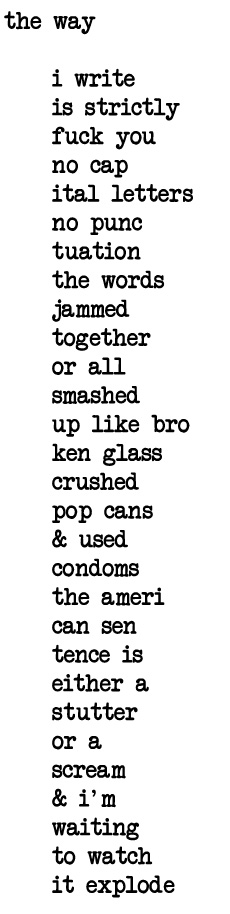
in american poetry because it is damaged because it is wounded because it is T boned and splattered all over the street. I work the shattered line in american poetry because the four beat, five beat, six beat line in american poetry are all dead or so close to death that they no longer have any power nothing to jump into my bones. I work the shattered line in american poetry because it is without pretension, it doesn’t try to hide its twistedness. It doesn’t try to bury rhyme inside rhetoric, it doesn’t try to meditate, it doesn’t try to teach any lessons, it doesn’t have Heidegger trying out his Bugs Bunny schtick re sein or zeit it doesn’t try to wang dang doodle you into thinking it’s alive when its very brokenness is proof enough that it works despite its brokenness. The grotesque nature of the way it looks on the page is what stops you in your tracks. It’s as memorable in appearance as a Jackson Pollack pour. The shattered line is the only real talking that exists in the broken world. The shattered line dates from Job’s cry and roars down to and well past HOWL. And, while HOWL is a long lined poem, the whole text is a masterpiece of shattered language. I work the shattered line in american poetry because for me and maybe only for me the shattered line is the most private the most personal the most wounded the barest and the most stripped down way of getting at and to almost anything I want to write.

And, writing in america is the closest thing I know of to kicking through the garbage, rummaging through the absolute shit and vomit and croak and rot of american culture. T. S. Eliot rummaged through all the stink and feces of his incessant dreams to write THE WASTE LAND. He was american in his hide and British in his intellect. He was broken inside that elite shell of the gentleman he tried to imitate. What he did can’t be done again. It is an unrepeatable act. Just as Hart Crane could never again write another Proem for THE BRIDGE or Allen Ginsberg could never again write another HOWL. They were all broken in chant and scrawl and dance and skin. Asking them to do that again would be like asking Peckinpah to make one more version of THE WILD BUNCH, expecting the Coen brothers to direct NO COUNTRY FOR OLD MEN one more time. Or, asking Michael Mann to bleed Dillinger out on the screen in PUBLIC ENEMIES again. These are electric acts of genius, sui generis, unrepeatable, and magnificent in timing, dream, vision, and event. Creating anything authentic and essentially Outlaw in america; poem, play, novel, painting is the closest thing I know of to trying to rescue the culture in the face of almost certain apocalypse. And, no one gives a rat’s bug infested ass except the Outlaws, the Outlaw Poets. If you stand at the margins calling down the black wind, you will get it. If you stand at the tornado blown borders conjuring the nearly demolished poem, you already understand.

I work the shattered line

in poetry because I respect the ultimate mystery of its damage and its power, because it almost looks like printed stutter on the page, it almost looks like all the syllables and words in my poems are trying to escape the inevitable violence of torqued nightmare and oblivion that await them. I work the shattered line in poetry because for me it is a reflection of the shatteredness the blown to smithereeensness state of language, the last tragic apocalyptic fuck you of the word. I work the shattered line in language because of the sheer aesthetic brokenness the jagged smashed fuckedupedness of language itself. The american language is wounded up to and maybe beyond repair and tries to hide itself in the Whitmanic line. And, what passes for the Whitmanic line is a an awkard lumbering cluttered march of mundane words across a page mined with silence, longing, and whiteness and each awkward line is followed by another and another and another with no energy or electricity or love or lust or want or hope or agony or murder or anything broken and remotely human. Nothing is going on. Nothing ever goes on in most of those poems. They ramble and chatter and take me nowhere and they should be an embarrassment for those use write them. No one since Whitman has used a line of that length and that depth and that breath of power with any matching originality or success. Only Whitman could write it successfully. He had the genius for it and it died with him. And, where is that genius that contemporary poet with a kicked and hungry drive comparable to Whitman?

I write the shattered line

because the world is shattered beyond all human understanding. And, maybe always has been a little broken beneath the river, inside the mountain. I write the shattered line and love its shatteredness. Love the way that words crack open like little bones with all the dried and primal marrowings falling out around me like pieces of an ancient corpse sheering off and twisting toward oblivion. And while I write, I have two minds going at the same time. One is plunging down the corridors of the poem. Maybe careening is a better word. Creeley used to write about breaking the line. The word breaking doesn’t mean anything when it comes to poetry. Breaking is so horribly and impossibly teacup polite. Breaking doesn’t suggest the real broken nature of the language after Abu Ghraib or Nine Eleven. Line breaks have always existed at the ends of phrases or even single words, obvious signals used for dramatic effects. Breaking a line is more like breaking air, the fart without the stink. Breaking a line is more like cracking gum in study hall, so what? It means nada. Shattering the line is what you do when the words are already fractured and wait in their quivering fracturedness to be snapped apart like old boards and bones, like something that is snapping apart behind the eyes. And, you know that that something’s going on in you, that some part of you is chipping into little pieces but you don’t know what and the same thing is going on in the culture and maybe for one knife edge Arthur Rimbaud snapped synapse second you want it to shatter into a million unrepairable bits. This is how it is for me when I write a poem. I want the poem and I want all the shatter blowing into my eyes and out through the back of my skull. Blue volt, then word scorching straight down the page.

The other mind, the second mind, goes in and out of it all. This is the blow fly of the intellect, sorting for story frequencies, going back and forth among the little fragments of memories or sub memories or sub sub memories any little thought or visceral echo, searching for one more resonance for the wooden gun one second and Dillinger kissing a machine gun the next. What is riddle, what is the impact of the riddle of riddle, death is a short red slit in a Mark Rothko painting bleeding the wound back into its wound, a shaved pale head in a Paul Klee painting that looks as though it is starting to tell a story but if it says even one word its head will implode, and the machine gun in THE WILD BUNCH is really becoming more than a machine gun, it’s death telling all the death stories while Pike Bishop is pulling the trigger, and Madam Rosa in MEDITATIONS ON A MACHINE GUN reminds me of one of Gauguin’s veiled women maybe a gypsy and she’s got that kind of blue jumping stuff she can do with her hands, she opens her mouth paints the walls with her dreams.

I write the shattered line

because it is really all I have left to work with or all I really want to dream and work with. I write the shattered line in order to get at what is left of the american story. I write the shattered line in order to discover what is left of the american myth. It lies way back in the language somewhere in a fetal position, waiting for the end. And, I tease it out every time I write. I write the shattered line because as short as this line is, it holds like rope, it twists like muscle over muscle, it cracks like a black whip while it dreams of splintering like a bone.

I work the shattered line

because of all the lines both short and long it is the one line which is closest to both speed and blood. Long lines drag all the words in and most of them are dead. Short lines kick all the words out except for those which are absolutely necessary for the archetypal story. Long lines depend on description. Short lines, especially the shattered line depend upon the bare declarative sentence smashed into greenstick breaks, fractures, and sub fractures. The shattered line is the end point and the origin for all of our words.

I work the shattered line

because it’s the place where the story has gone, the zone where the story has retreated. It is compelled to escape from the sound of its own dry shattering for awhile. I write the shattered text because it is a blown out line of words and each word or word fragment conjures all the wounds of language. I work the shattered line knowing full well that I am both retrieving and destroying the remains of the archetypal hum of what it means to be human.

Todd Moore | Photo: Roy Manzanares

Leave a Comment

Filed under essays by todd moore

machine guns, movies, culture, dreams

Right

in the middle of a bank robbery and probably staged for effect, Dillinger turned to Charles Makley and said, What is it about machine guns that gets the blood going. Makley gave the bank president a look, winked, and replied, It’s because they kill people. Dillinger glanced over at the teller who was nervously filling a gunny bag with money and said, No need to worry little sister. The big bad wolf isn’t here for you.

An

Auto-Ordnance ad published sometime around 1920 depicts a cowboy standing on a ranch house porch mowing down a group of mounted cattle rustlers. Part of the ad reads, Fully automatic, fired from the hip, 1500 shots per minute. There is something so old west and at the same time so incredibly and irresistibly modern and american about a machine gun that there is no doubt in my mind why it was the weapon of choice for both Capone’s mob and Dillinger’s gang. It just simply was and remains today, even in all of its high tech variations, the lethal apostrophe hovering above and pointing down to a large pool of blood widening in some dark alley.

Try

to think of an america without machine guns, especially those of the hand held Thompson variety. Try to think of Paul Muni or Al Pacino playing Scarface without a machine gun. Try to think of THE GODFATHER or THE WILD BUNCH without machine guns in them. Try to think of the St. Valentine’s Day massacre without machine guns pouring merciless fire. Try to think of Machine Gun Jack McGurn or Machine Gun Kelly without their nicknames. Try to think of that famous photograph of Dillinger holding the wooden gun in one hand and the Thompson in the other, without his machine gun. Try to think of Lucky Luciano without a machine gun. That’s like taking the murder our of Murder Incorporated. Try to think of Johnny Depp without a machine gun in PUBLIC ENEMIES. Try to think of Ernest Hemingway on board the Pilar without his famous shark killing Thompson.

You

can’t do it and the reason you can’t do it is that the machine gun has somehow become both intimately and subversively a murderously erotic part of american culture. And, just when did that happen? Maybe it occurred the day that General John T. Thompson actually invented the submachine gun which later came to be known simply as the machine gun. Maybe it took place sometime during the Twenties when some Texas Rangers were shooting it out with a band of Mexican bootleggers somewhere down on the Mexican border. Or, maybe it happened when someone shot Dutch Schultz to death in the Palace Chop House in Newark, New Jersey. The murder weapons were actually revolvers but were reported to have been Thompsons. By this time the machine gun was already fabulously famous and so much a part of american culture it could never be erased or denied its importance.

I’m

at a gun show, standing near a table loaded with all kinds of automatic weapons. But, the centerpiece is a Model 1927 A-1 Thompson with detachable buttstock and clip. The weapon is sleek, compact, pristine, and beautiful with only a few minor and forgiveable dings in the wood. The owner is standing behind the display table running his hand along the barrel as though it is a woman’s thigh. He sniffs his fingers a few times just to get a smell of the oil and maybe something a little bit darker. He is telling one of the gawkers that there is a strong probability that Dillinger may have carried this weapon during the Mason City bankjob. No real provenance, he says, but I bought this gun from the son of a deputy sheriff who was part of a squad that raided one of Dillinger’s hideouts and found this piece with a bunch of other guns. He paused and said, Every time I hold it I can almost feel him inside it. How much is it worth, the gawker asked, rolling a toothpick around in his mouth. The machine gun owner smiled and said, I’d never think of selling it. Hell, it would be like selling a piece of america. What would you give for a taste of america?

While

I was on the fire department it was the bloodiest thing I ever saw, my old man said, studying a shot glass filled almost to the rim with whiskey. Someone had killed this guy down by the old vinegar works and dumped him out in the middle of the street. He must’ve had half a dozen slugs in his chest. His neck tie was nearly cut in half. The cop in charge told the newspaper reporter, We’re gonna call this one a suicide. The reporter stepped back, said, Somebody mowed this man down with a machine gun. The cop smiled, hawked up a big gob of yellow spit and sent it next to the dead man’s face. Then said, Suicide, again. The news photographer motioned the reporter off to the side and said, Lets don’t get in the middle of this. How come, the reporter asked. The photographer leaned in and said, Where machine guns are involved it’s mob shit. You start asking around, we’ll both have blood out the ass. Like this poor bastard.

I’m

watching MILLER’S CROSSING for the nine thousandth time. Someone has just tried to assassinate Albert Finney who plays a corrupt big city politician. Finney is standing outside his house and he is firing back inside at one of the men who has just tried to kill him. Finney catches the would be killer with several bursts from the Thompson and the man starts shaking convulsively. It almost looks as though he is ecstatically dancing. When that many bullets hit you, how can you remain still?

At

one time this kind of high speed death might have been shocking but now it has become almost hypnotic. It doesn’t matter whether I am watching THE ROARING TWENTIES or THE BOURNE IDENTITY, the effect is the same. Suddenly, I can’t take my eyes off what’s going on in the film. It’s as though I have become hypnotized by the high speed velocity of death or even pretend death. Some critic, and I don’t recall who it was now, referred to the machine gun shootouts in PUBLIC ENEMIES as almost cartoon like, right down to those intense yellow globes of fire pouring out of machine gun barrels. And while I can understand the critic’s need to reduce this action to a highly charged movie still of words, I really don’t agree. When you have machine guns going off in streetfights like the ones staged in PUBLIC ENEMIES, and if you pull it off and make it all seem like intense reportage, you just might be able to concentrate the viewer’s attention and focus his imagination to a degree that almost borders on a near trance like state.

I’m

twelve years old, standing at the main desk in the Clifton Hotel where my old man is the night clerk and he’s talking to a man who calls himself the freelancer. Remember from back in the old days when I used to ride the suicide seat in a scout car for Keeler, the guy says. My old man grins and says, He was the only legger who tried to compete with Capone. The freelancer laughs, says, Nobody ever found his body. You still have that Thompson you carried back then, my old man asks. It’s in a canvas bag, the trunk of my car. These days you never know. My old man tapped some Bull Durham into a cigaret paper, sealed it shut with his tongue and said, Would it be bad form to ask if you ever used it. The freelancer paused, smiled. Said, Yeah, bad form. The smile partly went away when he said, It’s the gun that america is all about. My old man nodded inside the roll your own smoke, said,

The american dream.

Todd Moore | Photo: Roy Manzanres

1 Comment

Filed under essays by todd moore

danger beyond danger, where the outlaw lives

Todd Moore | Photo by Roy Manzanares

I’m

dragged back again almost hypnotically into PUBLIC ENEMIES, sitting hunched way down in my seat, popcorn with extra butter balanced on my knee, big cold drink jammed in the drink slot on the seat arm, lost and swimming gone and dreaming in all those quick murderous images pouring out of the screen. A twenty something blonde in the row directly in front of me leans over to her boyfriend and says, I wanna machine gun. Baby, you gotta get me a machine gun. He glances over at her and smiles while up on the screen Johnny Depp says, lets go to Chicago, make some money. Encapsulated in that magic moment is the electric essence of the american dream. Automatic weapons and movies and money, lots of money. Gatsby should’ve had a machine gun. Maybe Wilson wouldn’t have gotten him so easy.

Speed, death, love. Dialem up, baby. Someone writes from L.A., asks, Is the movie accurate. Death, speed, love, death again, gimme that good ole speedial, mama. You get this when you dream the roulette of american longing. Bet the red, the black comes up. A guy writes on my Facebook wall, says, you read all the books. Wadda you think of that Dillinger movie. Maybe the best answer I can give after I explain all the fast and loose moves that Michael Mann took with the Dillinger story is this film isn’t about accuracy. And, it isn’t really about history or the depression era or the midwest or the color of Dillinger’s eyes or the smell of rain or tobacco juice shot off the front porch or white lightning or all the lost shotguns. When that gets boiled away what it comes down to is Michael Mann’s obsessive exploration of the relentless american dark. This movie has roots that reach way down in the nightmare earth. Which never gets covered in American History 101 or American Studies and the Cultural Turn.

If you want the dark side of america you need to read THE KILLER INSIDE ME by Jim Thompson. If you want to get to the dark side of america you should read RED HARVEST by Dashiell Hammett. If you want to mess around on the dark side of america you should listen to some Robert Johnson while reading Gary Goude’s A CRUSHED, ROTTING DOG. Or, you need to get the video of NO COUNTRY FOR OLD MEN, catch the psycho killer empty in Javier Bardem’s stare. Or, beg borrow or steal Tony Moffeit’s novel BLUES FOR BILLY THE KID or John Macker’s poem ADVENTURES IN THE GUNTRADE.

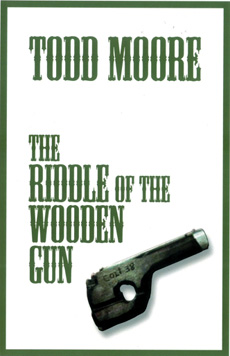
And I’m sitting at the table in the coffee house up in the mountains where I started to write THE RIDDLE OF THE WOODEN GUN but Cormac McCarthy isn’t here now. Instead, a roadrunner is walking around out on the patio looking a little lost. A storm wind is coming down off the mountains and the air is so black I could slice it like pie. I read somewhere, maybe it was in a Kell Robertson poem that storms like this carried double ought buck lightning. You get hit with it it just blows you all to hell. Shotguns going off in the dark always fuck around with me.

If you are looking for the dark side of america all you have to do is scratch a scab and watch the pus run. Then lick it up dried blood yellow shit dead skin and all, if you have the nerve for it. If you are looking for the dark side of america all you have to do is ride a Greyhound bus and read A HORSE CALLED DESPERATION while taking long hits of Beam wrapped in a brown paper sack. Or, maybe you could get good and fucked up and try conjuring Bukowski over on De Longpre Ave in Los Angeles. The thing about america is it has plenty of the dark side to offer and it is always available to you.

And, it is doubly available to you if you are an Outlaw Poet. If it weren’t you’d have to invent it. Lets get one thing straight right now. Walt Whitman never discovered the dark side of america. Otherwise, he would have written about Jack Slade, John Wilkes Booth, James Butler Hickock, and Doc Holliday. And Eliot and Pound and Crane and Stevens and Williams never wrote about the dark side of america. They may have touched the darkness a little but they never really tapped into that dark vein that makes america so wonderfully Outlaw, so attractively and magnetically bad.

The problem with american poetry is that it never had a Baudelaire or a Rimbaud. The trouble with american poetry is that it really never promised any real fuck you behind the eyes trouble. It was always slightly removed from the danger. Hart Crane might have been provisionally a bad boy but he was never an Outlaw. John Berryman painted his insides with darkness for THE DREAM SONGS but he was never a Outlaw. Hemingway came close because he liked to play with guns but he wasn’t an Outlaw. Bukowski, Bremser, Micheline, and levy came very close. They were the proto typical Outlaws. They lived by instinct, short grift, animal desire. Bremser was the only real criminal among them. But, he never had Dillinger. None of them did.

The interviewer leans in, says, are you an Outlaw. It’s almost a whisper. I reply, you mean do I rob banks. He says, Yeah, something like that. No, I don’t rob banks. Then what makes you an Outlaw? I give him a wide smile and say I don’t give a fuck. The interviewer is playing it cagey. He says, About what? He gives me an idiot quick smile that goes vacant. Most anything, I tell him. Except family, friends, writing. I write the way I want to and I don’t give a fuck. Especially about the literary establishment. The interviewer replies, Ashbery writes the way he wants to. Yeah, I say, but he gives a fuck. He has to. He’s locked into it, balls and soul. Okay, the interviewer says. Then is that what really makes you an Outlaw? You want me to make it simple, I say. Yeah, he says. Something I can cover in a couple of sound byte sentences. You give me a paragraph everyone’s lost. Okay, then, lets just bring it all down to this. I am stalked and haunted by poetry so raw it bleeds like a wound, I love the complicated violence and energy of John Dillinger, and I make little head movies of machine guns going off way into the night. The interviewer writes it down fast, then adds a quick note, bites a nail while thinking, taps the notebook with the ballpoint and says, that’s exactly what I was after. That’s what I really wanted to hear.

An L. A. writer is telling me I need to do a novel. People don’t read poetry but they would read a novel, especially if I wrote a novel the way I write poetry. It sounds like a reprise of John Martin and Bukowski. It also sounds like a hustle I’ve been through before. Thanks but no thanks. Still, I listen politely. I don’t say anything because I have said it all to myself a thousand times over. DILLINGER is DILLINGER because it is poetry and in poetry you can take enormous risks. Dillinger is maybe one of the most iconic characters ever because he is in a long poem. That’s the irony but it’s where he belongs, that’s where his dark, edgy, unpredictable violence belongs. Not in some chickenshit novel. The novel represents the accepted way of doing business in literature. It’s okay to tell stories there and it’s okay to read them because that is what everyone does. But you’re not supposed to do that in poetry and you’re not supposed to have characters in poetry especially characters like Dillinger not people who could press all your hot buttons not criminals you could fall in love with. That’s not how you do business in literature these days. Which is why writing DILLINGER is the equivalent of robbing a bank. It’s the best action going. Besides, all a novel would do is flatten him out into long strings of words stumbling across the page toward nothing. Long strings of words fanned out across a page in a novel bore me to death. I want action, I want energy, I want surprise, I want dreams going off like depth charges behind the eyes, I want to break all the rules in all the poems ever, I want the poem to explode in the reading the way it does in the writing. In the poem Dillinger jumps down the page the same way he would going over a teller’s counter, he is nervous and mythic and enormous beyond his bones and dangerous beyond dangerous with laughter and longing. He is the dark side of america, he is the trickster of all tricksters, he is maniacally archetypal in a way that most other characters in american novels are just simply flatlined and ordinary in sentences that threaten to hang them, drowning in the dreck and the slop of description. There are no great american novels about Dillinger, nothing all encompassing, nothing huge, nothing ambitious, nothing encyclopedic nothing endless and compelling which is the way it needs to be with this kind of character. The only great novel about Dillinger is DILLINGER.

Rainey sits near the second storey window of his hotel room playing with a 32 Smith and Wesson that has no cylinder. He keeps cocking and uncocking it, then sticking his fingers through the empty space where the cylinder holding the bullets would go. Every once in awhile he says son of a bitch and aims at someone passing by across the street below. Then he gives me a look, sticks the barrel in his mouth and makes the hammer go click, says I do this a lot at night in the dark.

I’m on the computer and have punched up Blogtalkradio. For the next hour I’ll be listening to Wolf Carstens interview John Yamrus who will read from his NEW AND SELECTED POEMS published earlier this year by Raindog Armstrong’s celebrated Lummox Press. Yamrus’ poetry has that laid back feel to it. You might pick it up sometimes through the paper thin walls of motel rooms or maybe in some city lounge where the blood red neon distorts the drinkers’ faces or maybe on the back porch right after dark when you could say things you really wouldn’t think of when it was light out. The look and sound of Yamrus’ work tricks wannabees into thinking, Hey I could do this. The reality is they can’t be this relaxed and meticulous with the line. What makes Yamrus’ work important is that he has that rare capacity for seeing what is futile, absurd, and broken in contemporary society while still holding onto that unique gift of disarming laughter. He laughs at the void the whole time knowing that it is the void and that we all stand poised in the doorways of our personal and undeniable and irrevocable black holes.

In PUBLIC ENEMIES Billie Frechette looks Dillinger in the eyes and says, Where are you going? Dillinger gives her a deadon stare and replies, Anywhere I want. The question no interviewer has yet asked me is, where are you taking Outlaw Poetry. My answer would be, anywhere I want, any way I want, any time I want. What Outlaw Poetry is doing is annexing the lightning bolt id to the american poem. Because that’s really where the Outlaw lives. It’s where I’ve been living for a long time now. .

Leave a Comment

Filed under essays by todd moore

i want it all and i want it now

Three men

wearing long black coats and hats emerge as if by conjure from an opening in the floor. They slowly climb up what is now recognizable as a staircase. They are carrying guns close to their bodies. They are heavy with guns and dark intentions. The guns have become coup sticks, game sticks, story sticks, magic sticks. In some peculiar way the guns merge with their bones, their blood, represent the essence of all their nightmare expectations.

They have surfaced in a bank and seem to glide effortlessly across the slick marble floor. They are going to show their guns to the tellers and bank officers partly out of a need to enact an archetypal ritual known as bank robbery. Part of an even deeper need to become both heroes and villains at the exact same moment. And, the reason for this is that the ritual calls for it, demands it, and that kind of ritual simply cannot be denied. Ever. To deny it would sooner or later bring on the fevers, the tumors, the terrors, and death.

The scene that I have just described is from Michael Mann’s film PUBLIC ENEMIES. And, it is also a scene that I have played and replayed in my imagination since I wrote The Name Is Dillinger in a migraine pounding frenzy back in 1976. The number of men robbing that bank may vary, the bank may change in description, the sequence of events may be shuffled and reshuffled to fit the circumstances, but Dillinger is always there. Dillinger will always be there. He is required to be there. He is the there of bank robbery because this is his story and no matter how many times it is re enacted in HIGH SIERRA, John Milius’ DILLINGER, WHITE HEAT, or PUBLIC ENEMIES, it is still derived from the primal outlaw story of america. And, the primal outlaw story of america is the one that keeps getting pushed back and down into the collective american id where all the homegrown furies live. Where everything outlaw has been denied almost from the very beginning.

And, it really doesn’t matter how the story plays out in that bank. Maybe the bank robbers will die Dalton brothers’ style in one spectacular shootout or maybe they will make it out of that bank that town the country the way Steve McQueen and Ali McGraw did in THE GETAWAY. One thing you can count on is that even the violent death of an outlaw is not the end of him, contrary to all of Hoover’s passionate puritan dreams. The most interesting and perplexing aspect of america is its peculiarly dark and abiding love for its outlaw heroes. Especially the ones that are so complicated, the ones whose fates are intertwined with money and love and power and desire and fame and violence and death. Death has to be in there somewhere just as it had to be in there for Jay Gatsby, just as it had to be in there for Pike Bishop, just as it had to be in there for Billy the Kid, just as it had to be in there for Butch Cassidy, just as it had to be in there for Cody Jarrett, just as it had to be in there for John Dillinger.

And, I’m sitting through PUBLIC ENEMIES for the umpteenth time, again, because I want to see Johnny Depp and those other two bank robbers climb that staircase. They appear to be floating up out of that floor like phantoms, their long black coats remind me of the dusters the James Gang wore in THE LONG RIDERS. On one level they are outlaws. On another they are lethal metaphors that tease us toward a darker understanding of who we all are, of who we all dream we could be.

This is the way that Dillinger appeared to me in 1976. He broke through those floorboards fully formed as a character, as a force, as an apparition, as a dream, as a man. His voice ached to be pried my mouth, to be broken out of my mouth, to be clawed out of my mouth, ached all the way back into my throat, ached in my spit and ached in my dreams. And, he became a dark presence that filled my shadow with the black water of all of his dreams.

I don’t know exactly where he came from. I may have clicked an old Edgemaster switchblade open just one too many times and something like his spirit poured out. Or, I may have played with an old break open Smith and Wesson 32 a little more than I should have and his soul poured out of the barrel along with some rust and dirt flecks. But, once he came out there was no shoving him back in. His darkness infiltrated me, his darkness found my darkness and began to insinuate itself into whatever I wrote.

If Carl Jung is right and there is some kind of primal substratum where all our dreams originate going back to the very beginning, then maybe there is also a psychic ocean where all our archetypal characters come from as well. If you believe the first idea, then you should also seriously consider the second one, too. Maybe it’s possible that Hamlet knew Ahab before Shakespeare or Melville drank from that enormous ocean of archetypal dreams. And. maybe it’s possible that Milton’s Satan and McCarthy’s Judge Holden were twins swimming around in the psychic slime of Cain’s best fantasies. And, maybe it’s also possible that John Dillinger and Benya Krik joined forces to rob the bank of all banks before taking off for Buenos Aires or Paris or just simply for parts unknown. And, to extend this beautiful travesty just one more time. Maybe Babel and I had knocked back the best of all possible vodkas before the Cheka even realized that we had exit visas and were already on the next plane to Lisbon.

When Dillinger came out from under the floor of my study I was more than ready. When Dillinger blew his way out from under the floorboards of america I had the dream car which was also the getaway car revved and waiting. The moment Dillinger appeared in The Name Is Dillinger he became one of the major metaphors for Outlaw Poetry. Like Tony Moffeit’s Billy the Kid, DILLINGER is a force to be reckoned with, a dangerous longing, a homicidal wet dream. There are no figures in contemporary american mainstream poetry going all the way back to THE WASTE LAND and coming all the way forward to the present time that are the equal of Dillinger in vision in scope in depth in dreamscape in ambition. And, since 1985 only BLOOD MERIDIAN’s Judge Holden can claim that honor and BLOOD MERIDIAN is a novel.

When I first started to write DILLINGER back in the seventies, I realized even then that what I was doing in poetry was the symbolic equivalent of bank robbery. What I wanted to do and still want to do is make DILLINGER a primal act of robbery and murder. Symbolic robbery symbolic murder, but crime kicked to the psychic max. Up until then writing a poem meant just writing a poem. When Eliot wrote THE WASTE LAND it was still just a poem. Forget the idea that Eliot really was trying to rewire the whole perception of what a poem and what consciousness in poetry were all about. When Pound was writing THE CANTOS it was also still just a poem. Forget the idea that he was really trying to reinvent the history of his dreams. But, no one, not even Ed Dorn had tried to reinvent poetry as bank robbery, which is the ultimate act of an Outlaw Poet.

The one idea to keep in mind is that this is not poetry about bank robbery. This isn’t the stuff of the pulps. This is poetry conceived as a criminal act. This is poetry that drags you bleeding into the raw wounded moment of the crime itself and then exhilaratingly pulls you back out. Baudelaire would have loved it. Rimbaud would have grabbed a machine gun so he could try to kill the moon. Dorn would have gone in search of those leather encased hands. I wanted to write a poem that was so irresistibly criminal, so hypnotically violent, so tantalizingly mythical, and so absolutely american that it couldn’t be neglected or denied even while there were many who just simply wished it would go away.

There is a line in PUBLIC ENEMIES which really applies to Outlaw Poetry as much as it is a driving force behind Dillinger’s frenzy. Johnny Depp as Dillinger tells Marion Cotillard as Billie Frechette, “I want it all and I want it now.” The way that Depp is talking is both low key and electric. What he says in this film is what Dillinger has known for always and what I realized when I began to write DILLINGER. And, this line just doesn’t apply to the character of Dillinger. It is the foundational force for a kind of poet and a kind of poetry that has been denied, neglected, forgotten and marginalized for a very long time. Like Dillinger, Outlaw Poetry has broken out of the national id and is now loose in the culture. It is loose and floating and dangerous.

And, it wants it all and it wants it now.

Leave a Comment

Filed under essays by todd moore

living at the movies with dillinger and depp

I live at the movies.

If I’m not actually sitting in a movie theater staring at the big screen, I am running bits and pieces of hundreds if not thousands of scenes in my head. I call them my psychic rushes. Or, I’m writing poetry which comes to me like scenes from movies which haven’t been made yet. Nano second scenes that play out like mini films that Peckinpah might have made, that John Ford could have made, that Roman Polanski needs to make, that Kell Robertson should have starred in, that Tony Moffeit composes the soundtrack to in Dodge City, Kansas and Taos, New Mexico.

I live at the movies because they have become a kind of national mythology and I use that word with the best of all possible ambitious intentions. I live at the movies and I live in that mythology and I can’t help but dream cinematically because that’s the way I see things, that’s that way that I write poetry. I can’t help but write a focused, totally visceral poem that plays out like a movie. That plays out so tightly scripted that it seems natural like a conversation swimming with images and words. Because if I’ve learned anything from being a poet and a movie voyeur it’s that the language of film is made up of a desolation of images and gestures punctuated with words and the language of poetry is made up of an oblivion of words and images punctuated with gestures. And, in the dream of all dreams they merge into psychic films we could never understand but are absolutely compelled to take part in.

I’ve played in so many psychic Dillinger movies that I’ve lost track of the number. And, DILLINGER is the one big movie that I know because the poem has dreamt its nightmare all the way through my blood. And, this summer I’ve been dreaming it all over again with Michael Mann and Johnny Depp. And, the dream is in both color and black and white and the dream wants to go fast and the dream wants to go slow and the dream wants to be the first and last dream of an outlaw america.

PUBLIC ENEMIES is the latest emanation of that dream and will inevitably be one of the major sources for even more dreams of Dillinger to come. But, lets talk about PUBLIC ENEMIES because it aches to be talked about, because it is a cluster of conversations tortured into violence and conjuring and longing and story.

If Michael Mann’s intention was to film an outlaw epic, then he has certainly succeeded. I haven’t seen a movie this ferociously ambitious or this well made in a very long time. And, I knew this even though I was well aware that Mann had played fast and loose with the sequence of events in the Dillinger story. Even if you have only read Bryan Burroughs’ book PUBLIC ENEMIES which the movie is based on, you know that Pretty Boy Floyd was killed months after Dillinger met his fate at the Biograph Theater. Mann has him dying prior to Dillinger. You will also know that Baby Face Nelson also died many months later in a gun battle with FBI agents just outside of Barrington, Illinois, rather than at Little Bohemia in Wisconsin. You will also notice that Dillinger in real life did not take part in the jaibreak which opens the film because by that time he was being held prisoner in an Ohio jail. My guess is that Mann was probably aware of the facts but had decided that a more compact and focused script would make the movie travel that much faster. And, I fall in love with the velocity of movies that travel. The thing you have to understand is that movies are based on the history of longing, not of events.

Still, I need to ask the question. Does this somewhat cavalier use or misuse of history flaw the film in any major way. My answer is no. When John Ford made MY DARLING CLEMENTINE he placed the date of the Gunfight at the O K Corral in 1882 instead of 1881 when it really occurred. And, he included Old Man Clanton in the gunfight when in reality the Old Man had been dead months before the gunfight actually occurred, shot dead in the Guadalupe Canyon Massacre. And, he also has Wyatt Earp meeting Doc Holliday in Tombstone for the first time when in reality they both had become friends earlier in Dodge City. Did these inaccuracies hinder the film from becoming a masterpiece? Not at all. John Ford has a character in THE MAN WHO SHOT LIBERTY VALANCE say, When you have the facts and the legend, print the legend. Ford was good at printing the legend. The best films of all are really about legends. In fact, these are the kinds of films that eventually become legends.

PUBLIC ENEMIES deals with one of the greatest american legends ever. John Dillinger. If Dillinger is anything, he is a cluster of contradictions shrouded in a universe of dark metaphors and even darker dilemmas. It would take a Picasso to get all of Dillinger’s faces exactly right. The end result might be a blizzard of cubist Dillingers. A gallery filled with tons of Dillinger likenesses. And, film directors don’t really have the luxury of showing all of Dillinger’s faces. Just one really good action portrait should do. Michael Mann was betting on that.

His choice is a zen minimal snapshot of the thirties outlaw. In fact, it’s almost a slomo glance. Zen because Depp’s dialogue is so unlyrical it’s lyrical. You really have to listen hard to catch the quick repartee, the half whispered menaces. What was it Bogart said in THE MALTESE FALCON? The cheaper the crook, the gaudier the patter. Except that there is nothing gaudy in any of Depp’s dialogue. There are no throw away lines here. The speeches are all chopped, abbreviated, clipped. This is talk with the teeth still in. It reminds me of the way that I write poems. My cadences are all in there. I can’t help but hear them. And, when Depp speaks, it almost seems as though he is sometimes speaking past the person he is talking to, as though he is talking straight into a void that he both understands and secretly longs for.

And, if the story holds true that thirties outlaws and gangsters often went to the movies to learn how to walk and talk, there is very little of that evident in PUBLIC ENEMIES. Depp makes no attempt to pretend to be doing Cagney or Robinson anywhere in this film. This is just Depp doing something so natural, so stripped down, so stark, so unpremeditated that it appears sui generis, without any precursors. Though, if you are a real moviegoer, you know that actors like Depp, Brando, Pacino, De Niro, and Pesci must have been and probably still are, haunted by the great precursors of Cagney, Bogart, Raft, and Muni. Still, there is no sign in this film that Depp is pulling from any of those golden age gangster and noir actors.

However, Mann’s homages are clearly evident. He has seen THE UNTOUCHABLES, he has seen Milius’s DILLINGER, he has seen BONNIE AND CLYDE, he has seen GOODFELLAS. He probably has seen every gangster and outlaw movie filmed from the thirties on. He knows the look of the railyards, the rooftops, the farmhouses, the streets, the woods, the tenements, the nightclubs. I found myself looking for the windblown hat from MILLER’S CROSSING. And, then I saw it when Winstead throws his hat away while chasing Dillinger and Hamilton along the lake shore in their escape from Little Bohemia. Mann has clearly done his homework, those movies must have been playing in his head. Playing relentlessly in his head. They play in mine.

It has also been suggested that Depp may have modeled his portrayal of Dillinger on the actual sound of Dillinger’s voice. This puzzles me since in the nearly forty years that I’ve been working on DILLINGER I’ve never heard any recordings of the man’s voice, nor have I discovered any sources where I might find these recordings. Or maybe I just haven’t been looking hard enough. In my case, a long time ago I decided to invent the way he sounds because it’s as midwestern as I am. I know I have heard voices like his for much of my life. I have heard those voices coming at me from passing cars. I have heard voices like his calling across fields and floating above front yards on hot summer nights. As for Depp, it’s quite possible that he and/or Mann may somehow gained access to the recorded sound of Dillinger’s voice. If that has happened, then Depp’s performance and the sound he got into his own voice based on Dillinger’s speaking style is indeed unique. A once in a life time shot at the sound of a myth. In my case, I took it straight out of the blood.

Either way, it all really comes down to Depp’s overall performance. Which is uncanny, almost other worldly. I think it’s every bit as good as Bardem’s Chigurh in NO COUNTRY FOR OLD MEN. In truth, Depp really doesn’t resemble Dillinger any more than Joaquin Phoenix resembled Johnny Cash, Salma Hayak resembled Frida Kahlo, or Marion Cotillard resembled Edith Piaf. An actor’s resemblance really plays toward an illusion that validates some darker dream of psychic acceptance. All I know is that somehow Depp managed to channel Dillinger or shapeshifted himself directly into the shadow of the outlaw. Once that happens, the film’s ultimate illusion completes the ragged edges of the dream.

As for some of the other members of the cast, Bale’s Purvis is, at least for me, standard issue boiler plate, not at all that interesting. He’s believable, he works but he doesn’t pull me in. He doesn’t surprise me. He doesn’t shake toward something sweaty quivering and new. His work in 3:10 TO YUMA was much more edgy and vulnerable. Billy Crudup as Hoover is a cross between Movietone News wackadoo wackadoo and aging eagle scout. The two actors who should have been given just a little more depth were Marion Cotillard as Billie Frechette and Stephen Graham as Pretty Boy Floyd. They were almost relegated to playing ciphers in the film. Cotillard, who won an Oscar for playing Edith Piaf in LA VIE EN ROSE, was nearly lost in this role. She ends up as beautiful wallpaper, flapper décor, someone who is almost totally reliant on Dillinger. In real life Billie Frechette was a much more interesting and darker woman who could be equally feisty and fiery depending on the circumstances. Graham as Baby Face Nelson is little more than a kind of sociopathic cartoon in the movie. In real life, he was a much more complex man and very likely a homicidal maniac. I would be willing to guess that Cagney based his character of Cody Jarrett in WHITE HEAT at least in part on Baby Face Nelson. One quick note. Diana Krall in the cameo role of the torch singer should not be missed.

Still, in the final analysis, PUBLIC ENEMIES belongs to Depp as the actor and Michael Mann as the director. They both share a tremendously large stake in this movie. What Depp has accomplished is unique. He has created the kind of character which becomes iconic, unforgettable, unrepeatable. It can’t be done this way again. One glance of Depp with that Thompson and you can’t help but think of Dillinger. Other examples are Brando in A STREETCAR NAMED DESIRE and THE GODFATHER. It just doesn’t get any better than that. Bogart in HIGH SIERRA, CASABLANCA, and THE BIG SLEEP. William Holden in THE WILD BUNCH. Henry Fonda as Wyatt Earp in CLEMENTINE. I could list more but you get the picture.

Movies are movies are movies are movies. But, what are the stakes here besides money and maybe just maybe having that slight shot for the Oscar even though PUBLIC ENEMIES is a summer release and the serious Oscar runs begin in the fall. What are the stakes when you make a movie about one of the most elusive american bandits ever? What are the stakes when you know that you are not just going up against the movies made this year but the movies made sixty or seventy years ago? What are the stakes when you know if you are Depp that this could give you a face and a look that rivals James Dean? What are the stakes when you know if you are Michael Mann that you are competing against Raoul Walsh, Samuel Fuller, Martin Scorsese, Francis Ford Coppola Sam Peckinpah? These aren’t just Oscar stakes, these are blood stakes, this is the stuff that dreams are made of. This is the stuff that brings the demons right out of the woodwork.

And, Michael Mann knows it. PUBLIC ENEMIES is his second masterpiece, flawed as it may be. His first really great film is HEAT. Roger Ebert stated in a recent review that Mann had eliminated the mythology from this film. And, I think Ebert was using the word mythology as a kind of synonym for sentimentality. There really isn’t much if any sentimentality in this film unless you want to nitpick and say the last scene between Billie Frechette and Charles Winstead is a little sentimental. As for the mythology, seventy five years after his death Dillinger has become an unmistakable american myth. He’s certainly an iconic outlaw, more in the old west tradition of Billy the Kid than in the street urban tradition of Michael Corleone. In many ways, Dillinger is the outlaw archetype. All of the anecdotes, all of the stories, all of the histories, all of the fantasies, all of the nightmares, and all of the dreams concerning any kind of american outlaw have been gathered into the Promethean creation of Dillinger, via novels, biographies, films, and poetry. He owns them. Depp owns them. Mann owns them.


1 Comment

Filed under essays by todd moore

the dillinger convergence: three ways of dreaming the outlaw

A few days ago

I was sitting in one of the darkened booths at a local coffee house reading Elliott J. Gorn’s new book DILLINGER’S WILD RIDE when a member of the wait staff strolled by clearing tables. When he saw the book cover, he stopped and said, I see you are a Dillinger buff. Did you know about the new movie called PUBLIC ENEMIES. It has Johnny Depp in it as Dillinger. I mumbled something in hopes he wouldn’t linger but, if anything, he was persistent. He noticed the Kangaroo Court copy of THE NAME IS DILLINGER sitting next to my well worn copy of BLOOD MERIDIAN and said, I’ve heard of Todd Moore. Have you ever met him, do you know anything about him? I let the question hang in the air like a dead crow for a couple of seconds and said, I have no idea who he is.

I’m doing target practice with a kid called Waggs. We are using his 22 Woodsman. It feels good in the hand and all you get is a light pop when you fire it. The targets are beer bottles and soup cans. But after awhile it starts to get boring and Waggs says I know what we can use and goes to the trunk of his car where he pulls a sawed off shotgun out of a tangle of women’s panties and fast food garbage. Waddya think and before I can answer he breaks it open and shoves a cartridge in. Twelve gauge double ought buck he says. It’s only a one banger, but I love it. Then he whirls around and fires a load into an old barn door propped against a tree. See the holes it makes, man. Dillinger couldn’t have done any better.

I was well into writing DILLINGER when I realized that just the name all by itself had morphed into some kind of magical spell. It possessed a mojo all of its own. Talk to anyone from the midwest about Dillinger, especially any of the old timers who were around at the time and suddenly you find yourself entering the country of storytellers, amiable liars, tricksters, and mythmakers. Dillinger wasn’t just an outlaw. He had a little something extra. Call it quality, strut, charisma.

Kidder had buck teeth and maybe the best right arm I ever saw. We’d stand on the railroad bridge above the Pecatonica River and see who could throw a stone the farthest. He always won, sidearm or overhand. Afterward, we’d go underneath the bridge and drink the beer he stole out of his old man’s fridge and he’d tell me stories about how his old man used to run a white lightning speak back in the twenties and thirties and that sometimes Dillinger would drop by to make a connection or maybe pick up a couple of under the counter guns. After the feds made things hot for him, Dillinger stopped coming around and Kidder said his old man missed that because Dillinger always had good jokes to tell.

When I look at the Johnny Depp trailers for PUBLIC ENEMIES, I know I am watching at least two things at the same time. First, I’m watching pure promo because I realize that the people who created this film are hoping to make money, lots of money. I also know that I am looking at something like an action painting by Michael Mann. Mann is the kind of film maker who is going to give me possibly the purest filmic essence of what a contemporary outlaw in america really is. And, when I think of Mann, I think of HEAT because that, for me, is his masterpiece up until now. And, when I think of HEAT, I think of that bankjob gunfight about three quarters of the way through the film. It’s not quite as spectacular as Peckinpah’s gun battles in THE WILD BUNCH but it does come very close. I think of Mann’s signature cinematic style for action but I also think of something else. I think of the classic tension he got between Pacino and De Niro. It just doesn’t get any better than that. Especially that truce scene in the diner where De Niro and Pacino just sit there talking, but there is so much powerful restraint in that scene it reminds me of those classic scenes in THE GODFATHER where the talk is all done quietly but you know there is going to be some serious shit going down as a result. The essence of the Mann style is all the tense homicidal talking. Just that hint of murderous noir.

Note: You can swith off the advertisement while watching this trailer.

And now, somehow everything Dillinger is all coming together in 2009. I haven’t known a year quite like this since 1976. Which is when I wrote The Name Is Dillinger and everything I had ever thought about poetry changed forever then. There have also been a few other years. 1986 when Kangaroo Court started to bring out those sleek, glitzy red volumes of DILLINGER. The year 2000 when Lummox Press brought out The Corpse Is Dreaming. And, 2005 when St. Vitus Press published The Dead Zone Trilogy. All of those times have been mysteriously complex years for me. Moments when something happened but I wasn’t sure what.

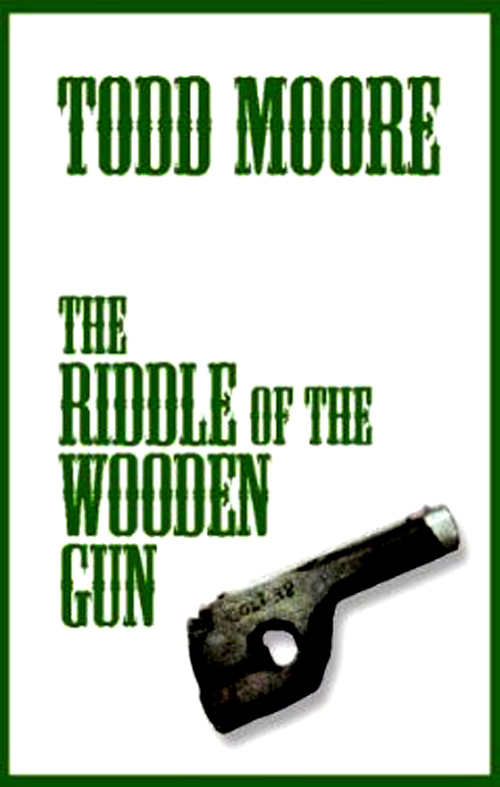
However, the year 2009 is becoming possibly the most interesting Dillinger convergence in history and in the culture that I have ever seen. In February, 2009, Lummox Press brought out The Riddle of the Wooden Gun. At one hundred and forty two pages, it is one of the most ambitious sections of DILLINGER I have worked on to date. Along with The Name Is Dillinger, The Sign of the Gun, Dillinger’s Thompson, and The Corpse Is Dreaming, Riddle is one of the keys to Dillinger both as a metaphor and Dillinger as a man. And, DILLINGER, the poem has become THE archetypal long poem about an america that has been shoved down into the cellar id where all the social outlaws and outlaw poets have been locked away from the polite world.

In early June Elliott J. Gorn’s book DILLINGER’S WILD RIDE appeared. A friend called me one day shortly after RIDE came out and informed me that he had seen the book advertised in an Oxford University Press spread in The New York Review of Books. So, the first thing I did that morning was head down to the local Barnes and Noble. I really didn’t expect them to have a copy since the book was officially scheduled for release in early July. But, the clerk surprised me when she said I’ve seen that book on the shelf and took me right to it. I was further surprised to find my name in the index. That’s when I realized that this wasn’t going to be any pedestrian bio/historical rehash of Dillinger. Rather, from a cursory thumb through I realized that this is Gorn’s cultural overview of Dillinger’s life and times. In a way, DILLINGER’S WILD RIDE reminds me of Stephen Tatum’s book INVENTING BILLY THE KID, wherein Tatum tracks the shadowy figure of the Kid through history, novels, films, poetry, as well as many other cultural myths, anecdotes, and various regional fictions.

The third Dillinger convergence is the film PUBLIC ENEMIES. From the few advance reviews that I’ve read, I would be willing to wager that Mann is placing big bets on this movie. If HEAT is a past masterpiece, then PUBLIC ENEMIES is certainly intended to become a current one as well. My first reaction to Johnny Depp as Dillinger is that Depp is too handsome for the role. Dillinger had a kind of roughneck look. Bogart would have been perfect for the part had he been alive and much younger. Warren Oates, who played Dillinger in the Milius film, came close to that look. To compensate for that, Depp seems to be playing Dillinger from the inside out. It’s the Dillinger look gleaned from the Tucson jail footage, the Dillinger look from the Crown Point snapshots. It’s subdued Dillinger. It’s existential Dillinger. It’s New Wave Dillinger. And, I am very sure that Depp sees this as his shot at something as outlaw iconic as Brando or Pacino in THE GODFATHER, Cagney in WHITE HEAT, Bogart in HIGH SIERRA. PUBLIC ENEMIES comes with that built in magical Dillinger look and I think Johnny Depp moved in and has lived there awhile. You can’t buy something like that at any price. It just has to be there and available.
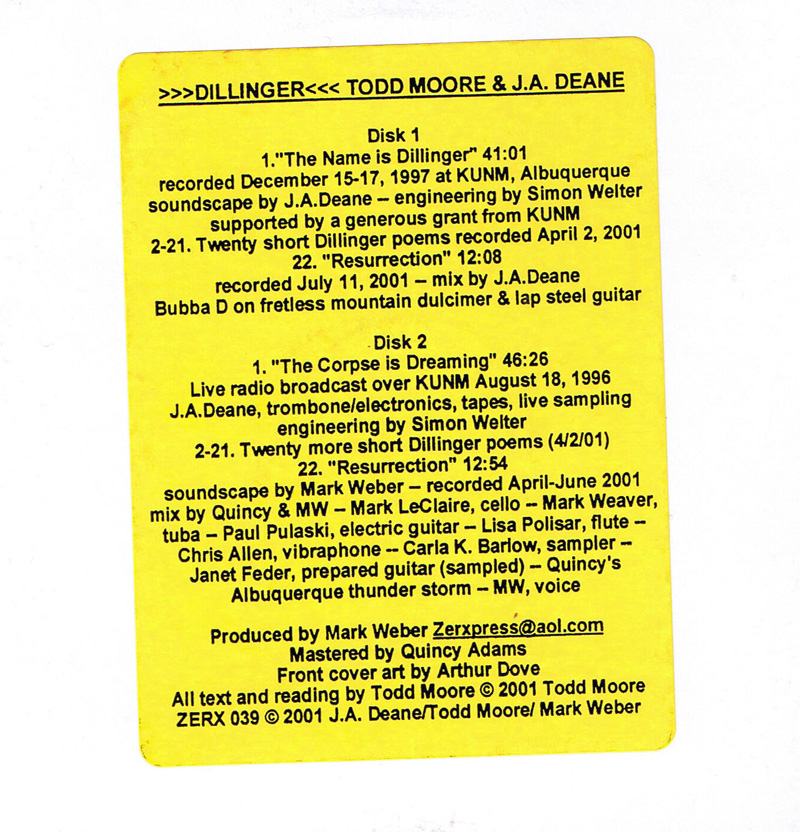
But, it’s the phenomenon of the convergence that interests me more than anything else. It’s this high voltage cluster of multiple Dillingers all appearing at the same time that is both exhilarating and mythical and mysterious. Personally, I have been working on the long poem DILLINGER for more than thirty years. And, when I say I have been working on DILLINGER, what I really mean is that I have been exploring the life, the blood, the legend, the soul of this man as well as his complex mythology which means that I have also been exploring the dark outlaw soul of america as well.

I can’t speak for Elliott Gorn or for Michael Mann, but I would be willing to hazard a guess that both men have been more than just intrigued by Dillinger. They very likely have been haunted by him as well. You can’t go into the Dillinger country without experiencing some kind of mojo, some kind of charisma, some kind of revved magic that takes you all over the psychic map.

So, the dead last thing that I would call myself is a Dillinger buff. I’ll reserve that tag for the gangster and civil war and outlaw reenactors. As for me, I’m not reenacting anything. I am playing it out. I am inventing John Dillinger just as much as Elliott Gorn is inventing him by attempting to salvage what facts of his life that actually apply and by accurately presenting Dillinger’s cultural milieu. And, I am trying to discover Dillinger’s darkness just as Michael Mann is trying to give us all the best live action portrait of Dillinger possible.

In a larger sense, The Riddle of the Wooden Gun, DILLINGER’S WILD RIDE, and PUBLIC ENEMIES are three ways of thinking about Dillinger and his world. You might condense them to just three questions. What is mythology? What is history? And, what is reality or in Michael Mann’s case, what is hyper reality when it comes to an outlaw? None of us may ever actually reach the central dream core of who John Dillinger was. But if we make it as far as Twain did with Huck Finn, or as far as McCarthy did with Judge Holden, or as far as Melville did with Captain Ahab, then maybe we’ve all contributed something to the ongoing mystery of John Dillinger and maybe also a little dark knowledge to the ongoing nightmare mythography of america as well. But, whatever we may have accomplished, we’ve discovered the three ways of dreaming the outlaw.

The Riddle of the Wooden Gun by Todd Moore | Lummox Press, 2009Dillinger’s Wild Ride by Elliott J. Gorn | Oxford University Press, 2009 – Public Enemies, starring Johnny Depp | Michael Mann, Director | Release July 2009

1 Comment

Filed under essays by todd moore

leaving a little blood on the floor

Do you think it’s possible for a poem to bleed? Do you think it’s possible for a poem to breathe? Do you think it’s possible for a poem to have a life of its own? Do you think it’s possible for a poem to have a soul?

Rumor, anecdote, or outright exaggeration, this story persists about Lorca’s execution. Just before he was forced to kneel in front of the killing wall in Granada, Lorca passed a poem he had just written to one of the soldiers on the firing squad and the man read it and discovered he could not participate in Lorca’s murder. And, right after Lorca was shot, the soldier was also shot for insubordination and later thrown into a ditch with the paper containing Lorca’s poem shoved into his mouth. And, the blood was all over everything.

dillinger.jpgI’m working on The Name Is Dillinger. I’m sitting at the dining room table in the old house in Belvidere. For some reason, I’m home alone. The old Royal typewriter is sitting in front of me. It’s black all over except for the name plate where some of the black has been rubbed off showing the brass. And, the poem is really beginning to jump at me. I’ve already written some pages in longhand and now I am typing and Dillinger is talking. And, he’s talking to me at the top of his lungs and it’s hard for me to keep up because it feels like I’m taking dictation. I’m typing on the old Royal as fast as I can and I know I am misspelling words but that doesn’t matter I’ll correct them later because I don’t dare stop and Death is sitting across from me. If I look directly at him I won’t be able to see him. I can only catch quick glimpses of him if I look out of the corner of my eye.

What is so ironic is that Death thinks that by distracting me he’ll mess up all my rhythm and that I’ll fuck the poem up for sure. What he doesn’t realize is that he’s one of the major inspirations for the poem in the first place. I need him there. I need him to be sitting at that dining room table because when I write a poem like The Name Is Dillinger I am actually eating language in great big bites and when I eat language I also need to eat pieces of Death as well. I need to keep tasting the words and tasting Death’s quick stink and rot. I need to devour a whole universe of Death along with the skin and the blood of the poem.

Whenever I get interviewed nobody asks me how I can manage to keep my day life separate from the night of the poem. Or, maybe that kind of question just doesn’t occur to anyone who doesn’t write the long poem, the epic, the saga, the novel dreaming itself into the frenzy of the poem. What happens, at least to me, is that I am somehow able to speak both languages at the same time. Just as I am sure Whitman did. Just as I am sure Neruda did. Just as I am sure Homer did. But, the strange thing about living this way is that every once in awhile I find the daylight language getting all mixed up with the night alphabet of the poem. The way the poem bleeds itself into me and me back into it.

I’m standing on a street corner and I overhear someone say, a man was shot right there on that spot two days ago and I look for blood signs on the pavement and while I am searching the cement for night colored stains Death is loitering in front of a liquor store window. He knows that I have already seen him and he thinks that just the sight of his rag and bone frame will short circuit my imagination but what really happens is that when I think of him the sight triggers a line I’d been wanting to use in DILLINGER and pretty soon I am getting the first twenty lines to Dillinger’s Thompson. I get a licorice taste in my mouth that goes all through me and makes me think of the way blood comes out of a wound and Dillinger is trying to tell me something he is both a photograph and not a photograph and the man talking about the victim who got gunned down on the corner is also talking this is the real nighttalk of dying, the chatter and the buzz and the static of the world becoming part of the poem.

I’m reading The Riddle of the Wooden Gun to a dark living room. Shadows have been thrown up on the wall from somewhere beneath me and I am reading to them as though they are the audience. I start out slow and pretty soon I can feel the poem begin to gather momentum. Then I am at the part where the rebel guerilla fighter has killed the kid and when he goes over to the body he discovers that the kid is armed with a wooden gun. And, when I glance up the shadows on the wall have moved slightly and a sigh comes from somewhere and Dillinger’s face has begun to levitate above the easy chair and little planets of blood are circling it and the poem has suddenly become a movie playing itself out in the air and Death has come close and is asking if I will give him just one image, maybe the one where Dillinger is able to rub the wooden gun three times and turn it into a real one and I tell Death to go fuck himself and Death only knows the meaning of the words but doesn’t know how to actually do it and I want to find a way to have Dillinger say that to Death in the poem but I don’t want to force it in and then I realize that Dilllinger’s escape from Crown Point Jail was the ultimate fuck you and the wooden gun was Dillinger’s best finger to Death ever.

I’m reading The Corpse Is Dreaming. It’s a rehearsal for the one I am scheduled to give live on KUNM from The Outpost. I have all the radios and tv sets turned on in the house because I want all of Death’s static in my ears. I need to taste and I want to hear all of Death’s static and the air is turning black with the noise but that’s okay, that’s just the way that I dreamt it. The air is supposed to turn black. And, then little by little, Dillinger’s feet appear on the floor. Then his fully trousered legs take shape. Then his torso all covered with blood, then his arms, one is underneath him, one out to the side. Then his head which is a bloody stew of wounds.

And, I am really into the poem now, I can never read Corpse without giving in to the rush and groan and whisper and scream of the poem. Because of all the poems in DILLINGER this is the one that refuses to just be read. It must be danced so that it can be undanced. It must be acted so that it can be unacted. It must be shouted so that it can be unshouted. Of all the poems I’ve written The Corpse Is Dreaming relies on static, stutter, slaughter, and silence and every time I do Corpse I have to reinvent all of it. I have to place myself squarely in Death’s zone. This is the only way I can reach into the heart and core of the man. Because Dillinger has become a complex metaphor for american darkness and oblivion. More than that. Dillinger has somehow become a national archetype which permits us all to fall in love with a uniquely american version of murder and mayhem.

All that he asks is that we leave a little blood on the floor. He never expected me to dance in it.

1 Comment

Filed under essays by todd moore

stealing dillinger, becoming an outlaw

I wasn’t surprised

when Raindog told me someone had stolen a copy of The Riddle of the Wooden Gun off the book sale table at the Berkeley reading. It wasn’t the first time someone had lifted a section of DILLINGER. I don’t know how many people have complained that their copies of The Name Is Dillinger, Dillinger’s Faces, Billie F, and Dillinger’s Thompson had come up missing. Books about outlaws just tend to go south if you don’t keep your eyes on them. Books about outlaws have something illicit, taboo, and tempting about them. Books about outlaws just ache to be stolen.

Someone once explained it to me this way over a beer. The guy held up The Corpse Is Dreaming, flipped through the pages, then set it down and said, owning a book like this is like having Dillinger right where you can touch him. Right where you can talk to him and have him talk back to you. You got his skin, you got his blood, you got his dreams. So, why not make it juicier and somehow steal the book because by stealing the book you steal the essence of the outlaw. And, in some marginal way, you also become an outlaw.

Still, there is more to stealing Dillinger than just stealing the book. There is the man, the blood, the history, the look, the mythos. The sheer act of writing about Dillinger is the complex act of theft. Anyone who has written creatively about Dillinger has either attempted to steal a piece of the corpse or has tried to reinvent the entire body of the man.

you were a handsome guy,
not like the rest of those
ugly bastards who went around
on killin sprees,

from Dillinger, Ed Galing, Big Hammer No. 13

A piece of the corpse, the body of the man, maybe his soul, but if you are ambitious enough and tough enough and you think maybe you have that special touch of genius, then you go for all of it. You try for the style, the history, the arrogant sprawl of outlaw, the myth because once you have the myth you also have the darkly shattered dream of america.

The key to Dillinger is that he always changes, he never stays the same. It doesn’t matter how many biographers have carefully delineated his life or at least what we know of it, no one really knows who he was. The one thing we can be sure of is that he was a force, he was like a wind that came up out of dustbowl Kansas and blew the shit out of everything. He was like a tornado that swept into northern Illinois and just simply levellled main street. That much we do know, that much we can be sure of.

The fact that he was a trickster, that he was always shape shifting into something else is maybe the most important clue to both Dillinger the man and Dillinger the metaphor. Because he was a metaphor. He was as much a gesture as the hand sign for gun or as the wooden gun itself. He was a meaning all unto himself. He was what Humphrey Bogart longed to be as Roy Earle and Duke Mantee. He was what Johnny Depp hopes he has become.

The thing is you can steal all of Dillinger. You can make off with his gunhand, you can swipe his hat the straw boater or the snap brim stetson, you can jack his machine gun, you can shoplift his comb his 380 auto, you can hang one of the original wanted posters of him up on your wall right next to the felt portrait of Elvis or the James Dean poster where Dean is leaning back against a car in his most memorable fuckyou pose, but do you have him? Do you have Dillinger? Do you really have the Dillinger that you dream of? That you long for? That you would like to steal and put him into a book of your own?

Dillinger is the anarchic essence of the american outlaw. You can see that from nearly all of his photographs. Take a look at the Dillinger pose on the paperback cover of Dary Matera’s book DILLINGER. The photograph is really the classiest mug shot that I know of. Dillinger is seated. He’s wearing a dark vest, a loosened tie that lies all twisted against a white shirt. He’s giving the photographer one of his get fucked stares. But the most interesting aspect of this snapshot is the way he holds his hands and arms. He is using his right hand to loosely hold his left arm at the elbow. My question is did he borrow this pose from the old western film actor Harry Carey or was it just simply a spontaneous way of appearing? Next time you watch THE SEARCHERS focus on the way John Wayne poses at the end of the film, the way that Huston has framed him in that doorway. Wayne stands with his right hand crossed over and is using it to hold his left arm. And, where did that stance come from? Harry Carey, obviously. But, isn’t it interesting to speculate that it might have come from both Carey and Dillinger?

Dillinger is the essence of cool while in he’s custody in Crown Point, Indiana. In this snapshot he’s leaning on prosecuting attorney Robert Estill’s shoulder as he makes the sign of the gun across the man’s lapel. Of course it’s a setup and Estill is the patsy. Dillinger is the essence of hot when he poses holding a Thompson sub machine gun and the wooden gun in his father’s yard. And, sometimes even when Dillinger is not holding a gun, he becomes the metaphor for all guns, always. Bogart shooting it out with Cagney, Warren Oates opening up with a Thompson, Johnny Depp vaulting over a bank counter with his sleek machine gun. These are all variations of the biggest dream that america could ever know. And the dream is the movie of outlaw and you can taste it. You can taste all of it.

And, this is really what we all want to steal. Forget about shoving that book under your coat and concentrate on stealing the mythos of Dillinger because that is what we are all after, if we are searching for the dream of all dreams in america. It doesn’t matter if you are a biographer, a novelist, a film director, or a poet. What you want above everything else is that one book, that one film that somehow catches the key to it all, the dark and prevailing myth of the outlaw in america and even that mysterious that apocalyptic america itself.

You want to do what Herman Melville did, you want to do what William Faulkner did, you want to do what John Ford did, you want to do what Raoul Walsh did, you want to do what Sam Peckinpah did, you want to do what Charles Bukowski did, you want to do what Cormac McCarthy did. You want to do what Dillinger did. You want the man Dillinger, you want the myth Dillinger, you want the poem DILLINGER. Because if you are alive in the man, the myth, and the poem,

you are an outlaw.


1 Comment

Filed under essays by todd moore

fighting death for the poem

Every time I write something

Death sits in the corner and watches. He is the consummate voyeur. Maybe he thinks he’s putting one over on me, but I know he’s there. He sits next to a cascade of empty boxes near my book filled closet. He would chew his nails if he could but in the absence of nails he chews the bone tips of his fingers. I can hear them click. He wants me to listen. This is Death’s music, his aria of stutter.

He knows when I am writing a poem, he can smell it. What happens is that the human body gives off an odor of provocative skin and quick electricity when it’s involved in the creative process. It can’t be helped. When Edward Hopper was painting NIGHTHAWKS Death tried to convince Hopper to put him in the picture. But Hopper resisted, though it made no difference. Death is one of the hats in the painting.

When Edvard Munch was painting THE SCREAM Death wanted Munch to make him the screamer and you can see how well Death succeeded. When Van Gogh painted that series of self portraits on cardboard Death kept trying to crawl beneath Van Gogh’s tortured face and the V man had to keep slapping new layers of paint across bones. He thought it would help, the effort was futile. When Picasso was painting GUERNICA Death got into the painting by becoming the thing that is flying out of the horse’s mouth. This is Death’s job. It’s the kind of work that he can get into.

That last paragraph of THE TRIAL where the two killers are getting ready to murder Joseph K, this is where Death has jumped into the novel. Death had been after Kafka for weeks to put him into the book. The way he does it is through dreams. He comes at you in nightmares and he doesn’t stop until you give in. Or, at least until some arrangement has been made. In Kafka’s case, he allowed death to bifurcate, to become the two killers wearing the same vacant faces. And, in some translations Death takes turns with himself when it comes to plunging the knife into Joseph K’s heart. And, sometimes Death is also the knife and the air around the wound.

Death’s argument for getting himself into books is that the story is nothing without his being in it. It’s like seasoning the meat. But Death didn’t really want to be a major character. He knows that he can’t carry a story all by himself. Instead, he’d rather be someone minor and nameless and more often than not with nothing to say. Death is the black paint in Goya’s nightmare paintings. Death is the hiss the words get when Sylvia Plath reads Daddy. The sound scorches him all the way through and he has to slough off all the burnt parts.

Death will do anything to get into a poem. He bribed Kell Robertson and Charles Bukowski with dream six packs of beer to be part of their poems. He kissed Frank Stanford on the mouth and then frenched him as a bonus for writing Death And The Arkansas River and the taste of Death’s kiss was all chocolate and ashes. He’d give you a blowjob if you wanted it but it would have to be in some sex fantasy nightmare Death wants you to eat. He gave William S. Burroughs a special dream revolver for having written NAKED LUNCH and then letting Death do some of Doctor Benway’s lines. He gave Lorca complete access to the Duende knowing full well that Lorca had to somehow make him a major player, a demon child, a cyanide wind. It was either that or kiss the theory goodbye. And, as for Death, he wasn’t all that sure that he liked the deal afterward because he was so visible in the essay. But he had no choice in the matter. Still, that was okay because Death knew he’d also be one of the bullets that would ultimately finish Lorca off later. It almost made Death laugh to think bang bang, you’re dead.

In THE STRANGER, that scene where Meursault shoots the Arab, Death is the sun. At the end of FOR WHOM THE BELL TOLLS, Death is the machine gun. In THE GREAT GATSBY when Gatsby is shot and falls into the swimming pool, Death is the black hole in the water. When Judge Holden kills the kid with his bare hands in the outhouse at the end of BLOOD MERIDIAN, Death hides in the shit.

You may think you know where Death is in any given story, poem, or novel, but you don’t. Death is the ultimate trickster, the absolute best shape shifter ever. In MOBY DICK he starts off as one of Queequeg’s tattoos. Then he changes to one of Daggoo’s shadows. Then he turns into St. Elmo’s fire. Then he becomes the rope lashing Ahab to the whale. And, this may happen just that way the first time you read through the book. But if you try reading it again, Death may become a whole new cluster of signs and shapes. Death never inhabits the same metaphor twice.

In a dream Death promised Ed Dorn he’d stay out of GUNSLINGER, then became the Gunslinger’s pair of leather encased hands. Death knows that you can’t create a gunslinger unless he has hands. Death knows he has Dorn where he wants him. Death’s laugh goes up in the smoke.

In The 13th Horse Song of Frank Mitchell Death is the shadow of the prayerstick as it strikes the ground. In Song Of Myself, Death waits under Walt Whitman’s right shoe. In a recent Dennis Gulling poem Death is a piece of lint resting on a sawed off shotgun barrel. In John Yamrus’ poem At The Funeral, Death is the ring missing from the corpse’s hand. In Tony Moffeit’s BLUES FOR BILLY THE KID Death has painted himself all over with red chile.

Death may remain the same thing in a poem or a novel or a story or he may change from object to object. Death likes to skip around. You think you have him and you don’t. Death is a literature of motion, blur, confusion, and flow. Death yearns for the sense of flux in Thomas McGrath’s LETTER TO AN IMAGINARY FRIEND, is almost sick with a longing for dust in THE WASTE LAND. Death is not so much the bridge in Hart Crane’s THE BRIDGE as he is both the bridge’s shadow and the wolf that eats the shadow.

If you asked me where Death was in DILLINGER, I’d have to say everywhere. And, also nowhere that I can be sure of. If I told you, Death was Dillinger’s Thompson, Death would suddenly turn into the dark band on Dillinger’s stetson. If I told you Death was the way Dillinger made the sign of the gun, then Death would have to become Dillinger’s fuck finger. If I said Death was Dillinger’s wooden gun, then Death would have to jump out and become a dust fleck circling the air around the wooden barrel.

Death is a riddle that cannot be stated, a quantum particle that cannot be tracked. Death’s metaphor is a collection of all metaphors and this includes the absence of all metaphors as well. Death is the black hole of poetry. All poetry comes out of that hole and all poetry returns to it. The supreme irony is we fight Death for the poem that we know he will become part of, this is the price of the poem.


1 Comment

Filed under essays by todd moore